From November 1, Employers Who Withhold Social Insurance Face Fines Up to Three Times the Arrears
A State Taxation Administration rule taking effect November 1 puts unpaid social-insurance contributions into the national tax-penalty framework, with fines of one to three times the arrears — and the most-liked comment on the news read it as a sign of how tight the money has become.
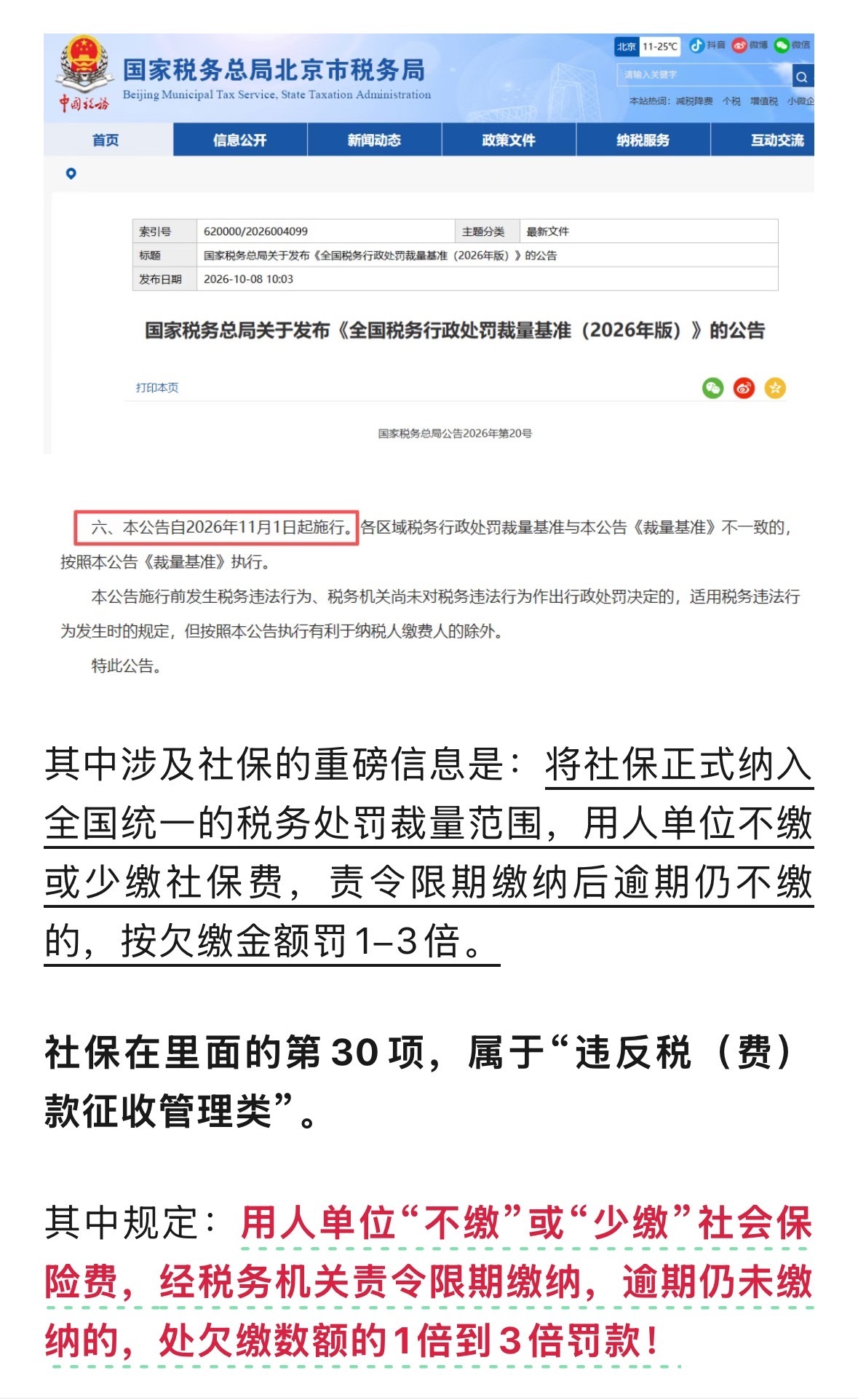
From November 1, an employer in China that fails to pay or underpays its workers' social-insurance contributions can be fined up to three times what it owes. The change comes in State Taxation Administration Announcement No. 20 of 2026, issued September 28, which folds social insurance into the country's unified standards for tax penalties — nine categories, 66 items, one national schedule where consequences were once set and applied unevenly from province to province.
The mechanism is graduated. Tax authorities first order the employer to pay within a time limit; the fine of one to three times the arrears applies only if that deadline passes unpaid. The standards also list eight circumstances that can reduce or waive penalties for minor first offenses corrected in time — a carve-out aimed at small employers who fall behind rather than skip. Tax authorities have been taking over collection of social-insurance contributions in stages since 2019, precisely because they can see payroll through the tax system; the new standards close the loop on enforcement.
What pushed the rule up the trending list is what social insurance means in Chinese working life. Contributions are the mechanism behind pensions, medical coverage, maternity and unemployment pay — an earlier piece on this site walked through the arithmetic of what a pension actually takes — and when an employer skips them, the bill lands invisibly on the worker's future. Employers dodging or trimming contributions has been a durable grievance, and the post that carried the news laid out the new exposure in one line: after a deadline, one to three times the money owed.
The most-liked response to the news, though, was four characters long. "真没钱了" — "really out of money" — wrote one commentator, in a post liked more than 24,000 times, reading the rule less as worker protection than as a symptom: employers strained, local budgets tighter, and the state getting serious about revenue it has been owed. Whether the three-times fine is mainly a shield for workers or a squeeze on employers is the argument running beneath the hashtag, and the rule itself does not resolve it. What it does change is the cost: from November 1, the money a company avoids paying into its workers' pensions stops being a negotiable debt and becomes a tax bill with a multiplier.