Trump Orders the US Government to Call AI 'Super Intelligence'
An executive order signed September 29 retires 'artificial intelligence' from federal documents in favor of 'super intelligence' — a rebrand that Chinese observers read as a vocabulary change doing the work of policy, and an invitation for America's tech chiefs to flatter themselves.
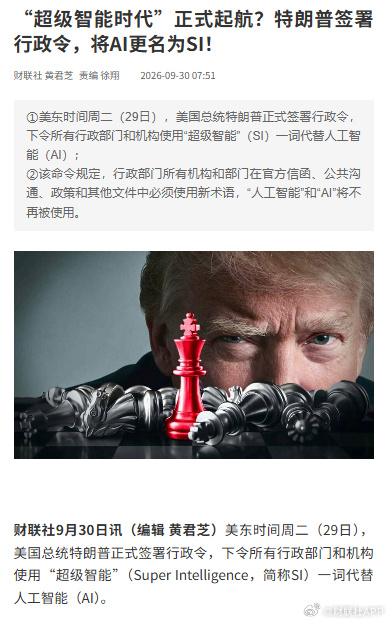
By executive order signed on Tuesday, agencies of the United States government are instructed to stop writing "artificial intelligence" and start writing "super intelligence," abbreviated SI, in official letters, public communications, policy documents and the rest. The order is titled "Inaugurating the Era of Super Intelligence," and the White House's fact sheet says the new term recognizes a technology whose capabilities have outgrown the old name. Historical documents need not be retouched.
Chinese financial media reported the order within hours, and the amusement started almost immediately; the order trended on Baidu's news board and drew explainer items from The Paper within a day. Cailian Press's own headline carries a question mark — "'Super Intelligence Era' officially sets sail?" — a small piece of skepticism that Chinese outlets use precisely when they decline to repeat an official framing as fact. One well-known Weibo commentator on legal affairs responded with the single character "抽象" — internet slang for "absurd" — followed by three 'bored' emoji.
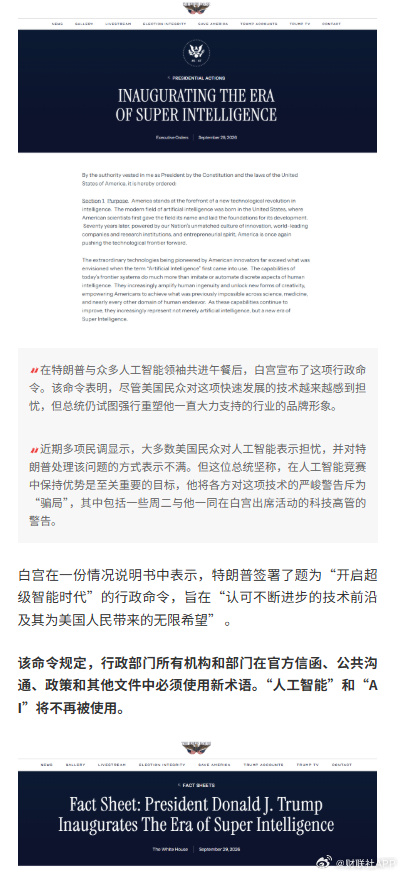
The rename arrived alongside something with more consequence: a White House gathering the same day at which Elon Musk, Mark Zuckerberg, Jeff Bezos, Sundar Pichai, Jensen Huang, Dario Amodei and OpenAI president Greg Brockman, among others, signed a voluntary "Joint Commitment to Frontier Responsibility," promising risk assessments, audits and third-party evaluations of their systems. The Paper noted what the arrangement leaves out: Trump has opposed new federal safety regulation, and when reporters asked what force the document carried, he answered that it had "moral binding force." The executives' pledge is exactly that — moral, not legal.
The stage business became its own news cycle. Asked a question at the event, Musk began his answer with "artificial intelligence," caught himself mid-word, and corrected to "super intelligence," drawing a grateful "thank you" from the president. A clip of the exchange posted by the outlet Observer Network made its own round on Chinese platforms.
For a Chinese audience, the interest is less in the renaming than in what it reveals about how Washington now talks to the industry it declined to regulate. Chinese internet users have a long habit of reading official vocabulary as a map of power — which phrases rise, which are retired — and they registered this one as a flattering gift to the companies being courted. The order's own text concedes its limits: it binds only non-statutory documents, and the same-day pledge binds nothing at all. Whether "super intelligence" comes to describe new capability, or merely relabels a policy of self-policing, will be settled well outside the White House briefing room.