Why Chinese Posters Recoil From the Idea of Universal Cash Handouts
As Beijing searches for ways to lift weak consumption, a blunt proposal keeps resurfacing: just give everyone money. This week's trending counter-question — why so many Chinese dislike universal handouts — opens a window on how people think the economy actually works.
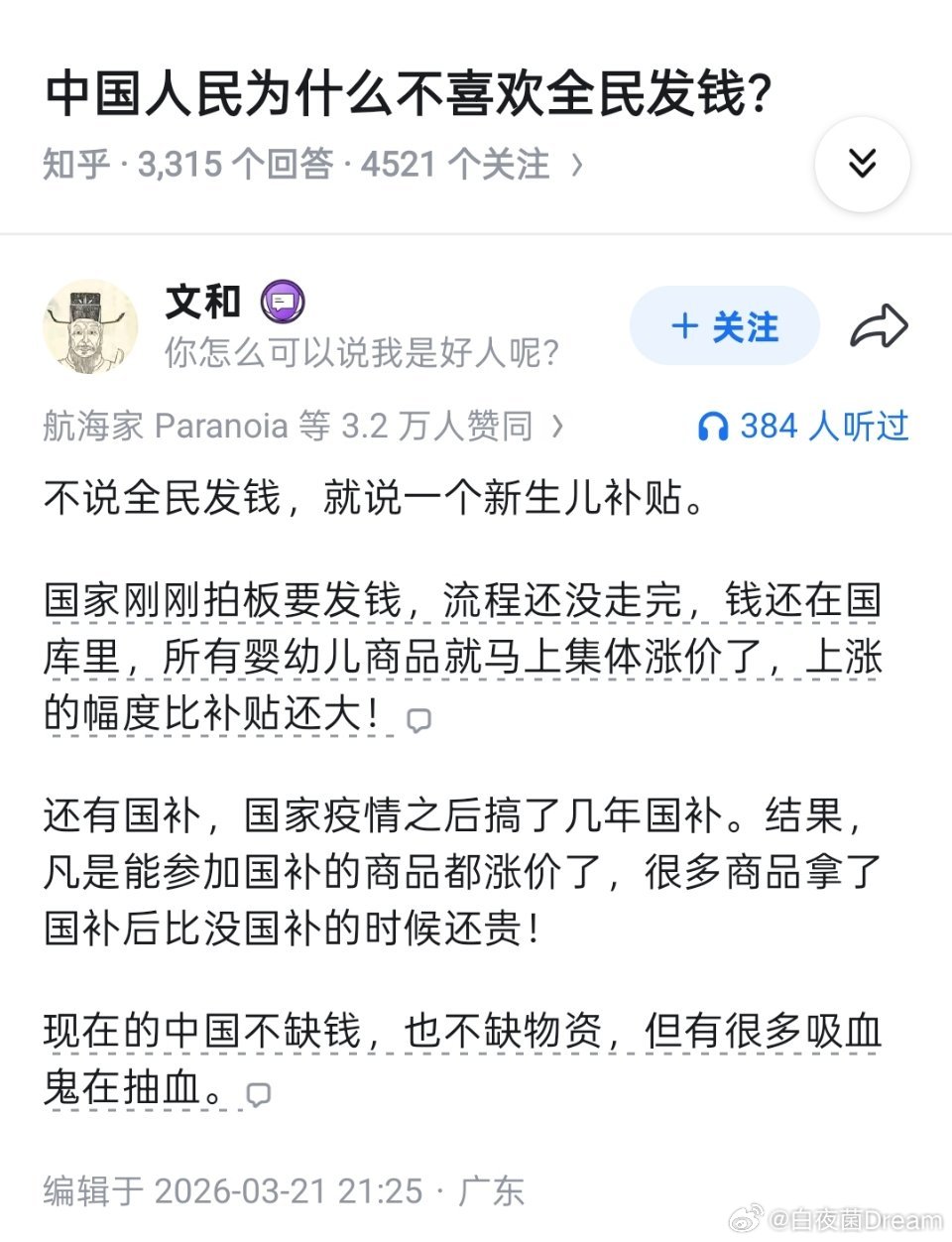
Whenever China's policymakers go looking for ways to revive spending, a blunt proposal resurfaces from the comment sections: skip the programs, skip the vouchers — just give everyone money. And every time it does, a counter-question trended hard this week on Weibo — why don't people like universal cash handouts? — draws an answer that says as much about how Chinese posters think the economy works as any white paper.
The richest vein is a Zhihu thread the hotword pointed to, a question that has drawn more than 3,000 answers. Its top reply argues that a handout never arrives intact. Announce a subsidy for newborns, and the prices of everything a baby needs rise faster than the cash; roll out consumption vouchers, as the government did during the pandemic, and merchants quietly reprice around them. The money is captured by whoever sits at the chokepoint between the state and the household — figures the reply describes, in the thread's most-quoted phrase, as vampires in the economy.
A popular Weibo video on the topic ran the same argument through concrete examples. If Tencent hands out raises, the argument went, landlords in the company's neighborhood simply raise the rents; when the firm built a new 30-billion-yuan campus and tens of thousands of employees moved out of one Shenzhen district, the district's rents had to recalibrate all over again. Pre-holiday sales mark prices up so the discount can restore the original number; the national trade-in subsidies for appliances have been priced into sticker prices, posters claim. In each case the injection is arbitraged by the party that owns the asset — housing above all, the rent that stands like a tax on every pay rise.
That diagnosis explains the policy tradition it is arguing with. China's stimulus has consistently been targeted and supply-side: infrastructure, industrial policy, consumption vouchers, trade-in subsidies aimed at producers and retailers — rather than the direct checks familiar from American or Hong Kong crisis responses. The stated reasons are usually inflation and welfare dependency. The Weibo debate proposes a different one: in an economy where the first stop for any new money is an asset owner, handouts without fixing the capture routes just pass through a household's account on their way upstream.
The argument peaked at an apt moment, on the eve of the longest break in China's calendar, as Mid-Autumn folded into National Day and much of the country got more than a week off. Forecasts put cross-region trips at 2.13 billion over the holiday, and tickets at top scenic sites sold out days ahead — yet analysts quoted by Deutsche Welle warn that record travelers may not produce record spending, with households hunting value as consumer demand stays soft. The same anxiety runs through both screens: people are clearly willing to move; the question is whether they will spend.
What the hotword's popularity signals, in the end, is less a demand for money than a demand that it arrive intact. Until posters believe a yuan from the state can reach a household without being taxed by the landlord on the way, the most direct tool in the kit stays the least popular one.