Israel Says a Flydubai Co-Pilot Stabbed the Captain and Tried to Crash the Plane
A Flydubai flight from Dubai to Tel Aviv made an emergency landing in Saudi Arabia on Wednesday after the co-pilot stabbed the captain and, by Israel's account, tried to crash the plane. Passengers and crew subdued him and everyone aboard survived. On Chinese social media, where the story filled two of the top ten trending slots, the question being argued is what it means that the route exists at all — and who guards the pilots from each other.
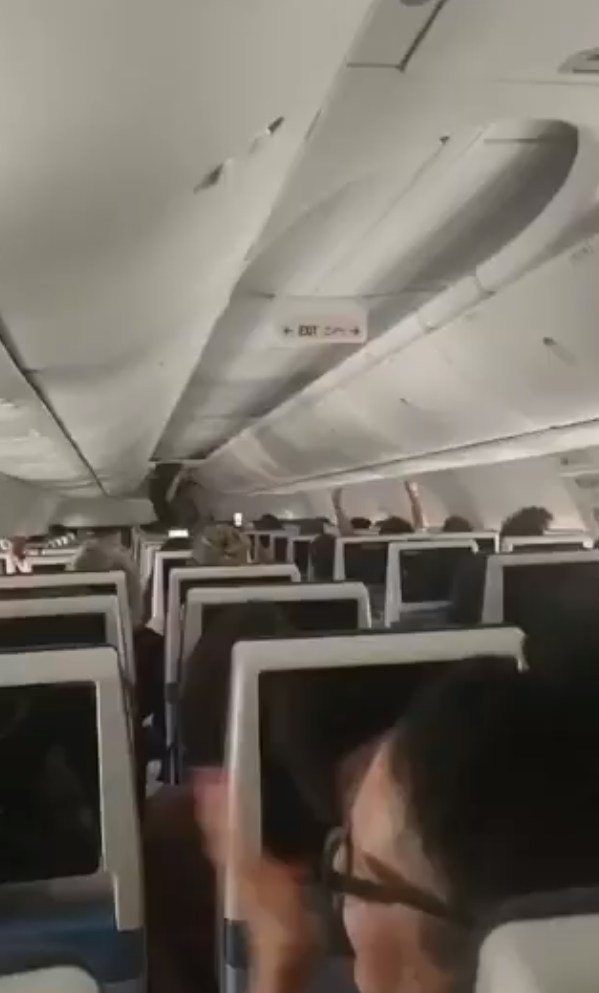
Flydubai flight FZ1073 lifted off from Dubai at 7:05 on Wednesday morning for the short hop to Tel Aviv — a route that barely existed before the United Arab Emirates and Israel normalized ties in 2020. Ninety minutes later, over Jordan, the Boeing 737 broadcast the transponder code 7700, a general emergency, and then 7500: unlawful interference, the code crews hope never to send, the aviation shorthand for a hijacking. Flight-tracking data showed the aircraft plunging about 5,300 meters in about two minutes, recovering briefly, then dropping again before it turned for Saudi Arabia and landed at Tabuk at 9:45 a.m. Everyone aboard — 174 passengers, 27 of them children — survived.
What the plane's own pilots had done to it took longer to establish. In a video statement on Wednesday, Israeli Prime Minister Benjamin Netanyahu said the co-pilot had stabbed the captain and tried to crash the aircraft before passengers and crew subdued him; the suspect, he said, was in Saudi custody and the episode was "extremely serious." Israel's defense minister, Israel Katz, went further, calling it an "attempted terrorist attack." Caixin reported that the suspect is an Omani national and the wounded captain Emirati. But the terrorism framing is, for now, Israel's alone. Saudi Arabia, which has no diplomatic relations with Israel, has given no account of its own — and, as HK01 reported citing Reuters, it refused Israel's request to send a C-130 transport to fly its citizens home.
Inside the cabin, the sequence was audible before it was explicable. One passenger told Israel's Channel 12 she first heard screaming, then saw the cockpit door open onto "a lot of blood" — someone had slashed a pilot with a folding knife. "For a moment, we all thought we were going to die," she said. Cabin footage The Paper posted shows passengers screaming and panicking; HK01 reported that the captain ended up bloodied on the floor outside the cockpit, that two reserve pilots who happened to be aboard took over the controls, and that passengers broke into applause when the jet finally stopped.

The story filled two of the top ten slots on Weibo's trending list within hours — one for the incident, one for the dive. Part of the fascination is geopolitical: a Dubai–Tel Aviv flight is itself an artifact of the 2020 accords, and this one came down in a country that does not recognize Israel, carrying a passenger list that was mostly Israeli. Hu Xijin, the former Global Times editor, laid out the fork Chinese readers were weighing. If the jet simply fell during a struggle, it is a horror; if the co-pilot deliberately pushed the nose down, it is either a personal rupture or a political one — the possibility, as Israeli officials suggest and Hu put it, of a terrorist "lone wolf" who boarded with a purpose.
Chinese aviation commentators reached for precedent. One widely read post recalled SilkAir flight MI185 in 1997, when the captain — insolvent, by the American investigation's finding — switched off the recorders and put the jet into a dive, killing all 104 aboard, and Germanwings 9525 in 2015, when a co-pilot who had concealed his depression locked the cockpit door and flew 150 people into a mountainside. The two-officer cockpit, the argument ran, was designed to keep intruders out, not to guard each officer against the other. "No matter how advanced the plane or how redundant its systems, the last line of defense is still the human being," as one commentator put it.
The open questions now have names attached: how the cockpit door came open mid-flight, what psychological screening the co-pilot passed and when, and whether a route this charged needs a crew-pairing review. Israel's transport minister has already asked that flydubai flights to the country be suspended. Photographs of the jet on the Tabuk apron show a torn rudder — physical evidence of how violent those two minutes were — and an investigation that will have to explain not just a stabbing, but why the plane fell the way it did.