Owed 1,700 Yuan, Published With Her Photo: How China's Court 'Spending Restrictions' Work
A county court in Xinjiang published a debtor's photograph over an unpaid debt of 1,700 yuan — about $240 — setting off a national argument about whether the enforcement tool is proportionate when the sum is trivial.
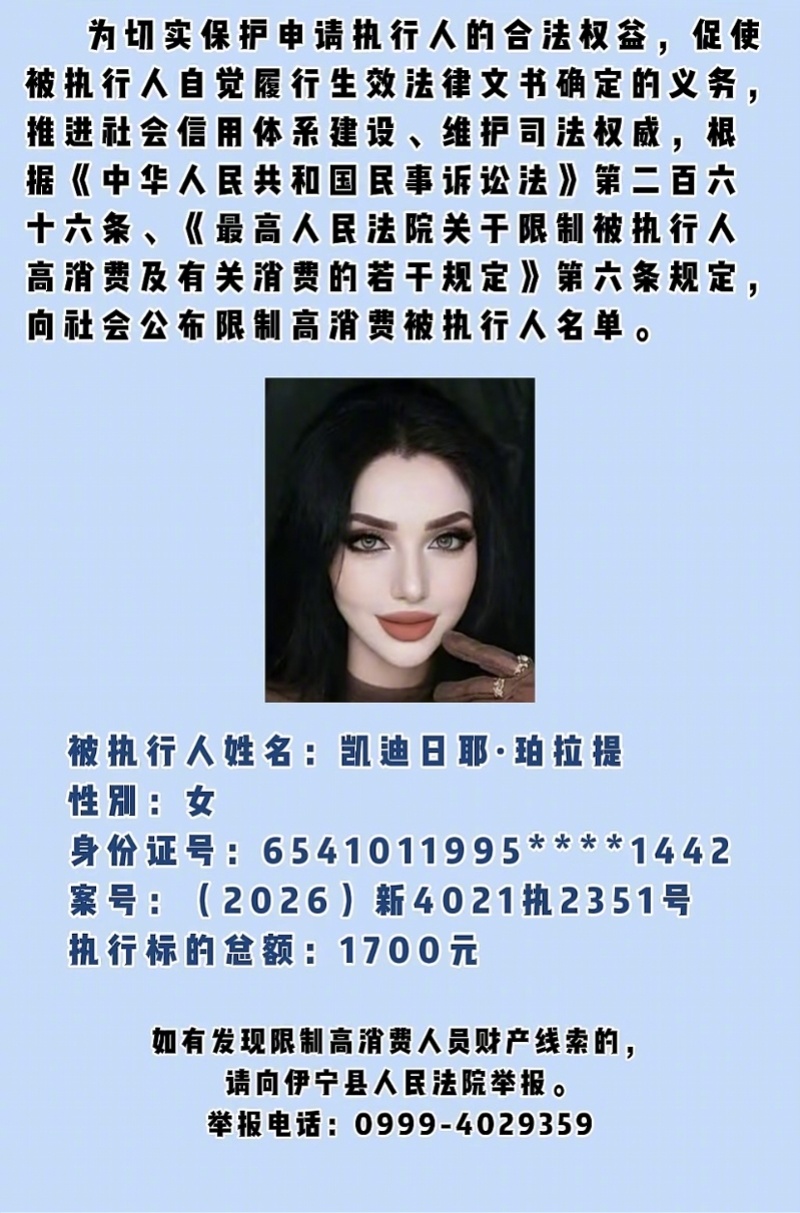
The notice looks routine: a pale-blue graphic listing people placed under "consumption restrictions" by the Yining County People's Court in Xinjiang's Ili region, with a request that anyone who knows where their assets are call the phone number below. The woman at the center of it is 31, her identity number half redacted, her case number printed in full. The amount the court is trying to collect — the "enforcement target" — is 1,700 yuan. About 240 dollars.
Southern Metropolis Daily's report of the list spread widely on Tuesday, gathering more than 1,500 likes, and the question underneath it was not "who is this woman" but "how can this be legal?" Another name on the court's list owed 3,500 yuan; most owed more than 10,000. Why would a court publish someone's photograph over a debt smaller than a month's rent in a big city?
The answer, lawyers were quick to explain, is that China's spending-restriction regime — 限制高消费 — does not scale with the debt. Deng Gang, a senior partner at Guangdong Fazhishengbang law firm, told the paper that even if the amount is only 1,700 yuan, as long as the person subject to enforcement has not fulfilled the obligations of an effective legal document on time, the court has the legal right to impose the restriction. The trigger is not the size of the debt; it is non-compliance with a judgment the debtor has lost and has not paid.
The restriction itself is friction, not confiscation. Someone on the list cannot buy plane tickets or premium seats on high-speed trains, cannot stay in star-rated hotels, cannot buy property or high-premium insurance products, cannot send children to expensive private schools — a set of everyday exclusions designed to make life inconvenient enough that paying becomes easier than not paying. And courts publish the names, faces and case details on notice boards and social media partly as pressure and partly as a crowdsourcing mechanism: the notices explicitly ask the public to report any assets the debtor is hiding.
That design is exactly what Tuesday's argument was about. The system assumes a debtor who can pay but won't; the viral case suggests a debtor for whom 1,700 yuan may be a genuine hardship, now publicly branded with her face for a sum that would barely cover the court's own costs of chasing it. Commenters split between those who read the notice as overdue pressure on habitual small debtors and those who saw a tool built for tycoons landing on someone it was never meant for. The story reached No. 22 on Baidu's search board by evening.
What the court has not said is how the case arose — what kind of judgment, contested or defaulted, sits behind a 1,700-yuan order. Until it does, the photograph is doing what it was designed to do: strangers across the country now recognize a woman over 240 dollars.