Zunjie Denies Real-World Brake Failures and Offers Owners Free Upgrades
After a tester's video showed three nearly new Zunjie V800s snapping their brake pedals in emergency-stop tests, the Huawei-branded luxury marque has issued its first statement: no customer car has ever broken the part — but the design will be improved and delivered owners offered a free upgrade.
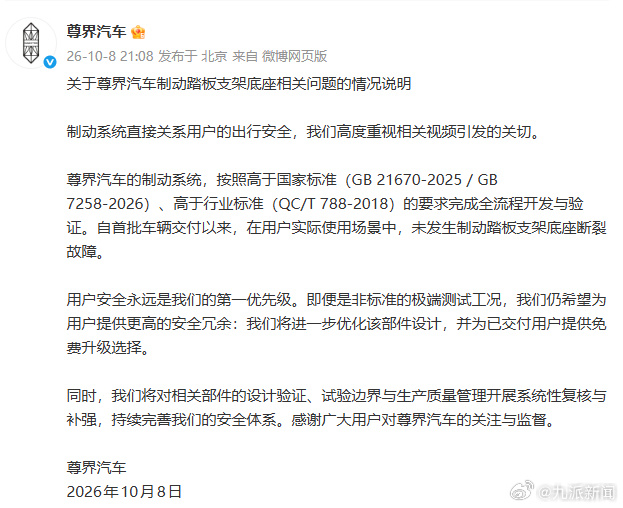
The statement arrived at 9:08 p.m. on Thursday, after a day in which China's most loudly marketed luxury car had been filmed shedding a brake pedal. Zunjie Auto (尊界汽车), the flagship marque that Huawei's HarmonyOS Intelligent Mobility alliance builds with JAC, published a formal account of the brake-pedal-bracket question on Weibo. Its core claim: the braking system was "developed and verified through the whole process to requirements above the national standards (GB 21670-2025, GB 7258-2026) and the industry standard (QC/T 788-2018)," and since first deliveries, "no fracture of the brake pedal bracket base has occurred in real user scenarios." Then came the concession: "even under non-standard extreme test conditions, we still want to provide users a higher margin of safety" — so the component will be redesigned, and every delivered car will be offered a free upgrade. The post drew more than 2,300 comments within hours.
That phrasing is the story of the day. The company did not deny the test, dispute the video, or threaten the tester; it reclassified the event as an extreme bench condition and promised to build beyond it. We covered the test itself, and the stock rout it triggered, earlier today: Dongchedi, the car-reviewing platform, put three nearly new V800s through repeated 100 km/h-to-zero emergency stops on a closed course, and in all three cars the pedal's bracket base snapped. A teardown found the breaks at the same spot, with differences in the reinforcing structure. JAC's shares hit their daily limit on the way down, shedding roughly 6.2 billion yuan of market value; the alliance platform had spent the morning saying it had received no customer feedback on brake pedals and that deliveries were proceeding normally.
The internet took sides long before the statement did. A photographer who covers the domestic car scene wrote that "Dongchedi keeps dealing the cards — quality like this is genuinely shocking to see." Others cautioned against cheering for either camp: one tech blogger warned that if a real safety defect existed it should mean a recall, and if the video were fabricated, "HarmonyOS Intelligent Mobility's response will be heavy."
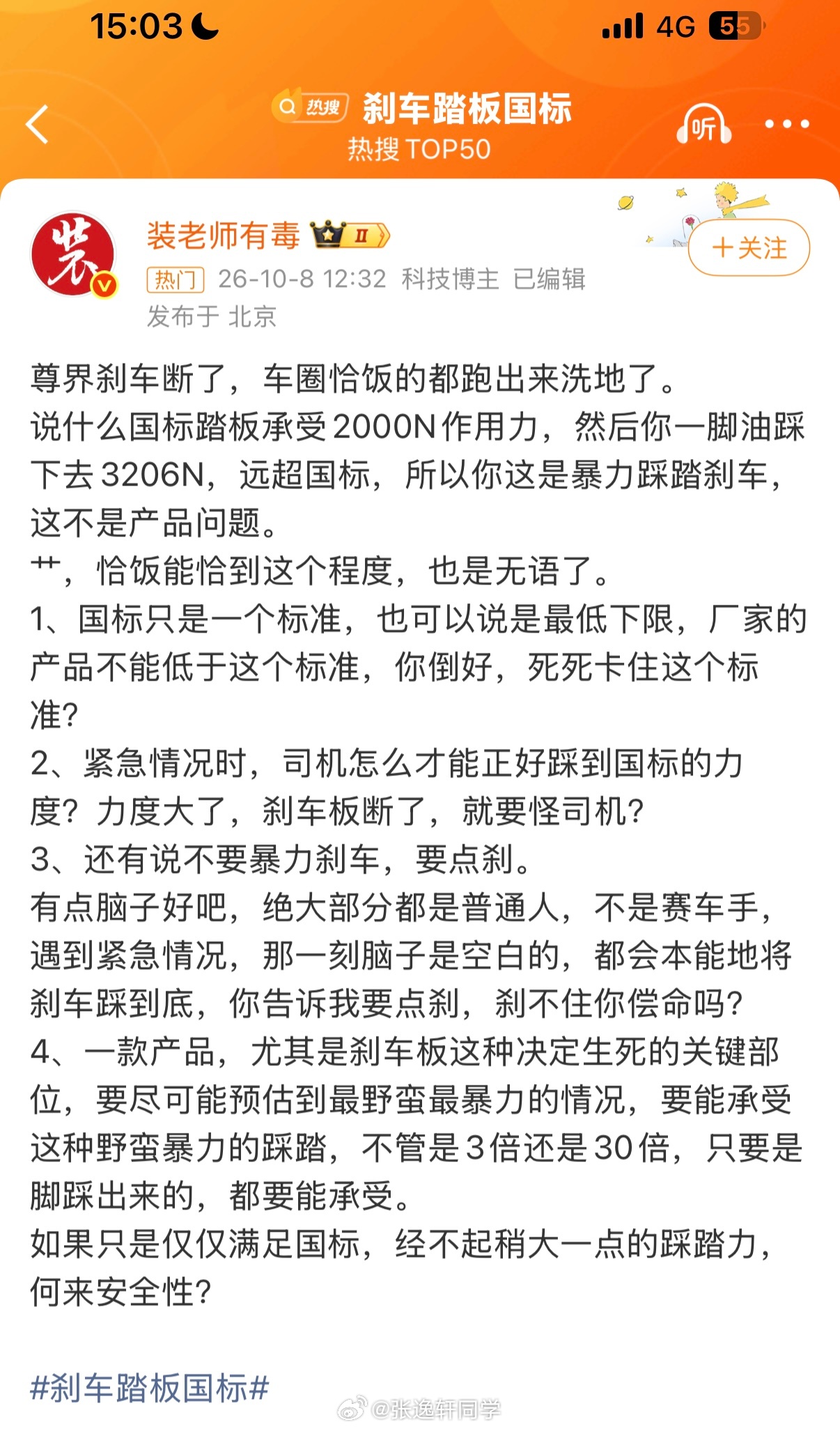
The argument that stuck, though, was technical. A screenshot of a blogger's post that made the rounds all afternoon holds that the national standard's 2,000-newton static load requirement is a floor, not a bullseye: a driver who once pressed a pedal with 3,206 newtons of force was, in the ensuing dispute, blamed for "violent braking" — as if an emergency were an occasion for calibration. "Ordinary people are not race drivers; in a panic they stomp," the post argues. "If a part merely meets the national standard and can't survive a somewhat harder stomp, where does the safety come from?"
The stakes explain the heat. Zunjie is the alliance's halo brand: the V800, launched in August, is a million-yuan-class MPV that Huawei's Yu Chengdong has billed as a class above the Maybach — and only days ago he personally handed the keys of one to the Fok Ying-tung Group's chief executive. A brand sold on impeccable engineering cannot shrug off three snapped pedals, even bench ones.
For owners, the statement converts into something concrete: a free, strengthened part on request. What remains open is whether the upgrade is the end of the matter or the prelude to a regulator's questions — JAC says it is running tests of its own and will issue an explanation once it has results.