Nine in Ten of China's New Short Dramas Are Now Made by AI
Chinese platforms released 13 times as many micro short dramas in the first nine months of this year as in all of last year, with AI-made shows above nine in ten; costs have fallen to as little as 30,000 yuan a title and cycles to days — and the actors and studios who built the genre are watching the floor drop out.
The post that captured the mood came at four in the morning. A Weibo user with a taste for Chinese history had just watched the first episode of Xiangjian Huan (相见欢), a short drama made almost entirely by AI by the Douyin creator 造梦国度, and declared it one of the best things he had seen all year. The protagonist, he noted, is coded as Li Yu — the last emperor of the Southern Tang, instantly recognisable from the classical detail that he had double pupils in one eye. The staging, the editing, the modelling, the writing: all of it, he wrote, was excellent, and the aesthetic judgment was the remarkable part. "Once AI levels the playing field, taste is the best tool" (审美才是最好的工具).
He was reviewing an outlier. The industry around him is a flood. In the first nine months of 2026, Chinese platforms released 490,000 micro short dramas — thirteen times last year's total — and more than nine in ten of them were made with AI. Costs that once ran to several hundred thousand yuan per title have fallen to 30,000–80,000, and production cycles that took months now take three to five days. The barrier to entry, as one summary circulating on Weibo put it, is two computers.
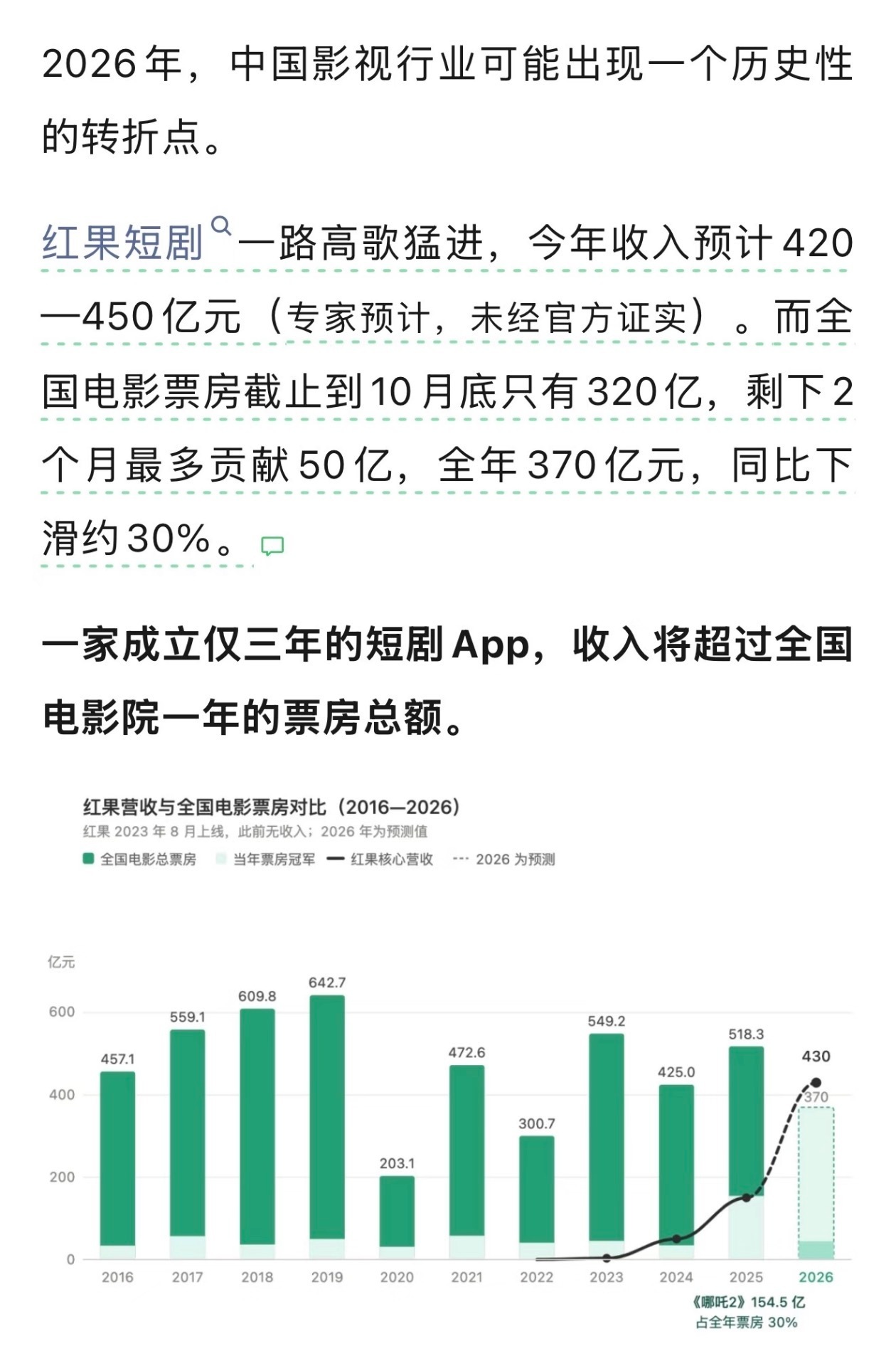
The market that absorbs all this is dominated by Hongguo, ByteDance's short-drama app, which claims 168 million daily users — more than iQiyi, Tencent Video, Youku and Mango TV combined. Its projected revenue for this year is 42–45 billion yuan, which would put it above China's total cinema box office for the first time. Investors have noticed: Wenhua Holdings and Hengdian Film and Television hit their daily trading limit, Ciwen Media and Guomai Culture are up more than 50% in a month, and margin traders have been piling into 21 short-drama concept stocks.
Whether any of it makes money is another question — one now being asked at the top of Zhihu, where users are dissecting the claim that a single AI-made episode may earn as little as one yuan. When two computers are enough to make a drama, homogenisation is the predictable result. "If the screen is full of this, will you still watch?" one commentator asked. He also supplied the counterweight: an actor he knows has gone three months without a single role, and his income for the year is zero.
The qualms are not only economic. As we covered when AI-made dramas first began skipping the Qing dynasty, the genre's runaway growth has come with a narrowing of what gets made — historical settings chosen as much for safety as for story. And as Hongguo's own experiment in telling binge-watchers to go to sleep showed, the platform that out-watched Chinese television knows exactly how much attention it is consuming.
The optimists, like the 4 a.m. reviewer, point to Xiangjian Huan and argue that when anyone can produce, the scarce resource is judgment. The pessimists note that 490,000 titles is not a market but a landslide, and that the first people under it were the actors and small studios who built the genre — while nobody has yet explained how any single title gets found in a feed of 490,000.