Back to the Furnace: University Graduates Enroll in China's Technical Schools to Get Hired
Beijing and other cities are opening technician classes reserved for university graduates as degrees lose their hiring power. The trend has a name — hui lu, 'back to the furnace' — and a case study: a sports coach who left the pitch to learn robotic arms.
Beijing's human-resources bureau announced that this year the city will run six full-time "university student technician classes" alongside 21 shorter skills-employment programs, built with employers in an order-style pipeline — the city's way of saying the seats are reserved for people who already hold degrees. Other provinces are running the same experiment: since August, several regions have opened technician classes for university graduates, with schools and companies co-teaching the curriculum so students leave with a state-issued technician certificate and the talent-policy benefits that come with it.
The phenomenon has a name on Chinese social media: 回炉, "back to the furnace" — re-melting a finished product. Last year, Guangzhou's public-utilities technician college opened the province's first degree-holding "pre-technician" class, described in local coverage as young people setting down the halo of their bachelor's degrees and walking into training workshops. The wave has grown enough that official media now run a recognizable genre of it: the student who passed the university admissions line and chose a technical school anyway, the graduate poached before finishing retraining.
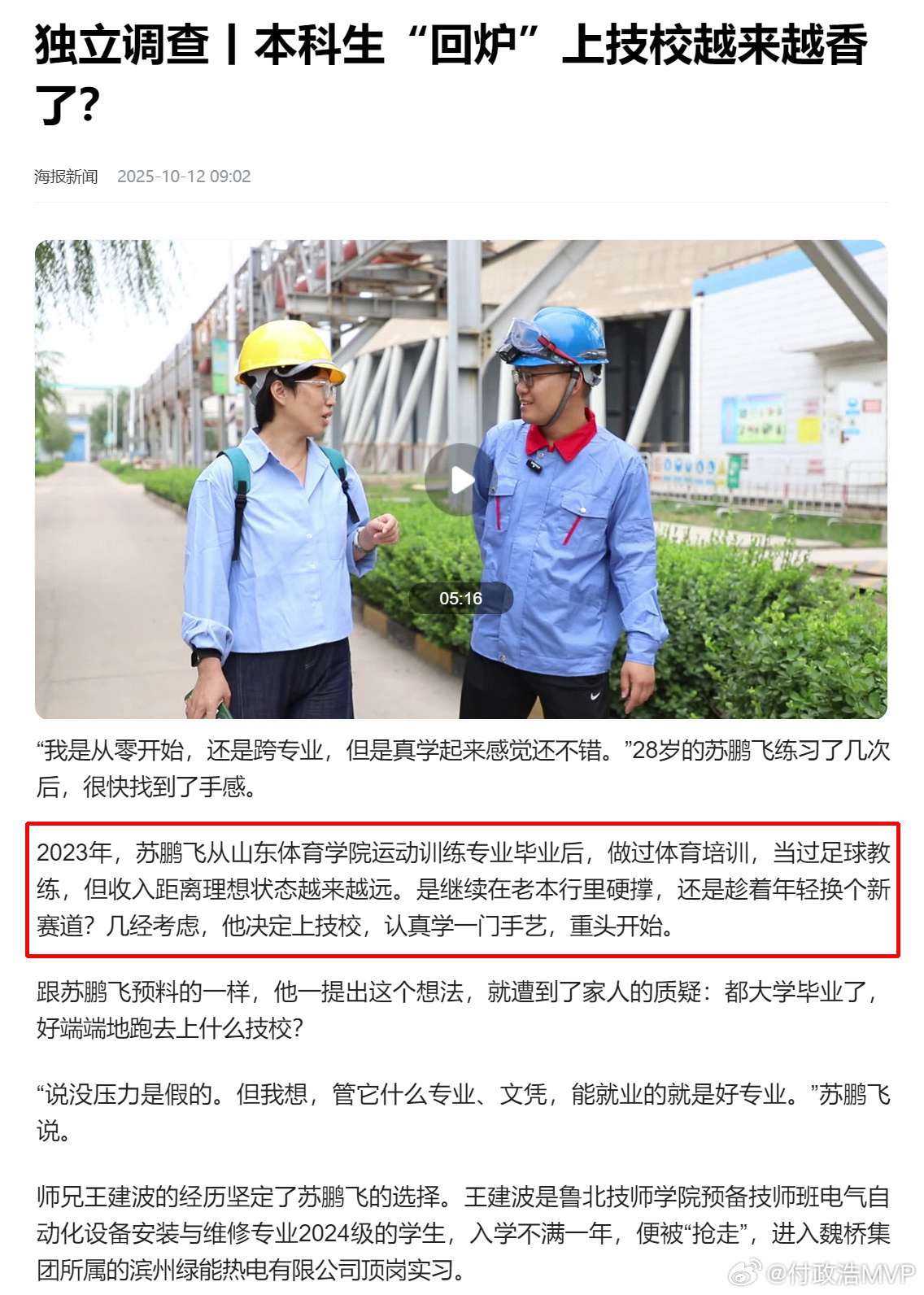
The individual case behind the trend's latest bump is Su Pengfei, 28, a 2023 sports-training graduate of Shandong Sport University who worked as a football coach and youth trainer until the income stopped making sense. He enrolled in the pre-technician class at Lubei Technician College in Shandong, in an intelligent-manufacturing applications program — learning to operate industrial robotic arms.
The posts under the topic are less interested in Su than in the arithmetic around him. A Beijing-focused account tallied the policy: multiple cities are now encouraging technical colleges to admit degree holders, framing it as opening a "new track" toward employment. And a sports-business commentator asked the uncomfortable version of the question — with undergraduates as common as they now are and entry-level pay depressed, does operating a robotic arm actually pay better than the coaching job Su left? His answer: possibly not — he argues Su's coaching income fell short mainly of his own expectations, and that China's sports industry, still growing faster than GDP, might yet have paid better than the workshop.
That is the shift being priced in. China's universities have kept expanding while the white-collar market thins, and hiring filters have hardened in step — employers still screen out candidates whose "first degree" is the wrong kind, even after officials said the concept does not officially exist, and an experiment with 4,500 fake résumés found overseas master's degrees now cost graduates interviews. Against that, a technician certificate in a shortage trade is one of the few credentials that changes the conversation.
Experts quoted in the coverage are blunt about what should follow: universities need to deepen industry ties and stop producing majors the job market has stopped wanting. For the graduates in this year's classes, the calculation is already made — better a marketable skill added on top of the degree than a second decade of waiting for the degree alone to matter.