A Clinic's Breast Exams Became a National Dispute Over Consent in Chinese Medicine
In Anhui, a woman says a TCM practitioner performed repeated breast exams on false pretenses; the doctor says he has video proving otherwise and is suing. The case has exposed a gap in how China handles misconduct claims inside clinics that keep operating.
In the city of Ma'anshan, Anhui, a woman's complaint about a clinic visits has become a test of where routine medicine ends and abuse begins. Last November, Wang, 27, says she went to a clinic run by a traditional-medicine practitioner named Jin for fatigue, only to be told — after taking her pulse — that she had breast nodules needing adjustment. She had no medical training, her own family were regular patients, and she trusted him. By Wang's account, twenty-odd appointments followed in which each visit to the clinic ended in a breast examination.
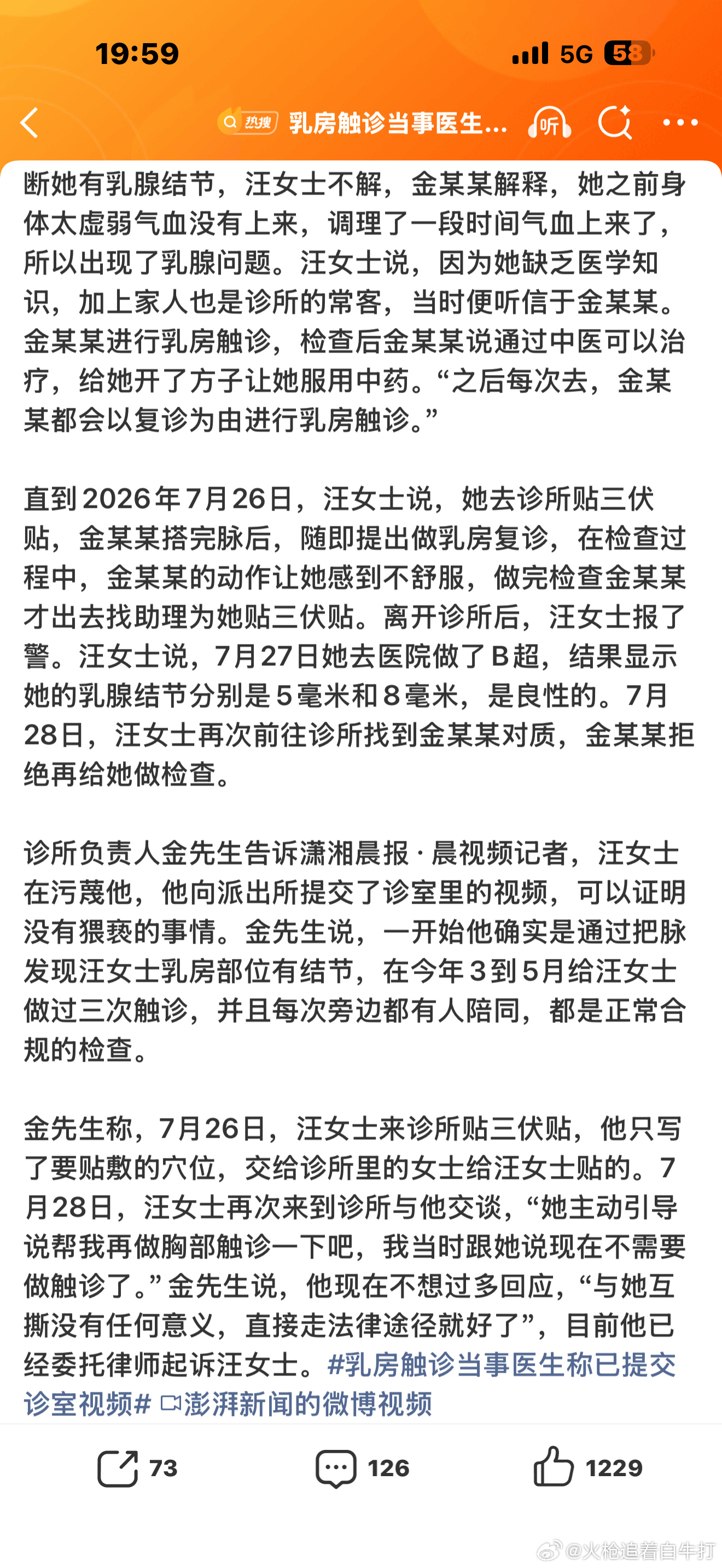
What broke her trust, she told local outlet Xiaoxiang Morning News, came on July 26 of this year. She had gone in for a "sanfutie" treatment — medicated patches applied at the height of summer — when Jin read her pulse and proposed another breast check without warning, and the examination made her uncomfortable. Only after it was over, she said, did he call an assistant to apply the patches. She left and filed a police report. A hospital ultrasound the next day found her nodules were 5 and 8 millimeters and benign, and her account spread fast: the phrase "乳房触诊" — breast palpation — climbed the trending list on Weibo, where posts on the story collected tens of thousands of engagements by Tuesday.
Jin tells a different story. He denies any misconduct and says he has handed police video he says was taken inside the consulting room, which he argues proves the exams were proper. He says he examined Wang only three times, not the "twenty-seven or twenty-eight" she described, and that a companion was always present. In his account, far from forcing anything, he turned down a request from Wang herself for another check in late July. Rather than argue the case online, he told reporters he has instructed a lawyer to sue her: "there's no point tearing each other apart — just go through the legal route." Police have opened an administrative case, and both the force and the local health commission say the investigation continues.
The dispute has split the platform. Some users see a textbook abuse of a vulnerable patient; others see a "小作文" — a disparaging term for a one-sided essay meant to convict someone in public — and the same gender divides and procedural skepticism that accompany almost every allegation of the kind. What makes this case more than a he-said-she-said is the regulatory vacuum it exposes. Because no definitive ruling has been reached, Jin continues to practice, and health authorities say they have no power to suspend a clinic while a complaint is pending. One widely shared post observed that the two receipts Jin submitted to different agencies didn't match, with the version given to Wang omitting any record of a palpation — the kind of discrepancy that will decide whether an administrative case becomes a criminal one.
For a patient, the higher stakes are simpler. Wang's report falls within a gray zone in which Chinese medicine, where touch is often part of diagnosis, meets a woman's right to refuse it — and where the standard of proof will determine not just who is believed, but who gets to keep practising while the answer is pending.