Foreign Cancer Patients Are Flying to China for a Therapy Only China Offers
A 59-year-old New Zealander has become the first foreign patient to travel to China for solid-tumor CAR-T cell therapy, paying 990,000 yuan for a course of treatment unavailable anywhere else. His case points to a quiet reversal: foreigners now come to China not for cheap care, but for care they cannot get at home.
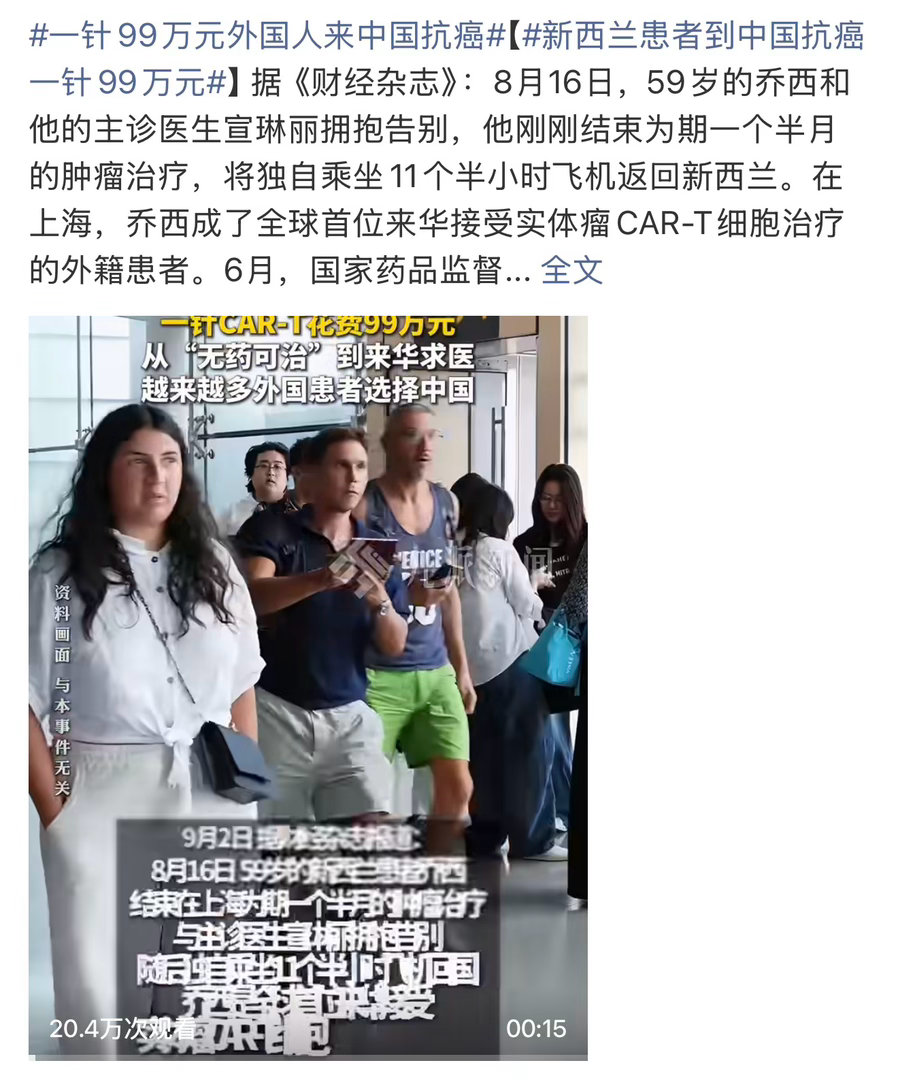
When the 59-year-old New Zealander known in Chinese media as Josh hugged his attending doctor goodbye in mid-August, he was ending a six-week stay that had begun with a piece of regulatory news half a world away. In June, China's National Medical Products Administration approved the world's first CAR-T cell therapy cleared for use against solid tumors. Josh, who had been following the field from New Zealand, arrived in Shanghai with his wife and younger son to receive it — and on August 16 he flew home alone, after becoming the first foreign national to complete the treatment.
His case, reported by Caijing magazine and picked up across Chinese social media this week, is being read as a milestone for "medical tourism" — a term that used to describe Chinese patients seeking treatment abroad. The flow is now running the other way. Jiahui International Hospital, the private Shanghai facility that treated Josh and says it receives more international patients than any other in the city, logged more than 100,000 visits by foreign patients in 2025.
The draw is not price alone, though price is part of it. A single course of CAR-T therapy — a treatment that reprograms a patient's own immune cells to hunt cancer — costs 990,000 yuan in China, roughly 138,000 US dollars, a sum that would strain even a New Zealand salary. But for blood cancers, Chinese hospitals charge about a third of what the same therapy costs in the United States, according to the hospital's written response to Caijing. And Josh's version, aimed at solid tumors rather than blood cancers, could only be found in China. "People like Josh aren't coming mainly to save money — they're coming to save their lives," the magazine's report concluded.
On Weibo, where the story drew thousands of comments, the reaction split between pride and sticker shock. "So China was built this well for the good of the global village," one user wrote, folding the news into a familiar trope of Chinese generosity to outsiders. Others were blunter about who could afford it: "For ordinary people, forget it. We can't pay for this."
That tension is the story's other half. The affordability of cutting-edge cancer care inside China remains fraught — this week the site covered the death of Fangfang, a cancer blogger who died at 39 after crowdfunding money for painkillers when she could no longer afford treatment. The same country that draws foreign patients with a therapy priced at nearly a million yuan is still debating how ordinary Chinese patients get access to basic oncology care.
For now, the direction of travel is unmistakable. China's regulators approved four CAR-T products in as many years, its hospitals are courting international patients, and the patients are arriving — one 990,000-yuan injection at a time.