China's 'Absentee Epidemic': Four State-Owned Company Employees Go Unpunished for Up to 16 Years
Four employees from a company in Jilin Province have been absent without leave for up to 16 years, sparking widespread outrage and ridicule on social media after the company issued a public notice calling on them to return to work. The notice, published on October 15, stated that the four employees had not been approved for leave and had failed to report to work despite repeated attempts by the company to contact them.
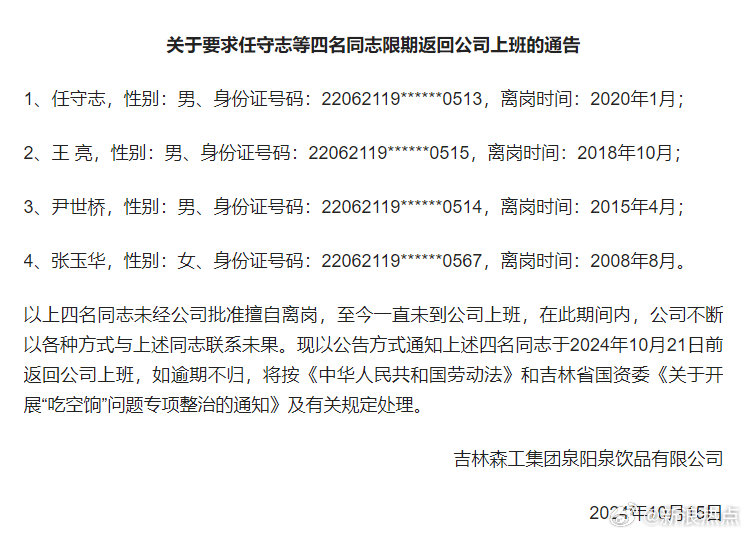
The company's announcement warned the employees that they must return to work by October 21, 2024, or face disciplinary action in accordance with labor laws and regulations. The case has raised questions about the laxity of management in state-owned enterprises and the phenomenon of "eating empty rice bowls," where employees receive salaries without performing their duties.
The incident has highlighted the stark contrast between the treatment of employees in state-owned enterprises and those in private companies, where absenteeism is often met with swift disciplinary action, including dismissal. The public notice has been met with a mix of incredulity and anger, with many commentators expressing outrage that the employees had been allowed to go unpunished for so long.
The news has sparked heated debate about the privileges enjoyed by state-owned enterprises. Many netizens expressed their outrage on social media, questioning the prevalent "iron rice bowl" phenomenon in state-owned companies, which refers to the perception that once an employee is hired, they are guaranteed job security and benefits for life, regardless of their performance.
A popular comment compared the treatment of state-owned company employees to those in private enterprises. “In private companies, you'd be fired after three days of unauthorized absence. Meanwhile, state-owned companies can let employees take 16 years off and still try to call them back to work with a simple notice.”
Another critic pointed out that this incident showcases a classic example of “eating from the bowl while eyeing the pot." "Those who hold a position but don't actually work yet still collect a government salary, this is something many people can't wrap their heads around. It’s having your cake and eating it too."
Many questioned the country's labor laws and the complacency of state-owned companies. As one commentator mused, “In many cases, taking just three days off without permission can result in termination. However, some state-owned companies only seem to care about the issue now that a high-level investigation has begun.”
The company, Jilin Senrong Group Quanyangquan Beverage Co. Ltd, first issued a notice on October 15, listing the names, genders, ID numbers, and dates of absence for the four wayward employees. The notice demands that the employees return to work before October 21, warning that failure to comply will result in disciplinary action in accordance with the Labor Law and relevant regulations.
Zhang Yu Hua, a 55-year-old female employee, has been absent since August 2008, followed by Yin Shi Qiao, who left in April 2015, and Wang Liang, who departed in October 2018. The most recent case is that of Ren Shou Zhi, who started his extended absence in January 2020.
The crackdown on the "eat-thin-salary" problem has been met with mixed reactions on social media, with some users criticizing the state-owned enterprises for allowing the practice to persist for so long, while others have praised the efforts to address the issue.
According to sources, the public notice is part of a broader campaign launched by the Jilin Provincial State-owned Assets Supervision and Administration Commission (SASAC) to tackle the "eat-thin-salary" problem, which has long been a thorn in the side of state-owned enterprises in China. The campaign aims to hold employees accountable for their actions and ensure that they are performing their duties as expected.
Some commentators praised the seemingly lenient treatment these employees received from their state-owned company. "Even though these employees went absent without leave for years, their employer chose not to give up on them. Instead, they've been asked to return to work. Perhaps this is the expression of a certain degree of humanity, and the phenomenon that's been witnessed on this extraordinary land is not truly extraordinary after all."
However, not all comments were sympathetic. Many netizens expressed concern about the systemic loopholes that allowed such abuses to happen. One asked rhetorically whether this was an example of "having one's cake and eating it too," where employees could enjoy the benefits of their posts without actually doing the work.
The incident has raised questions about the management and oversight of state-owned enterprises in China, and whether the system is too lenient towards employees who abuse their positions. As one netizen noted, the fact that it took the company so long to address the issue and the fact that the employees were still receiving their salaries despite their absence, suggests a deeper problem that needs to be addressed.