China's Anta Completes a €1.5 Billion Purchase to Become Puma's Largest Shareholder
The Fujian sportswear group behind FILA China and Arc'teryx's owner has bought 29.06% of PUMA SE from the Pinault family, turning a Jinjiang shoe business into the biggest shareholder of one of the world's best-known sportswear brands.
The Chinese sportswear group Anta announced on October 7 that it has completed its purchase of 29.06% of PUMA SE, paying 1.5055 billion euros in cash to Artémis SAS, the holding company of France's Pinault family. All regulatory approvals are in and the closing conditions met, the company said, making Anta the largest shareholder of the German brand whose leaping cat has rivalled Adidas and Nike since the 1970s. The deal charted high on Baidu's hot-search board within hours under a title that did the arithmetic for everyone: Anta Group becomes Puma's biggest shareholder.
Anta's statement framed the stake as a strategic partnership rather than a takeover. The announcement quoted the group's chairman, Ding Shizhong, and Puma's chief executive, Arthur Hoeld, stressing respect for Puma's management autonomy — and stating plainly that Anta has no plans for a tender offer. For now, Puma stays a listed German company with a Chinese anchor shareholder instead of a European family at its back.
For an international reader, the significant detail is where this buyer came from. Anta was founded in 1991 by the Ding family in Jinjiang, a Fujianese port city whose factories made shoes for export brands before making their own. It spent the 2010s assembling a portfolio of foreign labels: it took over the China operations of Italy's FILA in 2009 and turned them into a high-margin fashion business, and in 2019 led a consortium that took Finland-listed Amer Sports — the owner of Arc'teryx, Salomon and Wilson — private. Amer's Arc'teryx has since become one of the most visible status brands on Chinese city streets. Puma is the biggest name yet.
The timing matters as much as the price. Western consumer brands have spent the past two years renegotiating their place in China: Porsche, whose sales in China have collapsed under pressure from domestic electric vehicles, cut the Cayenne's price by 300,000 yuan this month. Chinese groups that once licensed or imitated Western sportswear are now positioned to own the brands outright — not to sell them to Chinese consumers, but to hold them for the global market. A stake in Puma is a bet that the value of an eighty-year-old athletic brand outlasts any one market's slowdown.
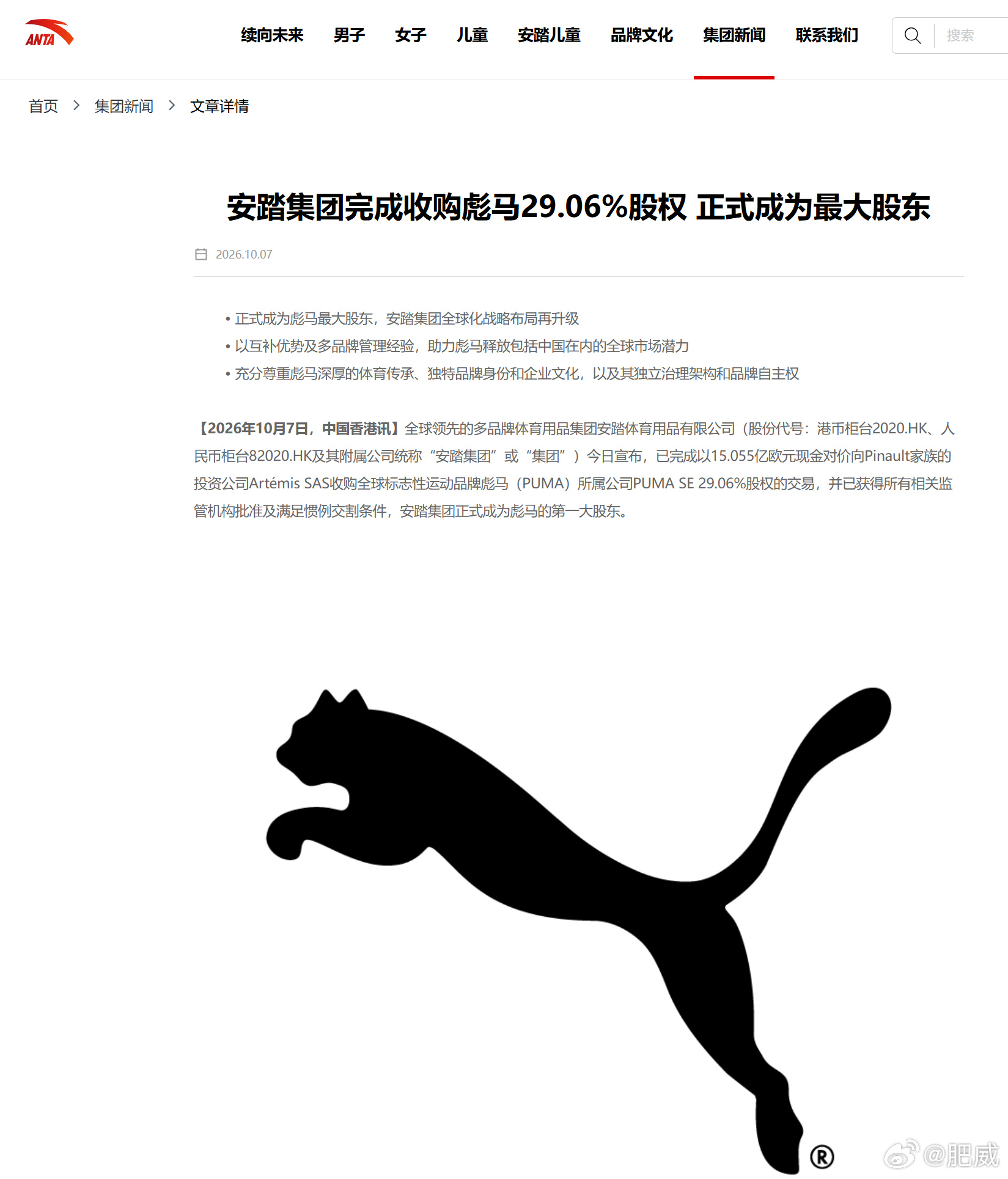
What Anta intends to do with its position is the open question. The statement's reassurances — autonomy respected, no tender offer — are aimed at German regulators and Puma's own management as much as at investors. Chinese companies have bought Western consumer icons before and left them mostly alone to flourish; Anta's FILA and Amer track records are, in the industry's view, the reason the Pinault family was willing to sell to Jinjiang. Puma, which has struggled to keep pace with Adidas's revival, now gets a patient, brand-experienced shareholder. The leaping cat's next decade will be watched in Beijing as closely as in Herzogenaurach.