A Hospital Told Doubao Users to Try Another Chatbot — the Notice China Can't Stop Sharing
A photograph of a printed notice in a hospital outpatient hall telling patients who arrived with self-diagnoses from ByteDance's Doubao to 'consult Qianwen or Yuanbao instead' has become the week's most-shared image, capturing both how far AI chatbots have entered Chinese healthcare and how exhausted doctors have become with them.
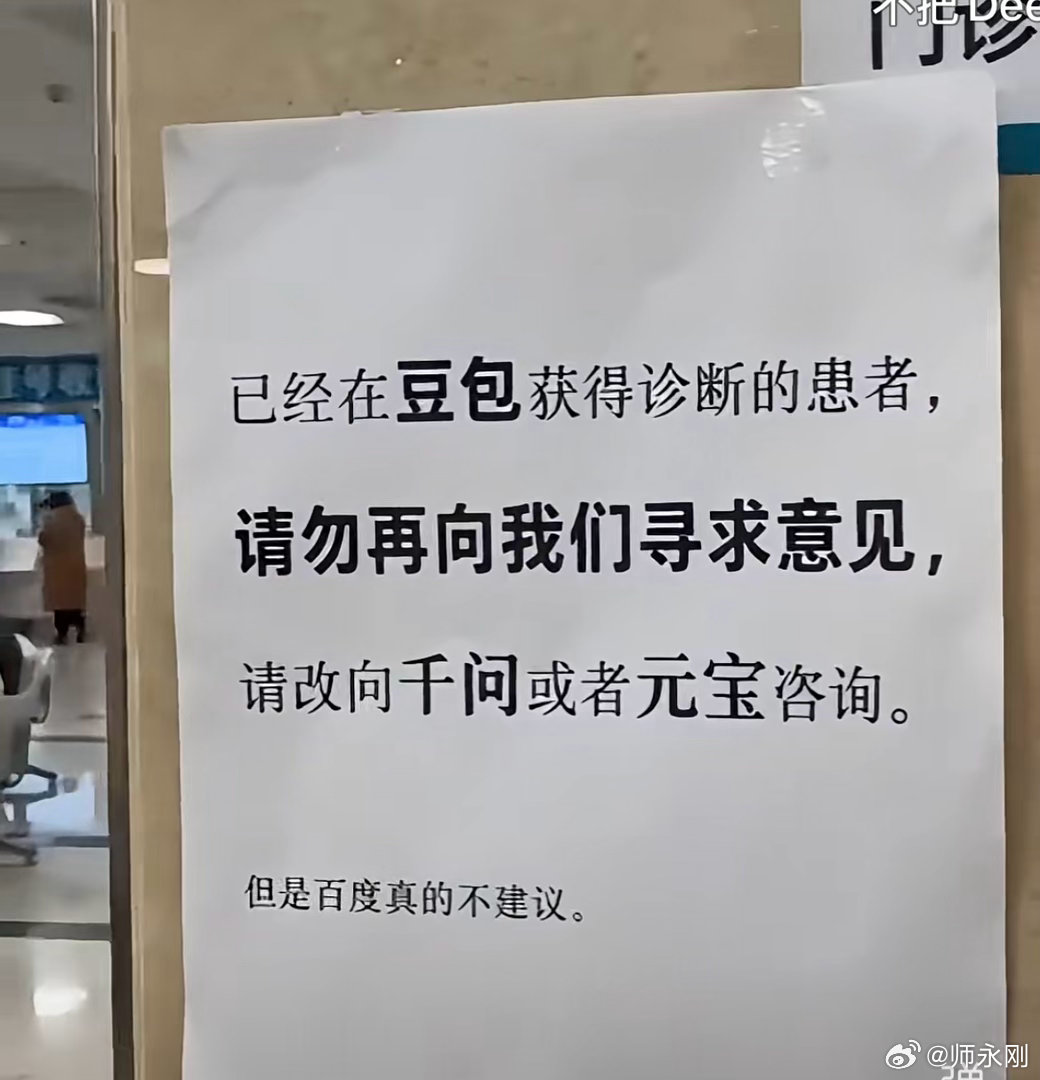
A photograph of a paper notice taped to the glass partition of a hospital outpatient hall is doing the rounds on Chinese social media this week, and its single sentence explains a lot about the state of AI in China today: patients who have already received a diagnosis from Doubao, it asks, please do not seek our opinion again; please consult Qianwen or Yuanbao instead. But Baidu is really not recommended.
The notice was photographed and posted on Weibo by the writer Shi Yonggang, whose post drew more than 7,000 likes within a day. In the photograph, the word "Doubao" — the name of ByteDance's chatbot — is printed in a larger, bolder font than the rest of the text, as if even the hospital's print shop had decided which AI had earned the extra emphasis. The word "instead" carries the real weight: this is a hospital telling patients that if they insist on outsourcing their medical judgement to a chatbot, at least have the decency to take the output somewhere else.
Doubao is China's default chatbot. Built by ByteDance, the company behind Douyin, it tops the mobile AI rankings with the kind of user base no competitor approaches; the site's own reporting has followed its footprint from people suing it over burial dates to its answer on dying before 70 and a trust problem its critics summarize in two characters. The hospital notice reads as the exhaustion point of that ubiquity. Doctors now routinely meet patients who arrive having cross-examined an LLM about their symptoms, and the notice's phrasing — singling out one product by name — suggests this particular hall had simply had enough.
The joke's structure is what made it travel. Rather than pleading with patients to trust doctors, the notice accepts the premise and redirects it, ranking rival chatbots Qianwen (Alibaba) and Yuanbao (Tencent) as acceptable second opinions while dismissing Baidu's chatbot out of hand. On Chinese social media the notice has been read as satire of hospital staff (an in-joke about which AI is "smart"), as satire of patients, and as satire of the AI ranking wars — every major tech company now has a consumer chatbot, and their relative prestige is being adjudicated in hospital corridors.
One Weibo commenter who works in science communication put the shift plainly: people now trust AI the way they trusted Baidu searches fifteen years ago — completely, and then some. "AI is a fine auxiliary tool, but something like medical diagnosis still needs a doctor," the commenter wrote, adding that the ability to smell whether a piece of information is credible comes only from years of reading primary literature — a view that itself drew wide agreement.
The deeper point the notice makes is that China's consumer AI boom is hitting the wall every consumer AI boom eventually hits: the technology's authority has outrun its competence. When more than 700 million people use generative AI, as an official report found in August, the patient arriving with a chatbot printout is no longer an early adopter; they are the mainstream. The notice is small, taped to glass, printed on A4 — and one of the clearest signals yet that the industry's next battle is not more users, but trust.