Doubao's Answer on Dying Before 70 Struck a Nerve Across China
A user asked Doubao, ByteDance's assistant used by hundreds of millions, what share of people die before 70 — and its census-based answer, roughly 35% overall and 40% for men, spread across Chinese social media as an unplanned meditation on mortality.
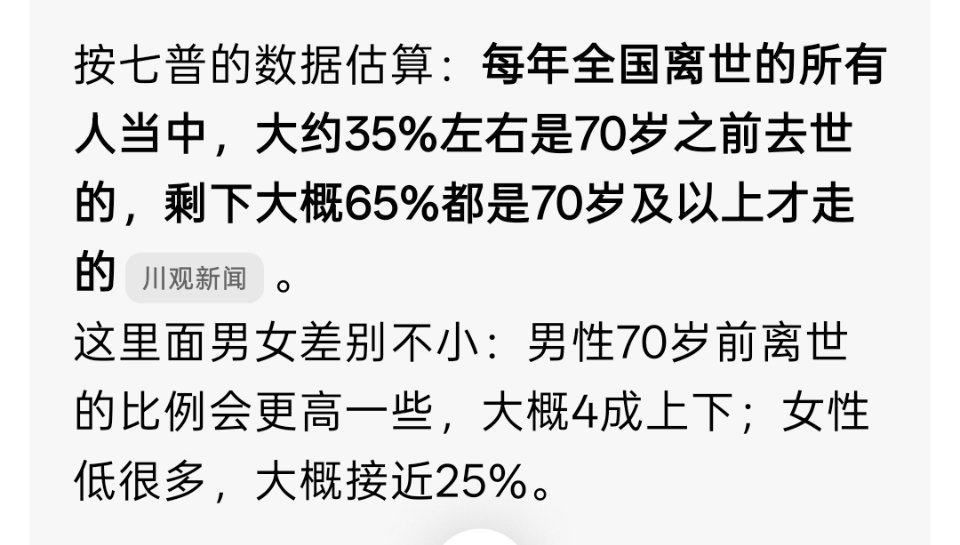
"I asked Doubao what share of people die before 70. Look at its answer." With that, a screenshot posted on Saturday — of a three-paragraph reply from China's most-used AI chatbot — set off one of the stranger viral waves of the Mid-Autumn holiday weekend.
Doubao, the assistant made by ByteDance, replied that based on the seventh national census, of all deaths in China each year roughly 35% occur before age 70, while about 65% come at 70 or older — with a gender split: for men the pre-70 share is around 40%, for women closer to 25%. The numbers are estimates layered on census tables, and Doubao's answer carried a cited source, in keeping with the citation habits that China's chatbots were built to display. The post sharing it drew thousands of likes and comments, and the topic charted high on Weibo's hot list on Sunday.
What caught on was less the arithmetic than the reflection it triggered. A widely shared post put it bluntly: "Life doesn't actually have 30,000 days. The people who reach their eighties and die peacefully in bed are the minority. People don't die only when old — illness, a car crash, an accident can take you at any moment. Stretch that out to the length of history and the universe, and a person is no different from an ant. Your earth-shattering personal matters are small things; work, money, reputation — all of it is gone when you die."
The conversation produced its own hashtag — literally "stop looking for a sense of safety in other people's deaths" (不再在别人的死亡里找安全感) — as users dissected why a cold statistical answer felt, to many, oddly bracing rather than morbid. Death remains a near-taboo subject in everyday Chinese speech; a chatbot volunteers the numbers without the euphemism.
Doubao, for its part, has been here before. The bot's habit of answering unsettling questions matter-of-factly has drawn scrutiny over its trustworthiness before, and earlier this month a man sued Doubao over a burial date it had chosen, making the assistant a party in a dispute about death rituals. This time no one is suing; the bot's mortality table is being forwarded as a prompt to reassess — to spend the health one has, as the shared post put it, on "living a bit longer, happily, and without regrets.