Why China's Labor Law Doesn't Mandate a Two-Day Weekend
A lawyer's explainer that Chinese labor law guarantees only one rest day a week — not the two-day weekend many assume is standard — became one of Wednesday's most-discussed topics, putting fresh attention on research suggesting 65 to 70 percent of Chinese companies run on a single-day week.
The question that climbed Weibo's hot list on Tuesday was disarmingly simple: "Is it legal for my employer to give me only one day off a week?" The answer, from lawyers fielding the hashtag, was yes — and the reaction said a great deal about the gap between how Chinese work life is imagined and how it is lived.
The explainer that set off the discussion, posted by the Zhejiang news account Qianjiang Video, walked viewers through what the law actually says. China's Labor Law requires employers to guarantee workers at least one full rest day per week and caps standard hours at 44 per week. The two-day weekend arrived only in 1995, by State Council regulation — which means, as one lawyer put it, that the five-day week is an administrative standard, not the statutory floor. "Only one day off a week is not, in itself, against the law."
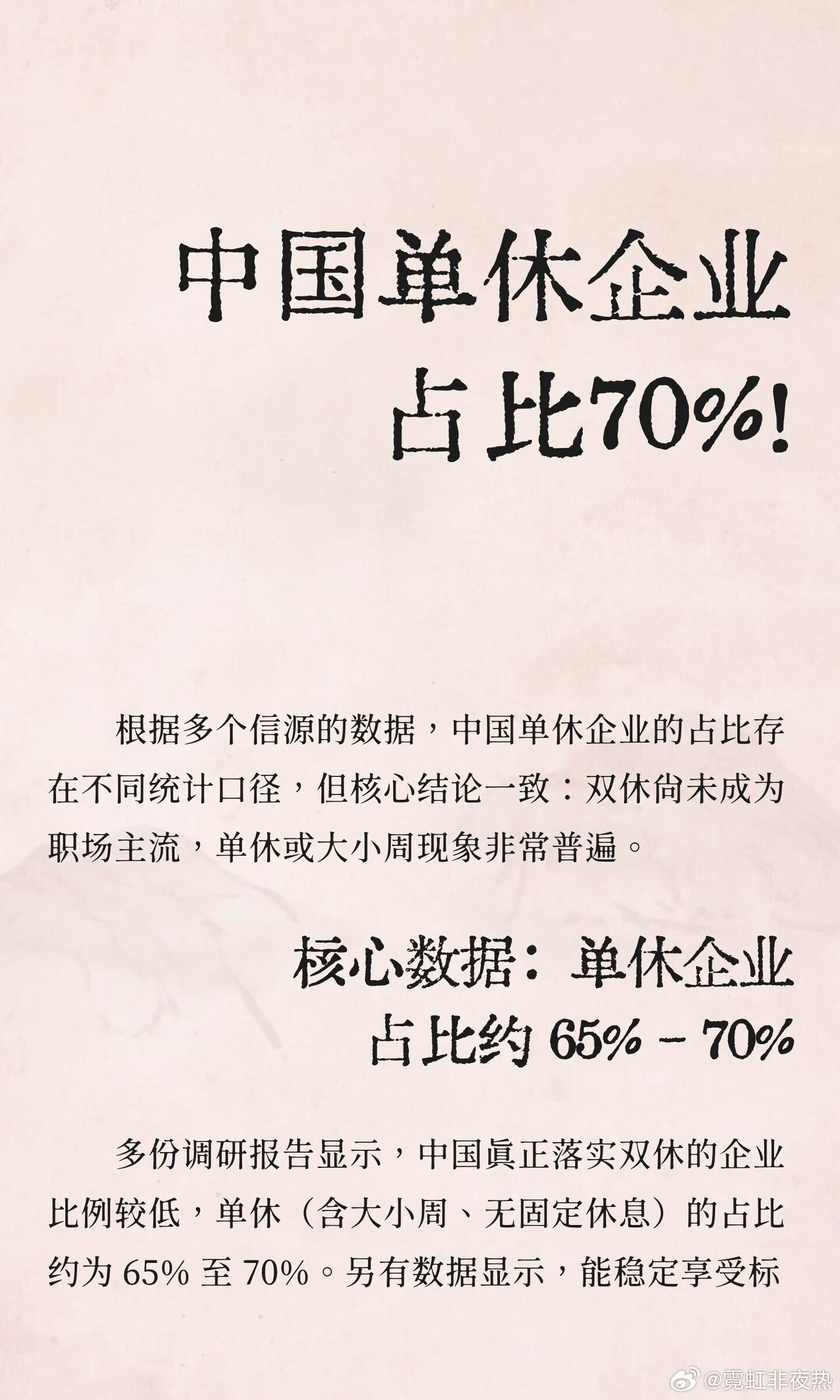
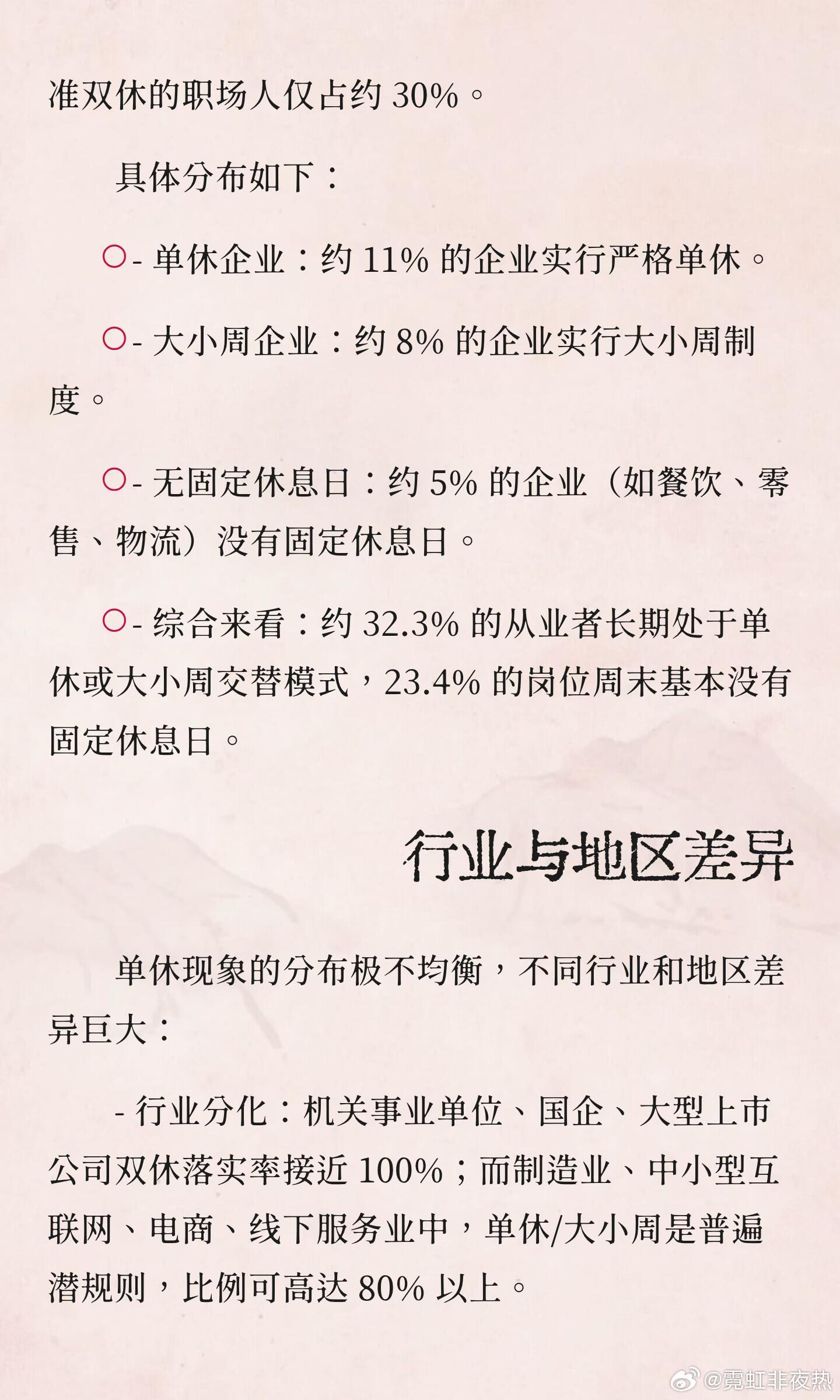
The reality on the ground is considerably worse than that floor. An infographic circulating with the topic cites multiple workplace surveys: roughly 30 percent of Chinese workers have something close to a two-day weekend, while single-day weeks account for 65 to 70 percent of companies. Another 8 percent alternate "big weeks" and "small weeks" — six days on, five days on — and 5 percent, mostly in catering and retail, have no fixed rest day at all. More than 32 percent of workers, the graphic concludes, live in prolonged single-day or alternating schedules, with compliance highest in government offices and state institutions and thinnest in manufacturing and services.
The argument underneath the topic was not about Saturday and Sunday specifically. Several top comments pushed back on the framing: what workers want, one wrote, is not the calendar weekend but the "freedom of the double day off" — guaranteed rest, whenever it falls, that does not have to be fought for. Others set the bar far lower and still found it out of reach. One widely shared post by a Yunnan-based NGO worker listed five conditions for what he called a merely decent job — pay above 3,000 yuan in a county town, social insurance even at the minimum, shifts that start no earlier than eight and end no later than eight, five years of stability with no layoff after 35, and overtime pay. "It looks like a very low bar," he wrote. "But 95 percent of people don't have a job that meets all five."
The discussion lands in familiar territory. Rest days have been the quiet casualty of China's work culture debates since courts declared the "996" schedule illegal in 2021, and only last week workers raced to splice three days of annual leave into a thirteen-day holiday, another reminder of how tightly leisure is rationed. What is newer this time is the arithmetic being shared openly: a two-day weekend in China is not the norm workers are struggling to defend. It is the exception they are asking to have explained.