China Now Fines Employers Up to Three Times the Social Insurance They Withhold
A new national penalty baseline that took effect on November 1 unifies how employers who skip social insurance contributions are punished across China — with fines of one to three times the arrears and 'voluntary waiver' agreements declared void. The news landed alongside a viral case from Nanjing, where a teaching assistant says she was fired after five hours offline on a day off.
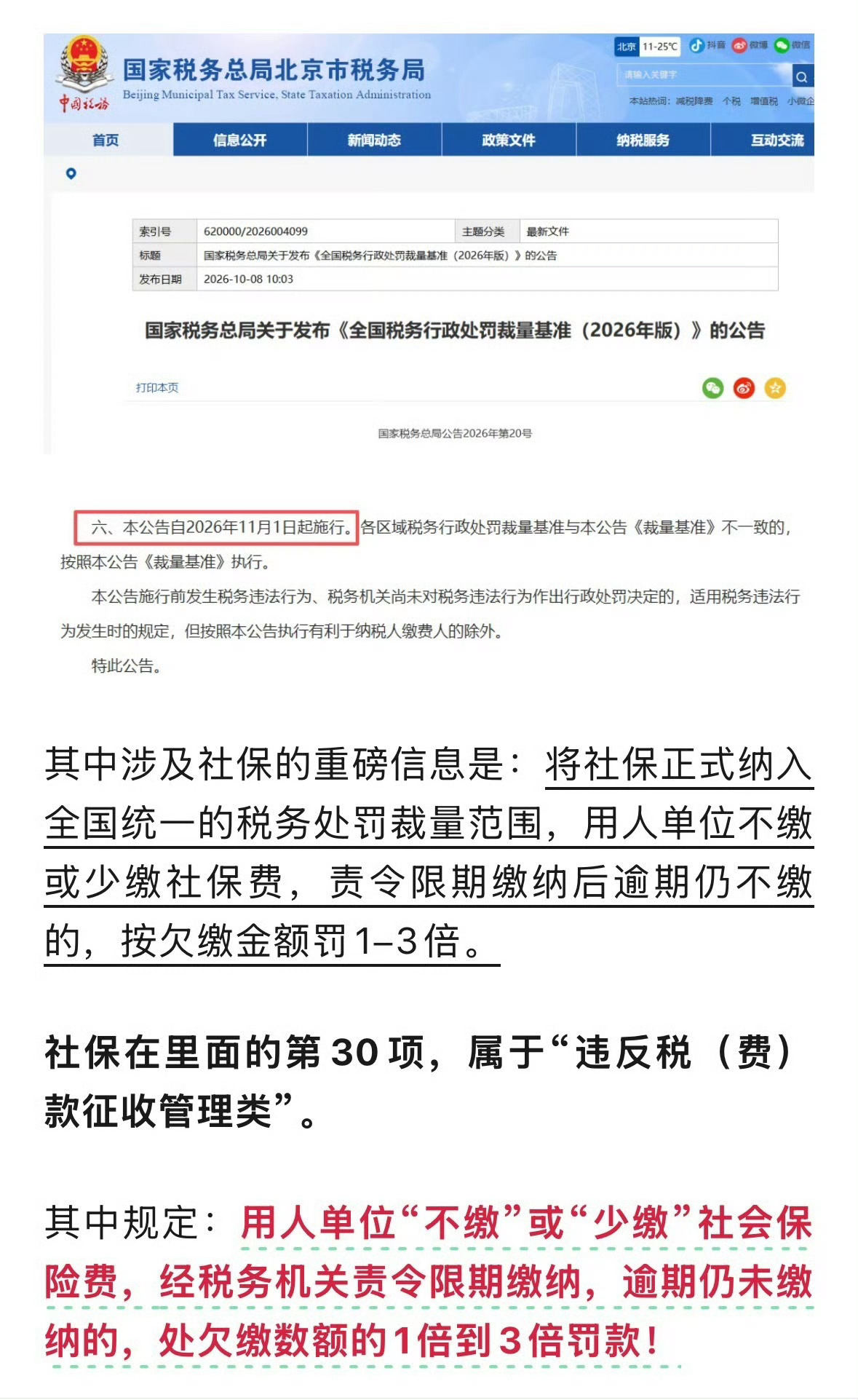
As of this month, an employer in Shenzhen and one in a small county in Gansu who fails to pay social insurance now faces the same punishment — a change workers have waited years for. On November 1, the State Taxation Administration's new national penalty baseline took effect, bringing social-insurance violations into one nationwide enforcement framework for the first time and ending the region-by-region patchwork that let some employers dodge consequences simply by operating where enforcement was soft. Under the rules, a company that ignores an order to pay owes daily late fees on the arrears — and, if it still does not comply, a fine of one to three times the unpaid amount, scaled to how much is owed and how large a share of the total it represents. Just as pointed, the new baseline confirms that "voluntary waiver" agreements — the papers some employers ask staff to sign giving up coverage — are void.
The stakes are easy to state. China's pension and medical systems are contribution-based, and the workers most likely to be skipped — young people, migrants, gig and service staff — are the ones who most need the years on the books. Commentators spent the weekend arguing both directions: one widely shared post warned young people that skipping contributions to protect this month's paycheck is a trade they will regret at sixty; a business-minded commenter countered that with small firms already struggling, piling fines on top is "adding snow to an already bad economy" — get growth moving first, then talk about collecting.
The rules arrived in the same news cycle as a case that shows why the paperwork matters. A teaching assistant at a Nanjing test-prep company told Yangzi Evening News that on her day off, October 17, she went hiking without her work phone; when a parent's question in a group chat went unanswered for five hours, the fallout was swift — reprimand calls from multiple managers, public criticism in the work groups, and by 8 p.m. a new rule: rest days should include checking the phone every three hours. She was later dismissed, and has filed for labor arbitration claiming unlawful termination — backed, she says, by roughly 900 screenshots of off-hours work messages, and a complaint that her social insurance was paid on an understated salary base. The question ranking near the top of Zhihu's hot list puts it plainly: is "check in three times a day on your day off" even legal?
That is the collision the new framework enters: a state tightening the screws on employers who shortchange the system, and workers discovering in real time what leverage they actually have. The Nanjing case will be decided by an arbitration panel. The fines, starting this month, no longer depend on where you live.