Beijing Publishes Its Eight-Point Summit Ledger: Tariff Relief, an AI Dialogue and What Both Lists Left Out
The day after Xi Jinping flew home from Washington, Beijing released an eight-point consensus with tariff cuts worth $30 billion, a trade council and an AI dialogue — and both governments' lists conspicuously skip Taiwan.
Xi Jinping's plane touched down in Beijing on Friday afternoon, and within hours Beijing published what the trip to Washington had actually bought: an eight-point consensus, released by Xinhua and state television in matching rundowns, that reads as the most concrete China–US document since the trade truce talks began. CCTV's summary of the eight points drew more than 67,000 comments within hours — an unusually heavy response for a diplomatic communiqué.
The first point gives the relationship its new name: a "constructive strategic stability relationship based on respect, fairness and reciprocity" (基于尊重、公平、对等). That is an expansion of the formula the two sides agreed when Trump visited Beijing in May, and Beijing's state commentators have spent the day since unpacking the three added words as the visit's core political outcome. As our earlier read of the summit's deliverables noted, the two governments had promised a list; now both have published one.
The seven points that follow are more concrete. On trade: a new China–US trade council, a package of matched tariff reductions both sides size at 30 billion US dollars — the quotation marks around the figure are Beijing's own — and an extension of the outcomes struck in Kuala Lumpur. On technology: a standing China–US dialogue on artificial intelligence, first convening this November, plus a communication channel for AI incidents. On enforcement: joint anti-narcotics operations that, per the list, have recently netted dozens of arrests over synthetic drugs and precursor chemicals on both sides of the Pacific. Then the softer ledger — a pledge that Iran will not develop nuclear weapons and that no state or institution may charge tolls on international waterways; a remembrance that the two countries were Second World War allies; the panda pair already bound for Zoo Atlanta, covered when it was announced; and a military memorandum on crisis communication, alongside resumed searches for American airmen missing in China since the war.
The interesting reading is in what the two lists say differently. HK01 ran the Chinese and American documents side by side and found the White House fact sheet mentions Chinese purchases of at least ten million tonnes of US coal, plus rare earths — neither of which appears in Beijing's version. Washington's text prefers "super intelligence" where Beijing writes artificial intelligence; asked about the swap, China's Foreign Ministry said it "respects the US formulation." And neither list mentions Taiwan at all — though Trump told reporters he had raised the island with Xi, saying the Chinese leader "understands my position," and analysts in Taipei read the joint omission as both sides parking the hardest issue rather than solving it.
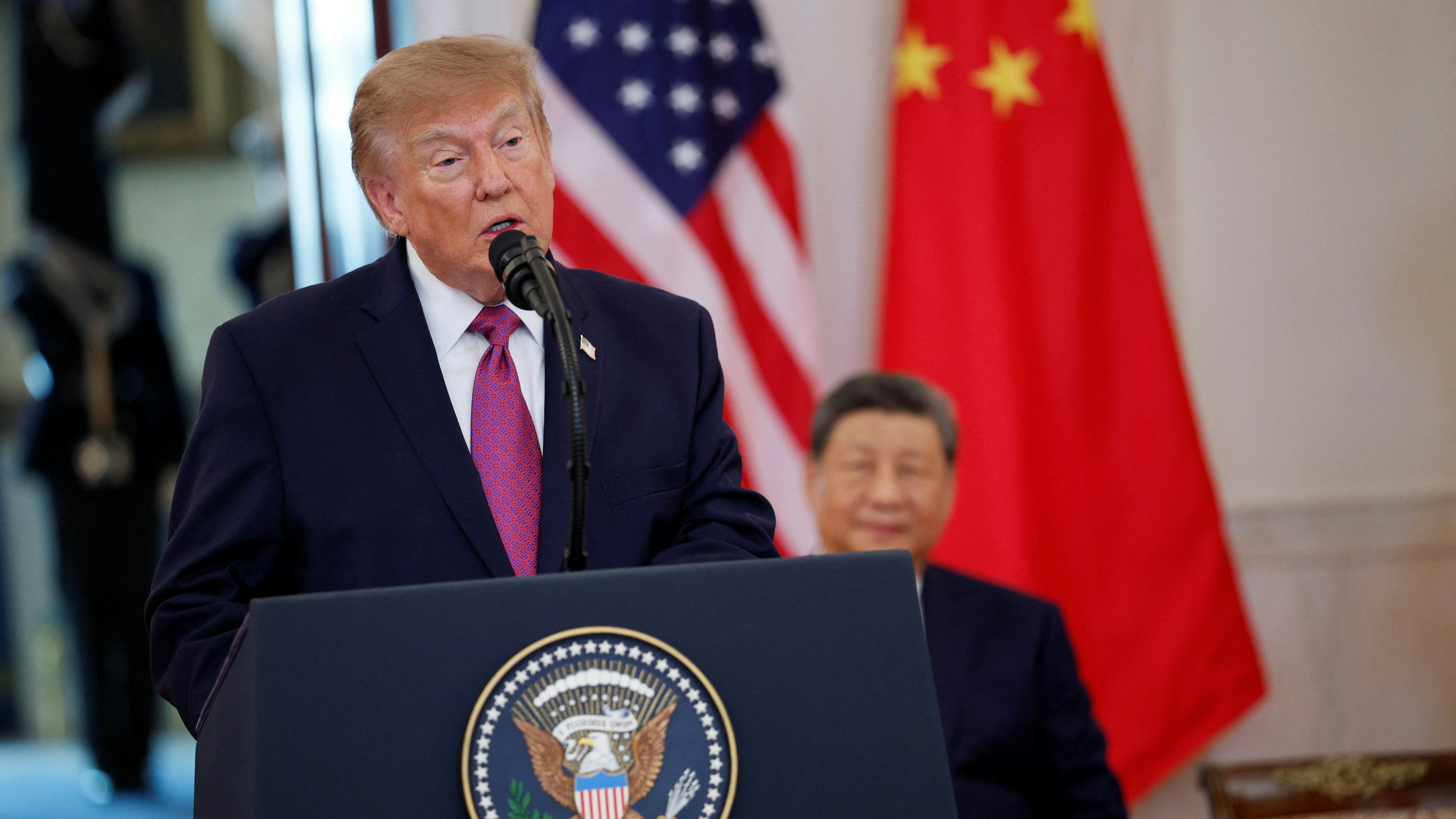
The ceremony carried its own message, as the state dinner's guest list already signalled: Trump and Melania met the Xis on the tarmac at Andrews, Chinese red dressed the White House East Room, and the farewell came at Andrews with a 21-gun salute. Foreign Minister Wang Yi called the protocol an expression of respect; commentators in Japan counted the contrast with their own prime minister's cool reception in New York.
Reaction mixed satisfaction with a clear eye. Putin welcomed the détente, telling reporters any positive US–China agreement "will affect the global economy." And one widely read Chinese analyst put it in the idiom of the day: the friendliness does not change the underlying competition — what both sides have really agreed is 斗而不破, to fight without breaking.
The ledger now gets its test. The tariff package needs implementing instructions; the AI dialogue convenes in November; and both leaders say they intend to meet again — first in Shenzhen, where China hosts APEC, then at the G20 in Miami in December.