No Jobs, No School: a Family of Three Generations Goes Off-Grid Above Dali
A 36kr profile of a 30-year-old mother who has spent six years on a Dali mountainside with her children out of school has split Chinese social media between envy of an escape from the rat race and alarm over the children's right to one.
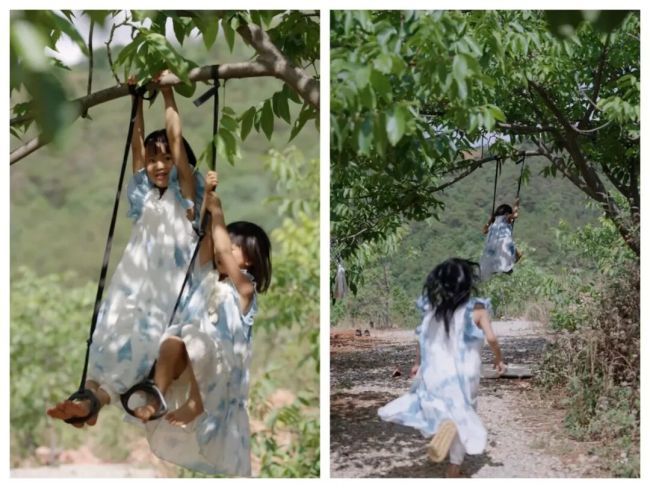
The profile that set off this week's argument reads like a document from a different country. Xia Mu is 30, born in Inner Mongolia, and has never worked a single day after graduating. Six years ago, the year her first daughter was born, she came across the "Anastasia theory" — the Russian back-to-the-earth movement built around a Siberian forest-dweller who convinces millions to found family homesteads — and she and her husband, Zhou Hai, moved onto an almost abandoned hilltop in the mountains above Dali, Yunnan, with 4,000 yuan between them. They rebuilt the house and improved the soil themselves. Her second daughter was born at home, in the bathroom.
Six years on, the family lives as profiled by the tech outlet 36kr in a hamlet of twenty households a twenty-minute drive above the valley floor: the adults do not go out to work, the children — now including a daughter raised entirely in the mountains — do not go to school, the family rarely comes down to the city, and Xia Mu describes the arrangement as "peaceful and quiet." Both sets of grandparents opposed the plan fiercely at first; seeing the children grow up unusually healthy and unspoiled, they came around, and no longer object to the girls being educated at home. Lately, the profile reports, other parents have been arriving — bringing children who could not settle into school.
On Weibo, the debate has split into two camps, and the story's hit rate says something about the audience it found: one camp reads the family as an enviable escape — the "松弛感," the relaxed unhurriedness that Chinese office workers are told they lack — while the other asks a blunter question: what happens to two girls who never learn alongside anyone else? One widely-liked comment allowed for travel in the holidays but objected to the core: "not even basic compulsory education has been carried out." The gendered texture of the story did not pass unnoticed either — the adults who opted out are a couple, but it is the mother whose biography ("has never worked a day") is offered as credential.
That question is where Chinese law sits, and it is not ambiguous: nine years of schooling are compulsory for every school-age child, with home education outside the state system not a recognized alternative — rural and minority-area flexible arrangements exist, but parents who simply keep children out of school are, in principle, in breach. As one of the most-shared commentaries put it, adults may choose their own lives, but a child's right to education and to society cannot be forfeited unilaterally by her parents; seclusion itself breaks no law, yet with minors involved "it is no longer only a lifestyle question."
The family, for its part, has been reported before — Dali's hills have drawn a generation of dropouts priced out of Beijing's pace if not its rents — and the profile's photograph of lunch laid out on a plank table under the trees carries the story's real seduction. The open question is the one the comment camp keeps pressing, and the profile does not answer: two girls are growing up healthy on a mountain, and one day they will be adults who did not go to school in the country that built the world's largest school system around them.