Police Mediate Jiuzhaigou Beating That Pitted Young Tourists Against an Elderly Man
A video of a 62-year-old tourist punching a 27-year-old visitor at Jiuzhaigou swept Chinese social media, but the case ended not in court: police mediated, both sides apologized, and the file was closed — a routine outcome under the country's public-security rules that many readers found hard to accept.

The videos that circulated on November 2 and 3 show what happened at a viewing platform above one of Jiuzhaigou's turquoise lakes: a man in a blue jacket swinging repeatedly at a younger man in purple, knocking him to the ground, while bystanders shout. The 27-year-old, a tourist from Beijing, suffered a fractured nose and needed more than a dozen stitches inside his lip; his 26-year-old companion, from Guangdong, was left with a bruised, bleeding nose. The man swinging the punches was 62, visiting from Shaanxi, with his 58-year-old wife beside him.
According to the account that spread fastest — one post was liked more than 15,000 times — the quarrel began when the young couple, queuing at the crowded platform, objected to the older couple jumping ahead for a photo spot. The older man attacked; afterward he tried to walk away, and it took a ring of onlookers to stop him. Blood on his face, the young man shouted at him: "别走,不要走,把人打成这样,不要走啊" — "Don't go. You've beaten someone like this and you want to leave?"
By the morning of November 3 the case had four hotwords to itself. Jiuzhaigou's management confirmed a "public order incident" had taken place the previous afternoon and that police had been called. Then, at midday, the Jiuzhaigou County Public Security Bureau issued a formal notice: the dispute was over a photo position, not queue-jumping; three people were hurt — the two younger tourists and the older man himself — and all were fine after treatment. Because both sides applied for mediation, the bureau handled the case under the Public Security Administration Punishments Law: the parties apologized to each other, reached a settlement, and performed it.
The catch is the law's own design
Mediation is not a favour to these parties; it is the route Chinese police prefer for minor affrays. Under the same law, a case like this — detention plus a fine is the ceiling — can be closed by settlement if both sides agree, and the state walks away. That is why an incident that looked, on the video, like a straightforward assault ended with no penalty for anyone. The question on Weibo was less about the men than about the mechanism: "How this gets characterized was decided in the few minutes after the punches," one user wrote — the couple never fought back, and that decision pinned the case on one side. Others were blunter: "双方都有责任就意味着一定要打人吗" — "Does 'both sides bear responsibility' mean he had to beat someone this badly?"
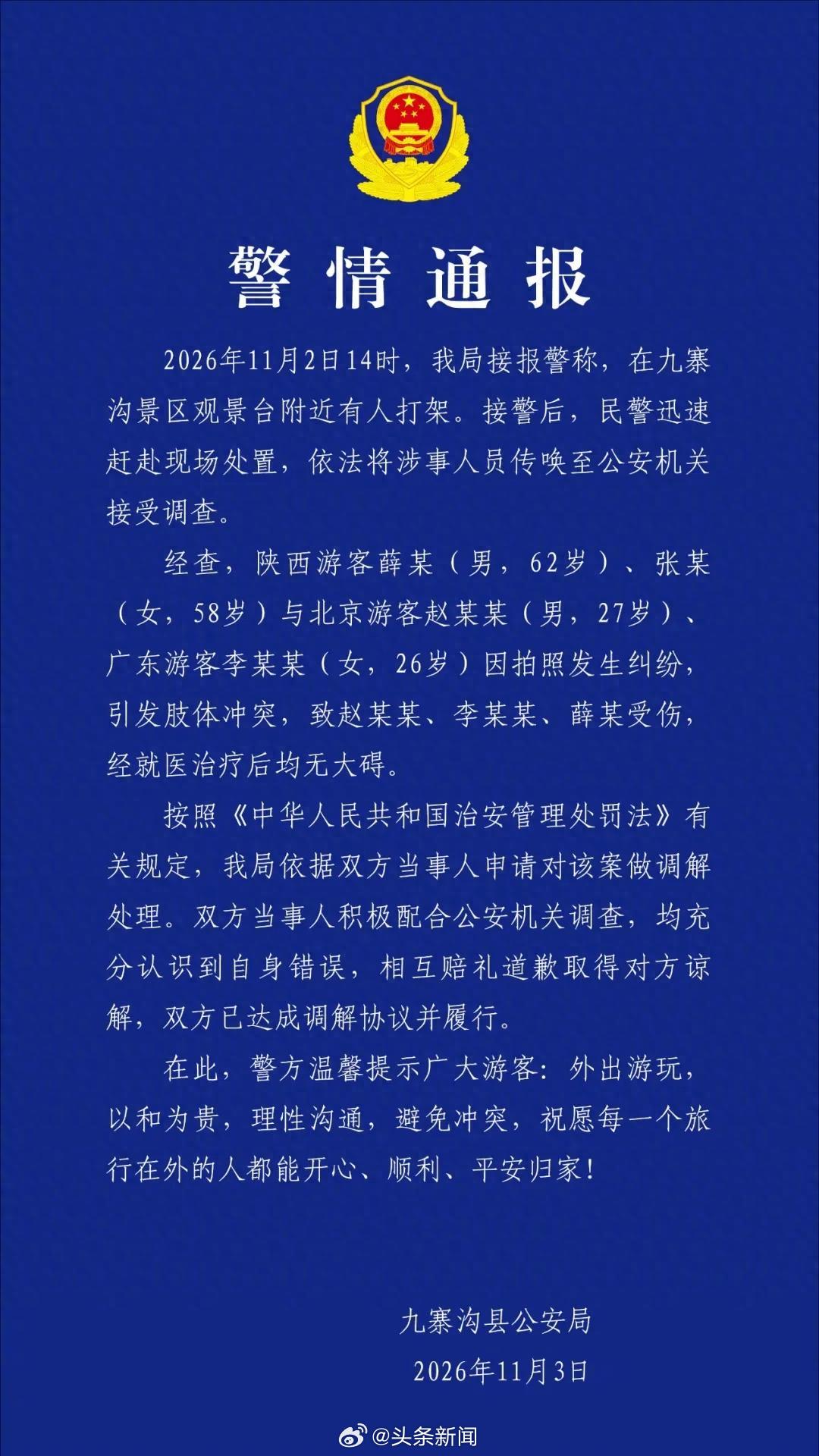
The story has also moved well past Weibo. Zhihu's trending board carries a question on the case — 网传九寨沟一老人被劝阻不要插队后发生打人争执,警方称双方都有责任,最新通报已和解 — and CCTV and The Paper both carried the police notice, as did Caixin's feed.
When 'both sides' reads as one-sided
What many readers cannot accept is the arithmetic of the settlement: a fractured nose, a dozen stitches, an attacker filmed mid-swing, and the file is closed with mutual apologies and no record. A comment liked thousands of times put it in a sentence: whether you can defend the older man depends on what you think mediation is for — keeping the peace, or allocating blame.
The park is back to normal operations; the police notice ends by wishing every traveler a safe and happy journey. The young couple's nose is set and the stitches are in. What the mediation cannot resolve is the question underneath: whether "harmony" is the same as fairness.