Actress Guo Yuxin Accuses Her Agency of Withholding Pay in Fight Over Short-Drama Rights
The actress's point-by-point rebuttal of a breach-of-contract statement — non-exclusive representation, unpaid income, a suit filed in February — puts the contract practices of China's short-drama boom on show.

The dispute between the actress Guo Yuxin and the agency that used to represent her has moved from duelling statements to duelling documents. On Wednesday, after Xinle Film & Culture publicly accused her of taking on film projects and commercial engagements without permission — a serious breach of contract, the company said — Guo published a point-by-point rebuttal on her own verified account, contract screenshots attached, and the rebuttal is now the louder of the two: a statement liked more than 34,000 times within hours.
Her version, in outline: the contract she signed with Dongyang Xinle Film & Culture in September 2024 was never an exclusive one. Its clause 2.3, as she quotes it, lets her perform contracted work herself or through third parties. The company's remit, the two sides agreed at signing, did not cover vertical short dramas or stage plays at all — the fast-growing formats where she has made her name — and she paid the production and promotion costs of her short-drama work herself. As for the money: projects the agency did sign on her behalf paid into its account, and some of those earnings, she says, are still there.
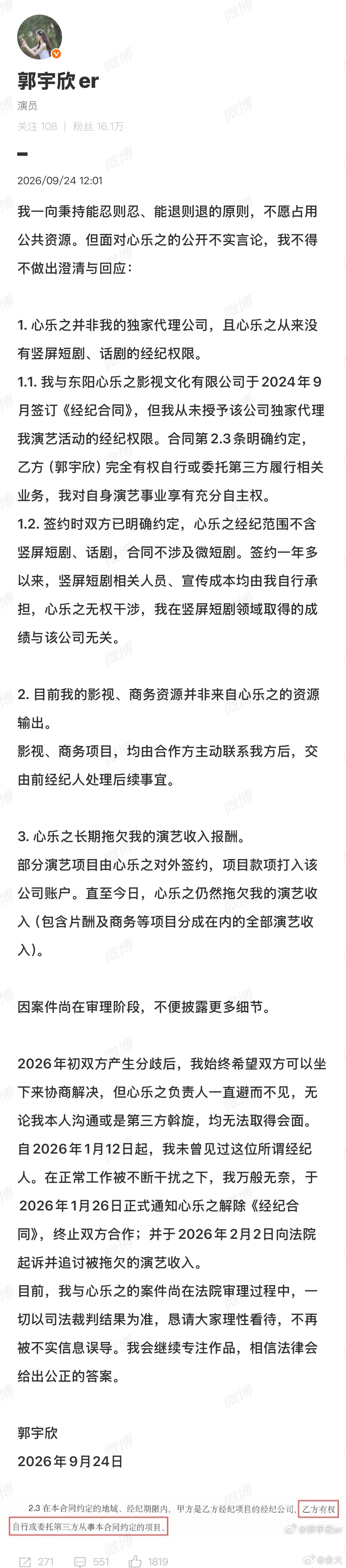
The timeline she lays out reads like a case study in how not to end an artist-management relationship. After disagreements began early this year, she says, she asked to negotiate; the agent she had signed with avoided every meeting, in person or through intermediaries, from January 12 onward. She served notice of termination on January 26 and filed suit on February 2. The company stands by its own account of events; the case is in litigation, and Guo's closing line defers to it: everything, she writes, awaits the court's judgment.
What makes the dispute more than a feud is the industry it lands in. The vertical short-drama business Guo built her career in has become the fastest-growing corner of Chinese entertainment — the giant Red Fruit now outdraws the four big streaming platforms combined — while the agencies around it are still running on contracts drafted for a television-era career. When a contract predates the format that generates an actor's income, the arguments write themselves: who owns a short-drama following the agency never managed, and who holds the money when a project is signed in the agency's name.

Entertainment accounts on Weibo spent Wednesday comparing the two statements line by line, several concluding that her side's documents carried the argument. Whatever the court decides, the case is already a template: an actor with her own audience, an agency with an outdated contract, and a lawsuit that will set the terms for the next signing.