A People's Daily Editor Urges Women to Skip the HPV Vaccine as China's Doctors Push Back
A viral post by a science writer arguing that young people need the HPV vaccine even without a sex life collided this week with a call by Lin Zhibo, a People's Daily bureau chief, for women to skip it — the sharpest episode yet in China's running argument over the cervical-cancer vaccine.
The argument that trended on Weibo this week was compressed into a single phrase: "No sex life means there is still reason to get the HPV vaccine." It began with a post by Zhuang Shilihe, a pharmacist-turned-science-communicator with a large following, who took on a claim that circulates constantly in Chinese parenting and health circles — that a young woman who is not sexually active has no need for the vaccine against human papillomavirus, the cause of nearly all cervical cancer.
"That's the same logic as 'I never leave the house, so how could I catch anything,'" he wrote in a post liked more than 4,000 times. The biggest beneficiaries of HPV vaccination, he argued, are not women in their twenties but girls of twelve or thirteen, before they ever become sexually active — which is precisely why the vaccine works best when it is given early. When a parent asked whether her son, a university sophomore, should be vaccinated, he recommended it: "You can't control who your child will love now or in the future, but the vaccine can protect him." HPV infects men as well as women, and the jab guards against cancers of the throat and genitals, not only the cervix.
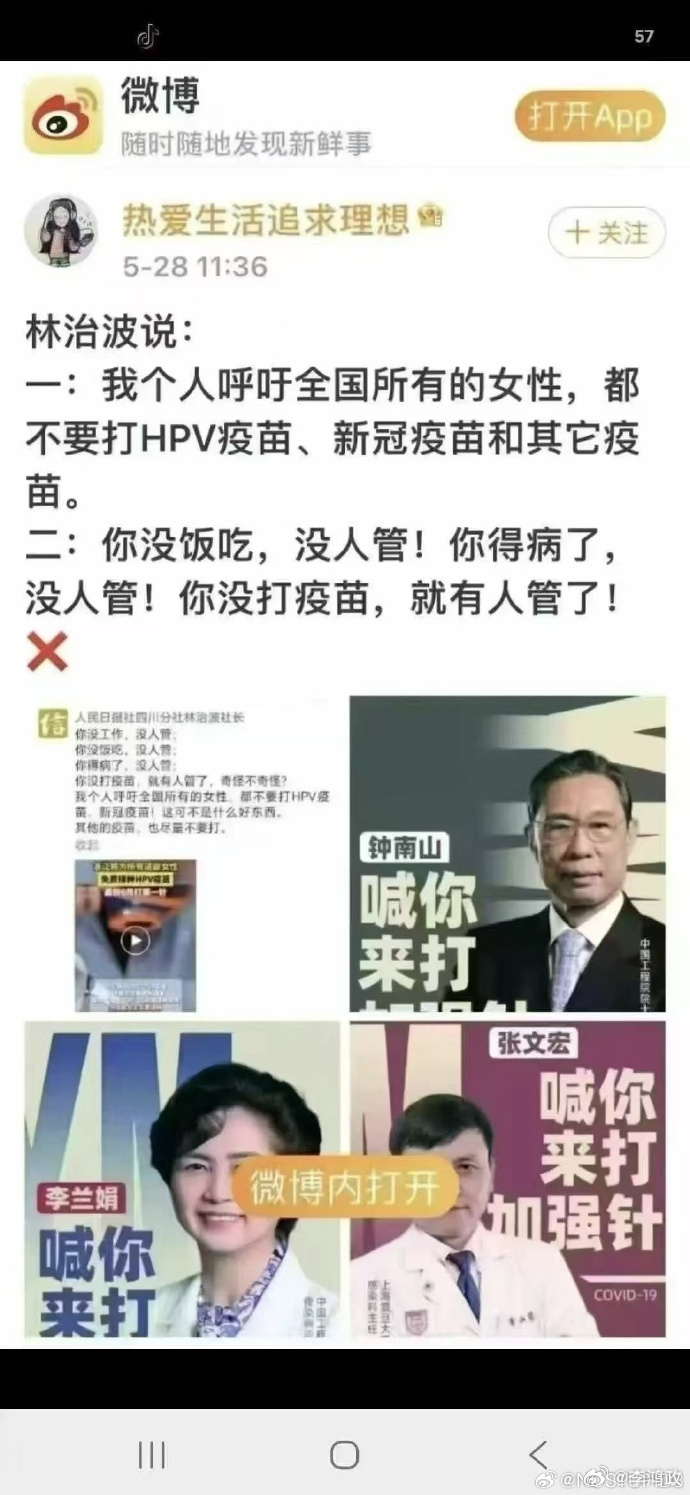
The skepticism he was answering is not a fringe murmur. Another health blogger complained in the same hashtag that pro-vaccine influencers tout the shots "without ever mentioning protection rates or side effects," and recycled years-old Japanese television coverage of girls reporting illnesses after vaccination. And the week's most-watched intervention came from Lin Zhibo, the longtime chief of People's Daily's Sichuan bureau, one of China's most influential newspapers: a widely shared post quoted him calling on "all women in the country" not to get the HPV vaccine, on the sardonic logic that when you have no food, no job or no medical care, nobody manages you — "but if you don't get a vaccine, someone does." The screenshot circulated beside a collage of three of China's most prominent public-health figures — Zhong Nanshan, Li Lanjuan and Zhang Wenhong — all shown urging vaccination, a juxtaposition that was the point.
Baidu's trending board, meanwhile, ran a companion debunk: the claim that vaccination "damages the immune system" is a misconception, its top-ranked explainer insisted — vaccines train immunity, they do not exhaust it.
The debate matters because China's HPV rollout has never had an easy ride. For years the country fought over scarce imported doses — waiting lists, booking lotteries and cross-border vaccine tourism were staples of the late-2010s news — before domestic manufacturers brought prices down and provincial campaigns began offering free shots to schoolgirls. Cervical cancer still kills tens of thousands of Chinese women a year, and the World Health Organization's elimination targets depend on vaccinating adolescents before exposure. Every round of high-profile doubt costs the campaign a season of hesitant parents.
Which is why doctors on Weibo were not treating the trend as trivia. The vaccine's payoff comes decades before its payoff can be seen, in cancers that never develop; the argument over it, meanwhile, is really about whether Chinese parents can talk about their children's future sex lives at all. Zhuang's closing line made that explicit: there is no need, he wrote, to fight human nature.