Fifteen Days After the 'Divorce,' Huawei and Seres Sign a New Five-Year AITO Deal
Huawei and Seres, the Chongqing automaker behind its flagship AITO brand, signed a new five-year cooperation in Shenzhen on September 30 — fifteen days after announcing a restructuring that looked, to China's internet, very much like a divorce. The new deal keeps AITO under Seres's operational control while Huawei supplies technology and its store network, and the speed of the reconciliation has turned the pair's business arithmetic into the week's most-read corporate story.
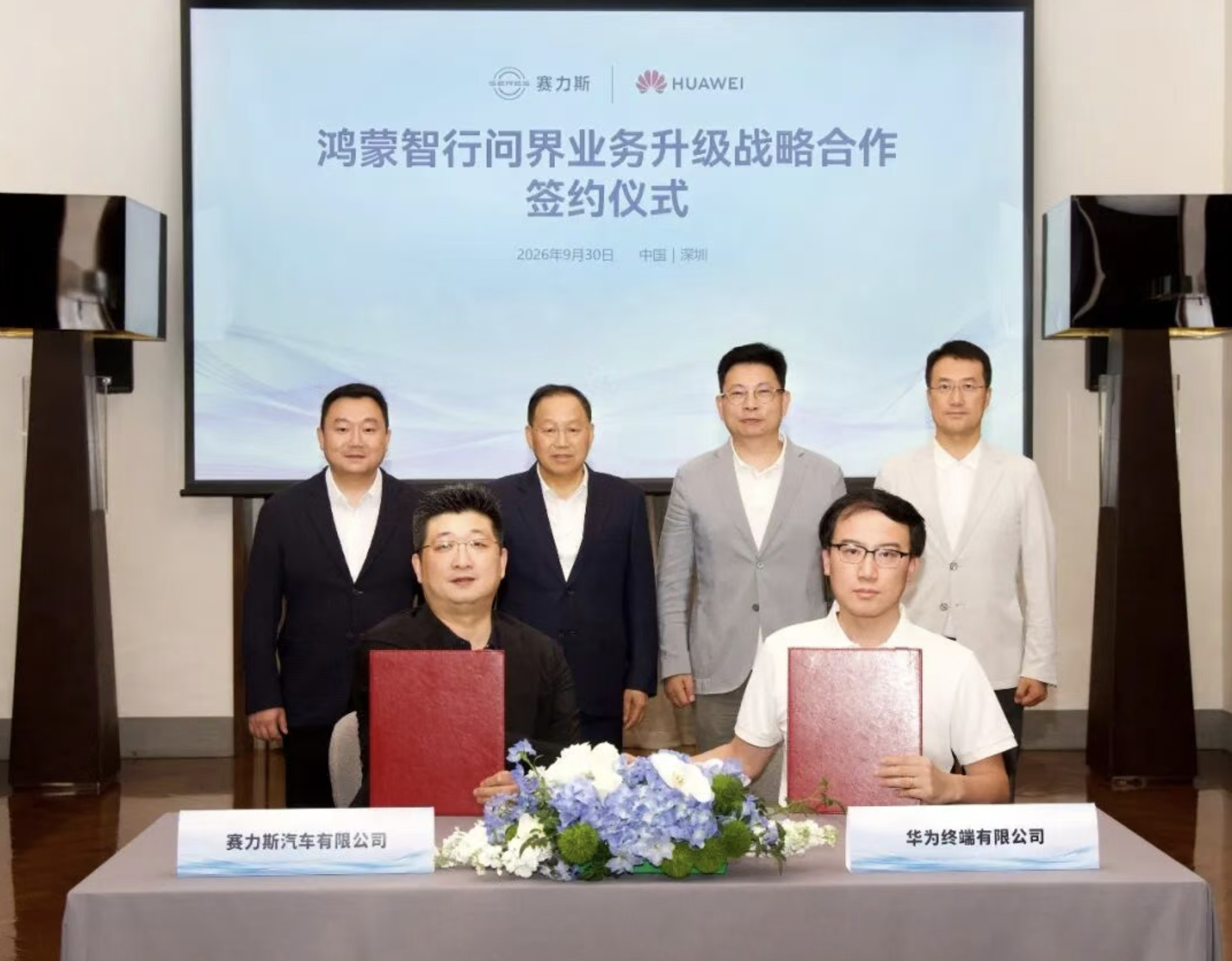
华为赛力斯 复合 — 'Huawei and Seres get back together' — is the phrase China's business internet used all day, borrowing the vocabulary of a celebrity reconciliation for a corporate contract. The facts behind it: on September 15 the two sides announced a cooperation-model change that this site covered as Seres taking the wheel at AITO while Huawei stepped back; for the next fifteen days analysts debated whether China's most successful car-tech marriage was ending. On September 30 they signed a new five-year deal at a ceremony in Shenzhen attended by Huawei's Richard Yu (余承东) and Seres founder Zhang Xinghai, as The Paper reported.
The new structure is called 专属专营 — 'exclusive franchise.' Seres keeps leadership of AITO's product, brand, channels and service, while Huawei's consumer-business arm participates as enabler, and the two will run a dedicated joint AITO team. AITO has surpassed 1.2 million users, the announcement said, with Huawei's broader HarmonyOS Mobility alliance at 1.56 million cumulative deliveries after a September tally of 37,490.
Why reconcile so fast? The most-shared explanation is a cost breakdown that reads like a prenup audit. In the old arrangement, a roughly 400,000-yuan (about $56,000) AITO carried an 8 percent fee to Huawei — near 40 billion yuan (some $5.6 billion) over four years, 'four years of working for Huawei,' as the analysis put it — while Seres lost 1.5–1.8 billion yuan in the first half of 2026, more than 20,000 yuan on every car. Walking away was no cheaper: Huawei's stores are AITO's biggest customer funnel, and the Huawei halo is why buyers pay AITO prices. On Huawei's side, AITO contributes roughly 65 percent of HarmonyOS Mobility's sales — but with Huawei's consumer business recovered to 339 billion yuan a year (about $48 billion), cars are now a profit line, not a lifeline; AI and chips are the existential bets.
The topic sat at No. 1 on Zhihu's question board with 9.35 million heat and trended on Baidu three separate ways on the same day — the deal, the reconciliation question, and who controls AITO now — before the announcement settled it. Commentators read the fifteen-day turnaround as mutual deterrence: as one put it, 'in business there is no remarrying for love, only recalculated costs.' Huawei's own suppliers had already moved to calm buyers during the split week, with a public pledge of continued support, and the company's confidence is on display elsewhere today — it launched the Mate 90 hours after unveiling it.
What the new contract actually encodes: the partner leads its own brand, the tech supplier sells shovels. Whether the other 'jie' partners in Huawei's car alliance copy the exclusive-franchise template is the next thing to watch.