Why Truls Möregårdh Thanked Wang Chuqin for Every Loss
Sweden's Truls Möregårdh has published his autobiography in Chinese just as the WTT China Smash opens in Beijing. The pages racing around Weibo are the ones about Wang Chuqin — written not as score-settling but as a thank-you letter to the man who beat him.
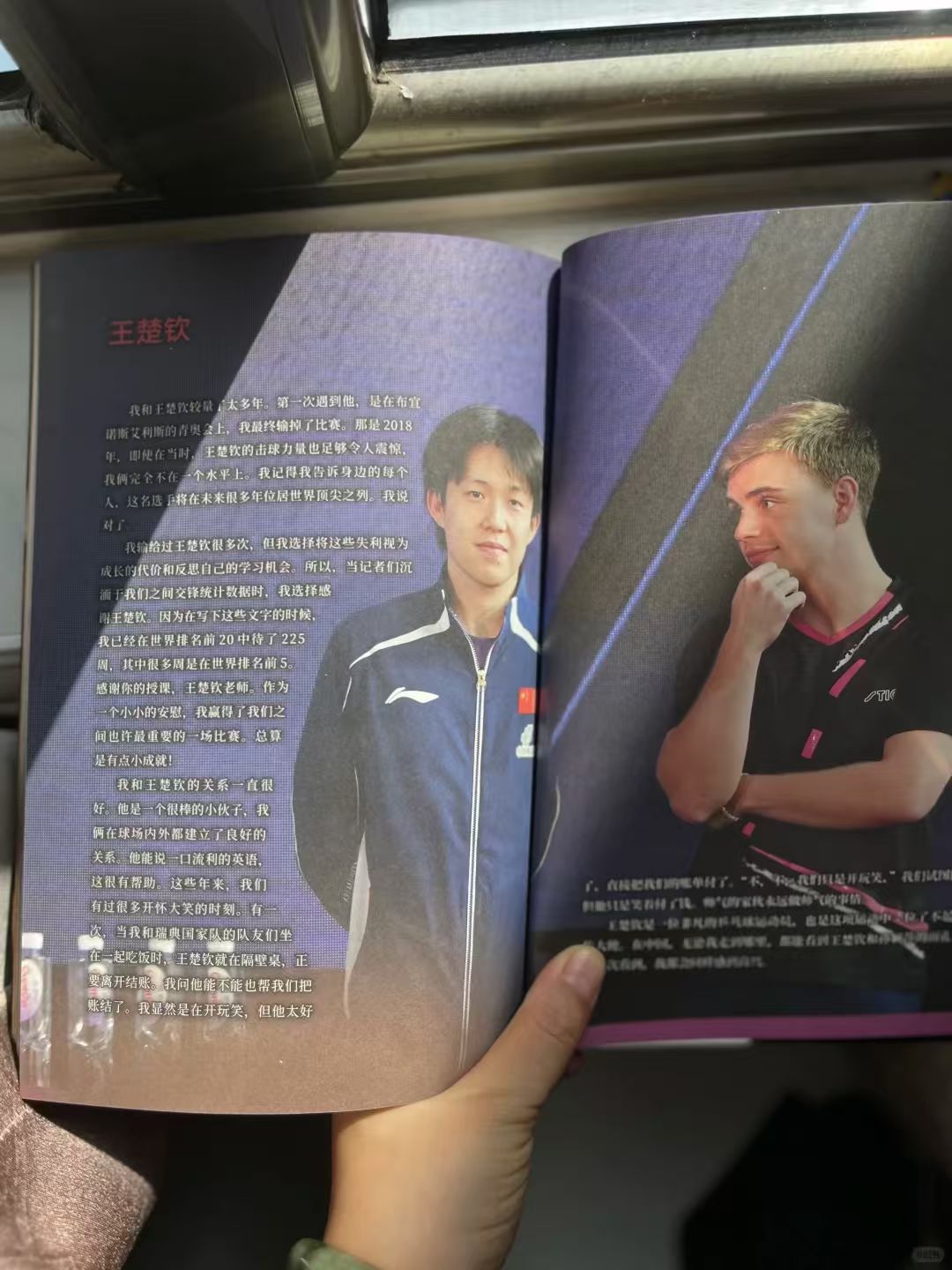
The Swedish table tennis star Truls Möregårdh has done something foreign players rarely do: he has published his autobiography in Chinese first. "The Heart of Table Tennis" (乒乓之心), the translated edition of his memoir "TÄNK SOM TRULS," went on sale this week, and his verified Weibo account announced it bilingually on Friday, promising a chapter written specially for Chinese readers — "My Bond with China" — and vowing to meet fans at the WTT China Smash in Beijing, which began this weekend.
The passage now circulating across Weibo is not about Sweden, or about himself. It is about Wang Chuqin, China's world No. 1 — and it reads as a thank-you letter to the man who has beaten him repeatedly.
Möregårdh dates the relationship to the 2018 Youth Olympic Games in Buenos Aires, where he lost their first meeting. "Wang Chuqin's shots carried a force that shocked me — we weren't remotely in the same class," the book says, in the excerpt fans are quoting. "I remember telling everyone around me that this player would sit at the top of the world for years. I was right."
What has charmed readers is the accounting that follows. "I have lost to Wang Chuqin many times, but I have chosen to treat those losses as the price of growth and as lessons in self-examination," he writes. "So while the reporters stew over our head-to-head record, I choose to thank Wang Chuqin. As I write these words I have spent 225 weeks inside the world's top 20, many of them in the top five. Thank you for the lessons, Teacher Wang Chuqin." (感谢你的授课,王楚钦老师。) The honorific is a joke with a point: in Chinese table tennis, the champions are addressed like masters of a school, and Möregårdh plays along — while noting, as "a small consolation," that he did win the one match he considers their most important.
The timing is delicate. Wang left the Nagoya Asian Games last week with three silvers and no gold, losing the singles final 4-0 in 32 minutes and saying afterward that he could no longer find the joy in playing — a confession that fed a wider backlash against the fan culture pressing on China's stars. Into that mood arrives a rival's public gratitude: a foreign colleague testifying that the losses themselves were worth something.
Chinese readers have received it warmly, and with a quiz. A sports account's poll — which major event was the one where Möregårdh actually beat him? — had fans digging through finals. Baidu's trending board carried an item about Möregårdh gifting a signed copy to Sun Yingsha, the women's world No. 1, as the book tour rolled through Beijing.
Underneath the warmth sits a commercial logic both sides understand: Chinese fandom is the largest table tennis market on earth, and a European star who publishes in Chinese, addresses its champions in its idiom and writes a chapter called "My Bond with China" is courting it deliberately. The book's publishers seeded the print run with randomly distributed autographed copies. Möregårdh, for his part, closed his announcement the way a visiting student would: see you at the China Smash.