Three Forensic Reviews, Three Verdicts: A Maternal Death Case Tests China's Medical-Accident System
A woman died after a caesarean section at a Shandong maternity hospital in 2024. Three successive forensic reviews — district, provincial and national — flipped from 'no accident' to the hospital bearing main responsibility, and this week the penalties drew national attention.
When Zhao Xiuling went in for a caesarean section at a maternity hospital in Zhoucun district, Zibo, in April 2024, her heart and breathing stopped on the operating table. After 52 days of emergency care, the 45-year-old was dead. What followed her death has become the reason half a million people have been reading about her case this week: three official forensic reviews, three different answers.
The district-level medical association in Zibo ruled first that what happened was "not a medical accident". The provincial association disagreed, calling it a grade-one medical accident — the most serious category — with the hospital bearing minor responsibility. In January this year, the national Chinese Medical Association went further: a grade-one medical accident with the hospital bearing main responsibility, finding that multiple failures in care had directly caused her death. The fossilised verdicts, reported this week by Dahe Daily, have drawn more than 12,000 likes and a wave of comments asking the obvious question: how can the same medical records produce three different truths?
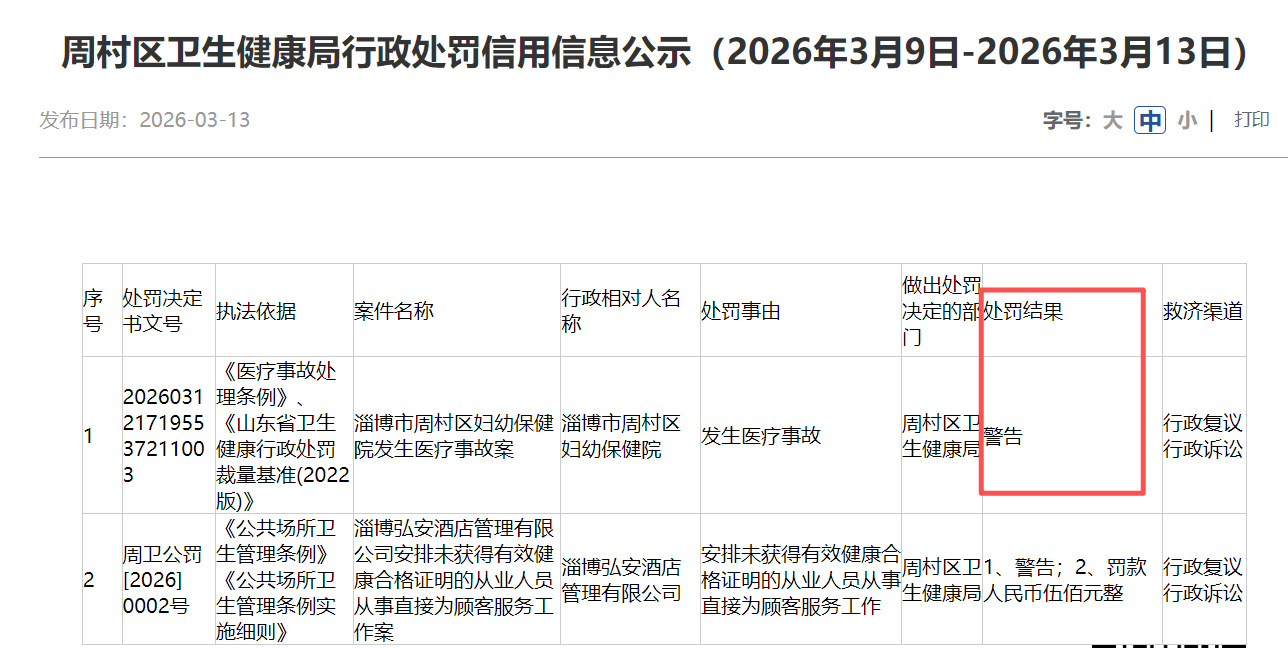
The penalties that finally arrived have done little to settle it. The district health bureau issued the hospital a formal warning — its administrative penalty notice, published by Toutiao News, sits in a corporate-records database between a hotel's fine for staffing without health certificates and a blank fine amount. Three doctors involved were suspended for seven to nine months for violating professional standards. Zhao's husband, Mr Han, told Dahe Daily on Tuesday that the punishment is too light, and that he plans to file an administrative lawsuit against the health bureau's decision.
For an international reader, the case is a window into how China adjudicates medical harm. There is no jury and rarely an early court date: the standard path runs through medical associations — bodies whose members are practising clinicians from the same professional world as the accused — whose verdicts shape both compensation and whether prosecutors ever engage. When lower and higher bodies disagree, the escalation itself becomes the story. Commenters this week openly asked whether local review bodies protect local hospitals; Dahe Daily's own report noted that the three-way contradiction "inevitably raises suspicion of local favouritism".
The argument has also pulled in the wider arithmetic of childbirth. One widely shared comment put it bluntly: "Most people win this gamble. Some people lose everything" — and appended China's own maternal mortality figures, roughly one death per 7,000 births, as context for why the weeks of procedural argument matter. The hospital is a public institution; the warning on its record is, so far, the only institutional consequence. Whether a court weighs the same records a fourth time is the open question the family's lawsuit will force.