Strongest Aftershock Yet Rattles Tibet's Quake Zone as Resettlement Camps Switch On the Lights
Three days after the magnitude-7.0 earthquake in Baqing County, a 5.7 aftershock — the biggest yet — struck as prefab housing came online, a baby was born in the county hospital, and a 12-year-old girl became a medic's indispensable translator.
Three days after a magnitude-7.0 earthquake struck Baqing County in Tibet's Nagqu prefecture, the strongest aftershock yet rolled through the same mountains — and the work on the ground did not pause.
The main quake on October 22, which has so far killed 16 people, was followed by a 4.7-magnitude aftershock at 7:24 p.m. on October 25, at a depth of 10 kilometres — and, seconds behind it, a 5.7 that monitoring centres called the largest aftershock since the earthquake. Seismometers across the border in Qinghai logged it as a 5.6 near Zadoh County, a reminder of how thinly populated and how vast the affected terrain is.
In Mharu township's second village, close to the epicentre, a Xinhua reporter was filing when the ground moved again. The report's framing became the trending phrase: the rescue and resettlement effort never stopped for a moment. By that evening, Global Times reported that the prefabricated housing at the village's resettlement site was fully wired for electricity — no small thing on a plateau where night temperatures near 4,500 metres fall to minus six degrees Celsius, and where more than 5,000 rescuers from firefighting, armed police, military and medical teams have been working in thin air since the first night.
The county's hospitals, meanwhile, screened every pregnant woman in the quake zone for signs of early labour. The screening found one. On October 25 at 1:03 p.m., Baqing County People's Hospital delivered what Chinese media are calling an "earthquake baby" (地震宝宝) — a boy whose mother, from Mharu's third village, was driven to hospital at nine that morning after going into labour, and whose delivery ran into difficulty before doctors brought it to a safe end. Mother and child, the hospital said, are both well.
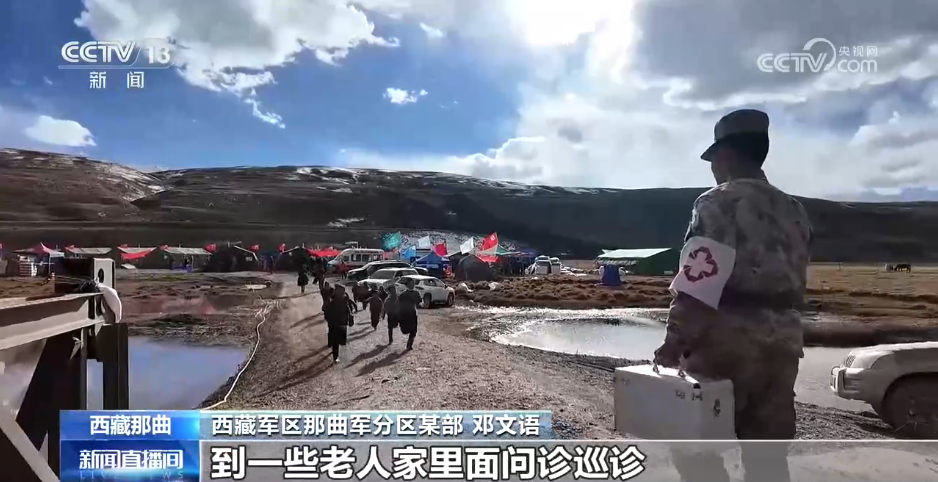
The quieter human story from the resettlement sites is a twelve-year-old. Dejil Zama, a pupil at Mharu township's primary school, has been working as the on-the-spot translator for Deng Wenyu, a military medic who covers the Gelonggai village site — between them, the pair have treated more than 140 residents in the site's first days, and villagers have nicknamed the duo "the best partners."
Rescue, in the formal sense, ended days ago. What continues is the harder-to-film part: keeping 140-odd households warm, fed, monitored and — as of Sunday — lit, on the wrong side of winter.