Kevin Tsai Denies Supporting Taiwan Independence in a Statement Many Read as His Mainland Farewell
The Taiwanese host's Sunday-night Weibo post addressed the rally photo that ended his mainland career — but the sentence his critics demanded, 'I am Chinese,' never appeared, and the hashtag noting its absence trended within hours.
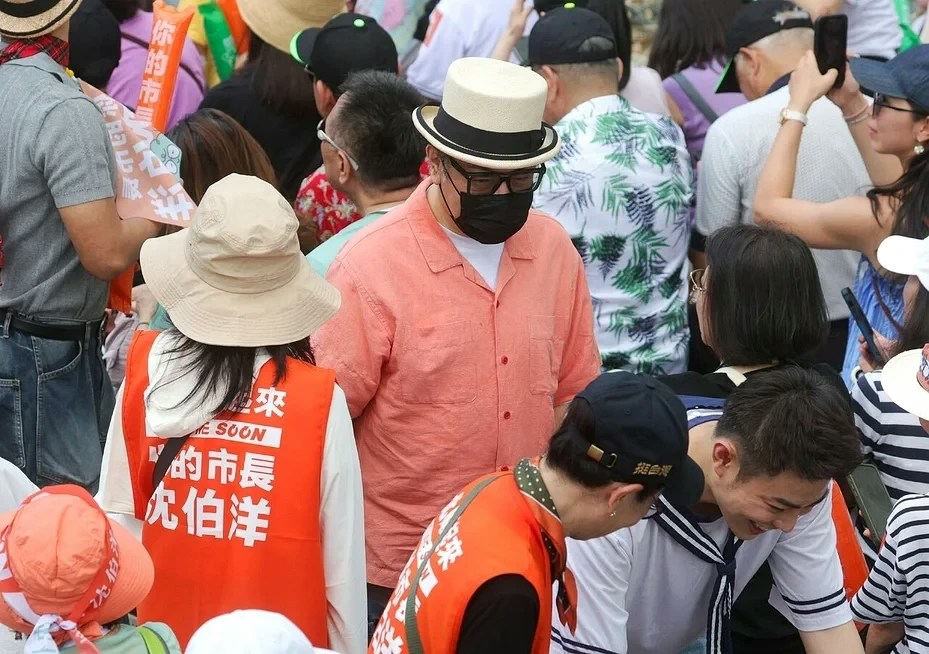
For three weeks Kevin Tsai said nothing. On Sunday night, the Taiwanese host — once the most familiar voice of Chinese-language talk television — finally broke his silence on Weibo, and the statement he posted confirmed what much of his mainland audience had already concluded.
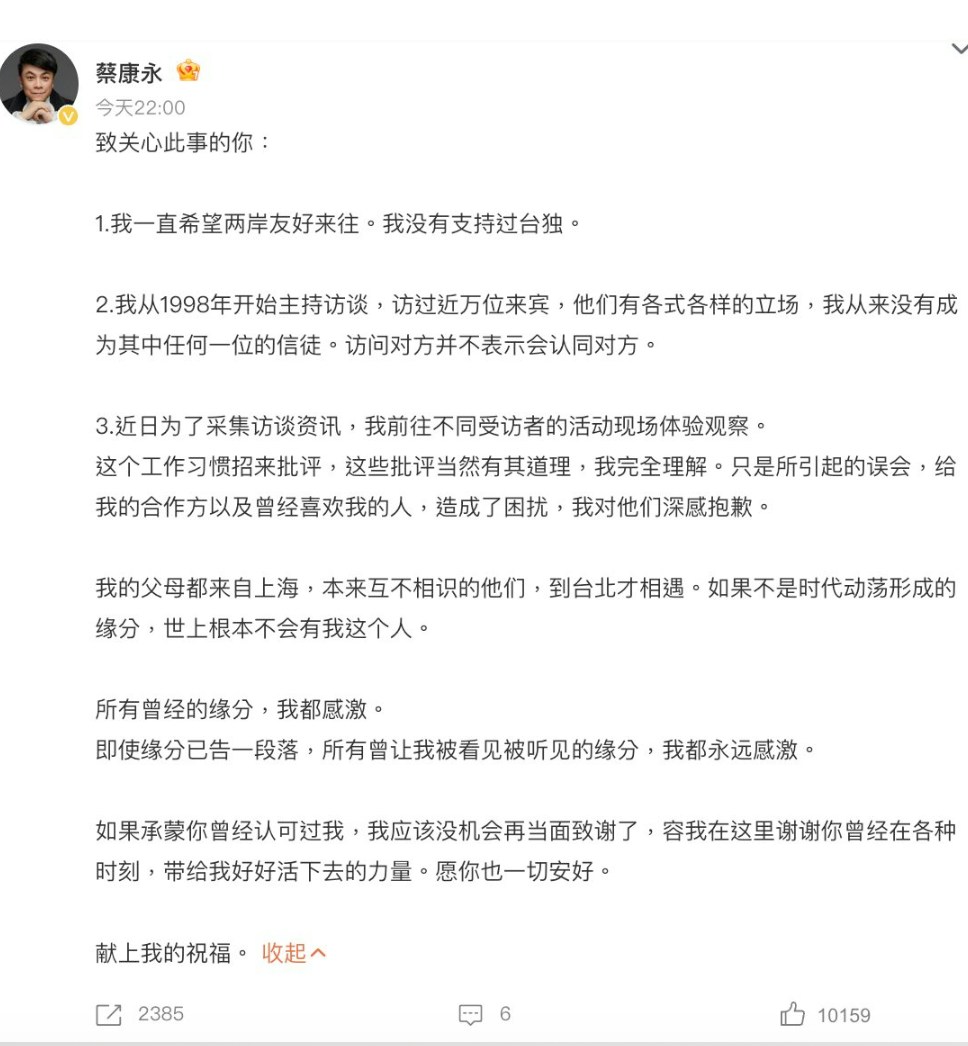
"I have always hoped for friendly exchanges between the two sides of the strait. I have never supported Taiwan independence," Tsai (蔡康永) wrote in a nearly 400-character post. His statement explained that visiting campaign events, the conduct that started the crisis, was simply his working method: in nearly three decades of interviewing he had sat with guests of every political stripe and "never become a follower of any of them." Sitting across from someone, he wrote, does not mean agreeing with them.
Then came the apology — and its careful limits. Tsai was sorry for the trouble the "misunderstanding" had caused his partners and the people who once liked him. He did not apologize for going to the event. His parents, he noted, both came from Shanghai and met in Taipei; "if not for a chance born of a turbulent era, I would not exist in this world." Within hours, the hashtag #蔡康永依旧没有说一句我是中国人# — "Kevin Tsai still hasn't said a single 'I am Chinese'" — was climbing the trending list, one commentator framing the problem precisely: a long post that mentioned only that his parents were Shanghai people, and no sentence his critics could accept.
The road to Sunday's post began on October 4, when Tsai was photographed at the campaign launch of Shen Po-yang, the Democratic Progressive Party's candidate for Taipei mayor — the photograph from which Leapmotor scrambled to cut him loose. Mainland brands ended their contracts, and the Taiwan Affairs Office put his appearance on the record, saying there is "no ambiguity" on questions of separatism.
What he posted instead of a recantation read, to many, as a farewell. Hu Xijin, the former Global Times editor, read it as a soft-toned exit: Tsai apologized for the disturbance, not the act, and seemed to know he would not be hosting mainland variety shows again. The highest-liked replies under the statement urged him to simply "post 'I am Chinese' and be done with it." His post drew more than 36,000 likes — a scale that says less about forgiveness than about how many people showed up to read the ending.
The episode reflects a litmus test now standard for Taiwanese celebrities working in the mainland. Two weeks earlier, Jay Chou's "I am Chinese — what is there to discuss?" earned Beijing's official endorsement; the declarative identity statement has become the proof, and anything short of it reads as evasion.
Tsai's own final lines did sound like a goodbye — blessings, gratitude, no next step. Hong Kong outlet HK01, which has followed the case, noted that he had earlier emptied his Weibo and removed his mainland work contacts, and that he had already accepted an invitation from Taipei's incumbent mayor, Chiang Wan-an of the Kuomintang, to appear at his campaign events. The mainland chapter of a thirty-year career appears, for now, to be closed.