'If I Had to Pay for Training, I Would Never Have Made It': Zhang Guowei Defends China's State Sports System
Retired high jumper Zhang Guowei, who now funds his own comeback through a 70-million-follower influencer career, waded into China's state-versus-self-funded sports debate this week with a defence of the system that raised him — read as a rebuttal to the Liu Xiang retirement fight.
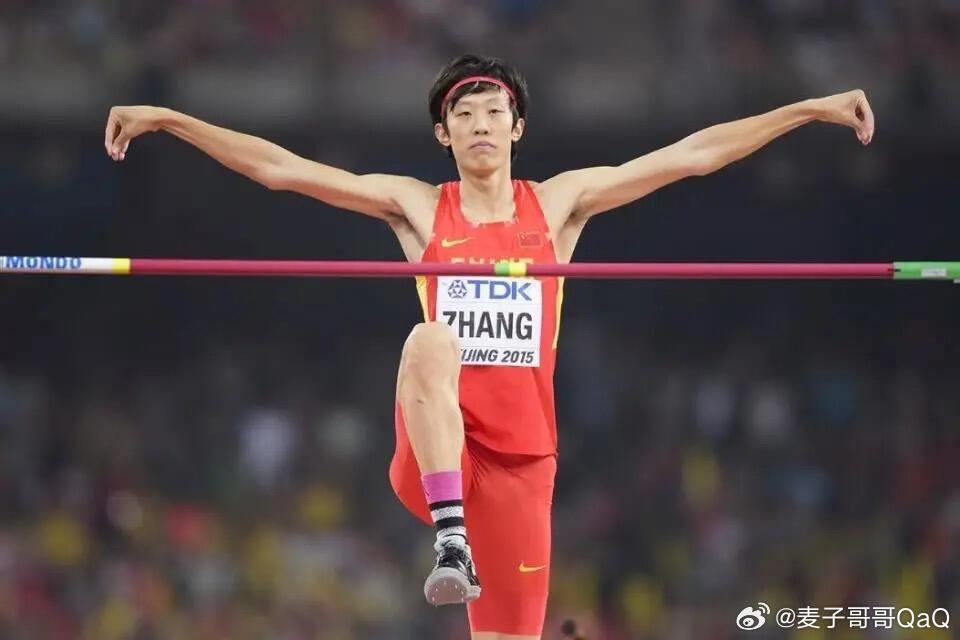
Zhang Guowei has an unusually good vantage point on China's sports system, because he has lived on both sides of it. He was plucked out of Shandong as a teenager and raised to national-team standard on state money, became one of the country's best high jumpers, retired into a second career as a variety-show regular and short-video celebrity — and now funds his own athletic comeback out of that fame, with more than 70 million followers across platforms paying for what the state once did. This week, with China arguing about athlete welfare after the Liu Xiang affair, he posted a defence of the system that made him: "Sports at home and abroad are different. Abroad, you pay your own way. In China, the state trains you. If I had had to pay for my own training, I would definitely not have trained. My family didn't have that money to support me, and I wouldn't have today's achievements."
The timing made it read as an intervention. Liu Xiang — the hurdler who was once the country's most famous athlete — has spent weeks at the center of a public fight over what the state owes a sportsman after retirement, a saga that went from a public dispute over his state coaching post and his 11 years of untouched salary to a quiet buyout and a donation to Tibet schools. Commentators had framed it as an indictment of the whole-country model (举国体制), the pipeline of sports schools and salaried national-team places that produced China's Olympic champions but leaves retired athletes dependent on a placement system few outsiders ever see. Zhang's post, liked some 9,000 times within hours, was widely read as a rebuttal — from a man whose family, he pointed out, would never have paid for the sport on their own.
His second post sharpened the point into an argument about class: "Don't cut off the pathway upward for kids from poor families." The implication is that a pay-to-play system like America's, whatever its virtues, filters sport by parental income — and that a poor child with a gift has one route in China, and it runs through the state.
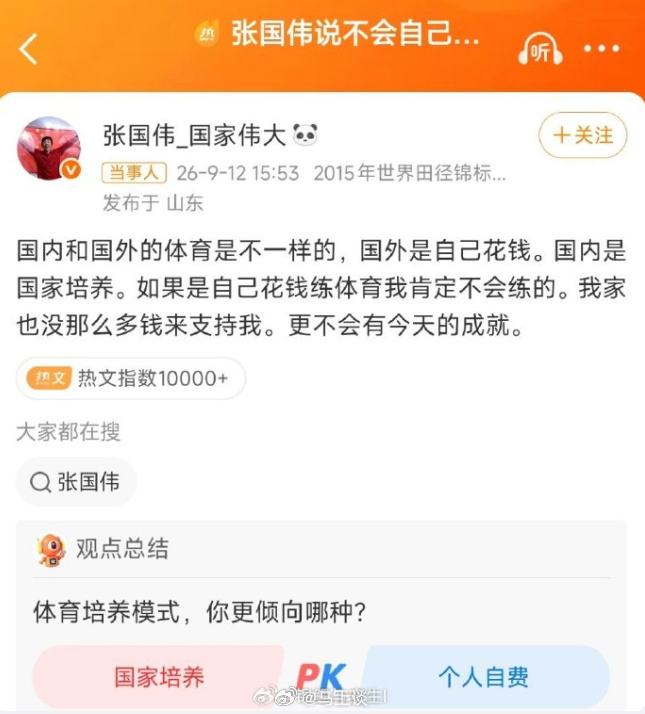
The reply threads have mostly declined to pick a side cleanly, which is itself a measure of how far the argument has moved. A widely shared sports-blogger post laid out the tension in a sentence: Zhang retired from the national team and now trains at his own expense — "high jump is his side business, short video is his main business," using traffic income to keep a jumping dream alive. The blogger invited followers to choose: state cultivation or self-funded training. Others pushed back from the opposite direction — not every child's talent lands where a scout can find it, one popular commenter noted, and for most families the first patron is not the state but a parent willing to plan.
What makes the episode more than a sports debate is that both models now exist in China at once, sometimes inside the same athlete. Zhang is a product of state training who has become the country's most vivid example of the self-funded route — and his argument, which neither side of the Liu Xiang fight has an easy answer to, is that the route he took only existed because the state paid for it first.