China Completes Track-Laying on the 700-Kilometre Chongqing–Kunming High-Speed Line
The last pair of 500-metre rails was set at a tunnel mouth in Sichuan on Friday, completing track-laying on the 700-kilometre Chongqing–Kunming high-speed railway. When the line opens, expected in 2027, it will cut the journey between the two megacities to roughly two and a half hours.
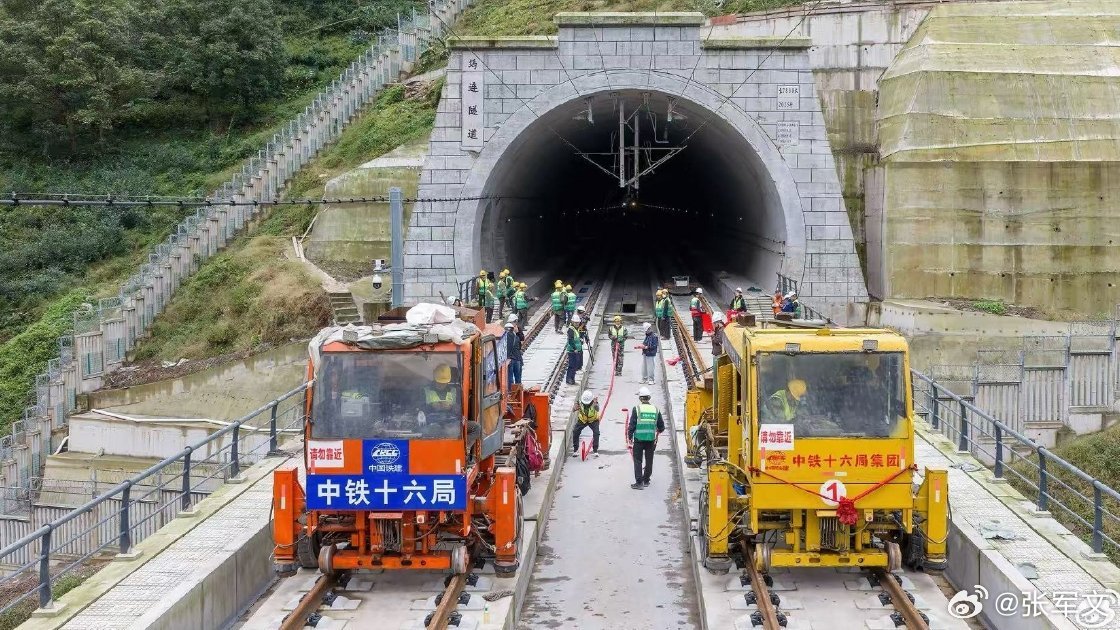
At the mouth of a tunnel in Sichuan on Friday afternoon, the final pair of 500-metre rails was lowered into place, and track-laying on the Chongqing–Kunming high-speed railway was complete. The announcement came from Xinhua, which reported that the line — roughly 700 kilometres long, designed for 350 km/h — now moves into static acceptance and joint testing, the last phases before trains run.
The line is a piece of China's "eight vertical, eight horizontal" high-speed grid — specifically the Beijing–Kunming corridor — running from Chongqing West station through Sichuan and Guizhou into Yunnan, ending at Kunming South. It was built in sections: the Chongqing–Yibin stretch opened in September 2024, and the Yibin–Kunming section is the one that just reached the end of its track-laying. That stretch crosses some of the most fractured terrain on the network, and the project's track-laying lead, Zhang Yan of China Railway 16th Bureau, credited purpose-built systems for long grades, braking and precision alignment with getting the rails down safely through it.
When the line opens, expected in the first half of 2027, it will compress the trip between Chongqing and Kunming to about two and a half hours. On Weibo, the milestone was read less as a construction update than as a redrawn map. One commentator reached for the vocabulary of systems theory, writing that the real story was the "spatial-temporal compression" of China's southwest: a physical distance dissolving into a train timetable, with consequences for how people and money move between the Chengdu–Chongqing economic circle and the cities of central Yunnan. Another offered the gentler image of a camera snapping into focus, a blurred map of the southwest suddenly sharp.
The milestone also fits a pattern that has become ordinary in China and remains startling elsewhere: a 700-kilometre line through mountains, announced, financed and built within a decade. As the pace of China's fastest services has risen — the railway has even introduced a new X prefix for trains that run above 350 km/h — the gap between a line's track being laid and its trains running has become the only real waiting left. For the Chongqing–Kunming line, that wait now runs through testing and trial operation, with a 2027 opening at the end of it.