China's Railways Add an X Prefix for Trains Faster Than 350 km/h
From late November, China's national railway starts issuing train numbers with a new letter — X, for 'xin', new — reserved for Fuxing bullet trains that will run faster than today's 350 km/h flagship services.
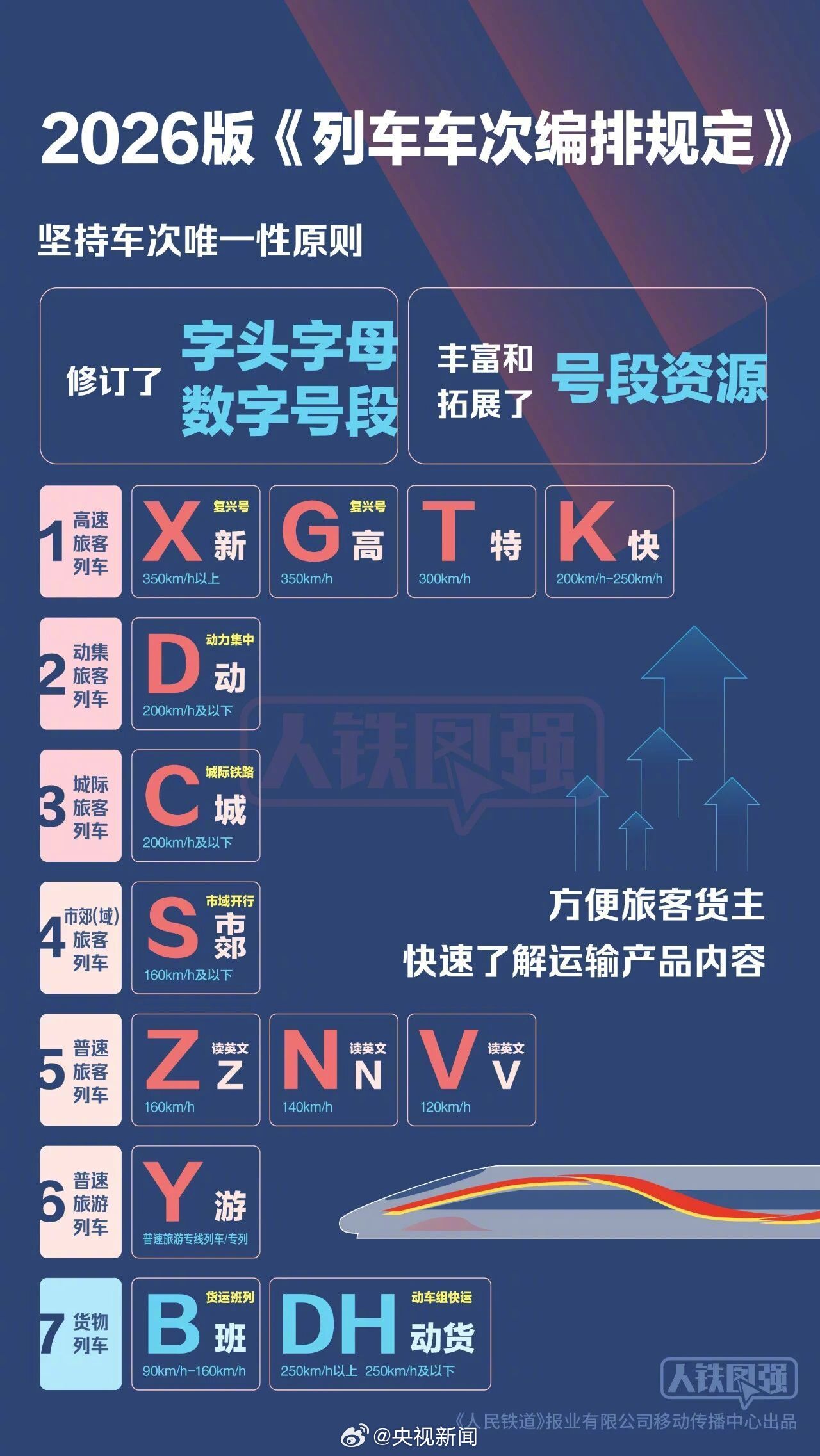
China's national railway is making room in its timetable for trains that do not exist yet. In two batches, from late November through December, the network will adopt a new edition of its train-numbering rules — and the headline change is a new letter: X, read as xin (新), for "new," reserved for Fuxing bullet trains rated above 350 km/h, bookable as X1 through X9998 (@央视新闻).
A Chinese train number is a spec sheet the whole country can read. G, for gao (高), is the 350-km/h flagship service; T, for te (特), runs up to 300; K, for kuai (快), between 200 and 250; D, for dong (动), at 200 and below; C covers intercity lines, S suburban ones. The letter tells a traveler, before any timetable is opened, roughly how fast the journey will be and how it will feel. The recast raises the number of bullet-train prefixes from four to seven and expands the bookable number space by nearly 40 percent.
The reason is arithmetic. Between 2014 and 2025, the fleet of 300–350 km/h trainsets grew from 1,018 to 3,149 standard sets — up 209 percent — on a network that also moved a record number of trips over the Golden Week holiday (A Record Golden Week on the Rails). At May Day and National Day peaks, G-prefixed services already claim more than 90 percent of the available G number space, and new lines and new sets keep arriving. The old alphabet ran out of room; the new one has numbers to spare.
What makes X more than housekeeping is what it is reserved for. No commercial passenger service in China currently runs faster than 350 km/h; officials describe the new prefix as covering "future" Fuxing sets above that mark. The letter is being minted ahead of the trains that will wear it — the number space is being prepared before the fleet that fills it arrives.
CCTV News turned the decoder into a graphic that spread widely on Weibo (@央视新闻), and the change reached Zhihu's front page, where readers debated what a reshuffled alphabet means for the person holding the ticket (Zhihu). For travelers the practical change is nil for now: routes, stopping patterns and timetables are unchanged; only the designations move. The first X numbers are issued in the November batch — empty slots in the numbering system, waiting for trains still being tested.