JD Pledges to Back Its Employee in a Defamation Suit Brought by Douyin
A procurement employee's WeChat posts accusing a rival platform of rigging its trending topics have drawn a defamation suit from Douyin — and a company-wide promise from JD.com to help him sue back, as China's e-commerce giants head into the Double 11 shopping festival.
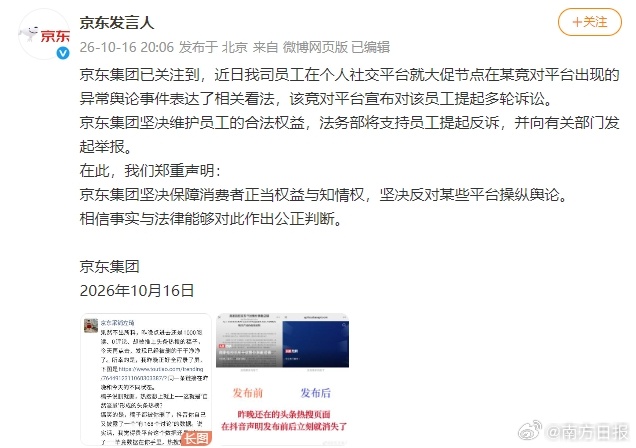
A defamation suit Douyin filed against a single JD.com employee turned into a corporate standoff on Friday evening, when JD's official spokesperson account announced that the company's legal department would support the man's counterclaim — and report the rival platform to the authorities.
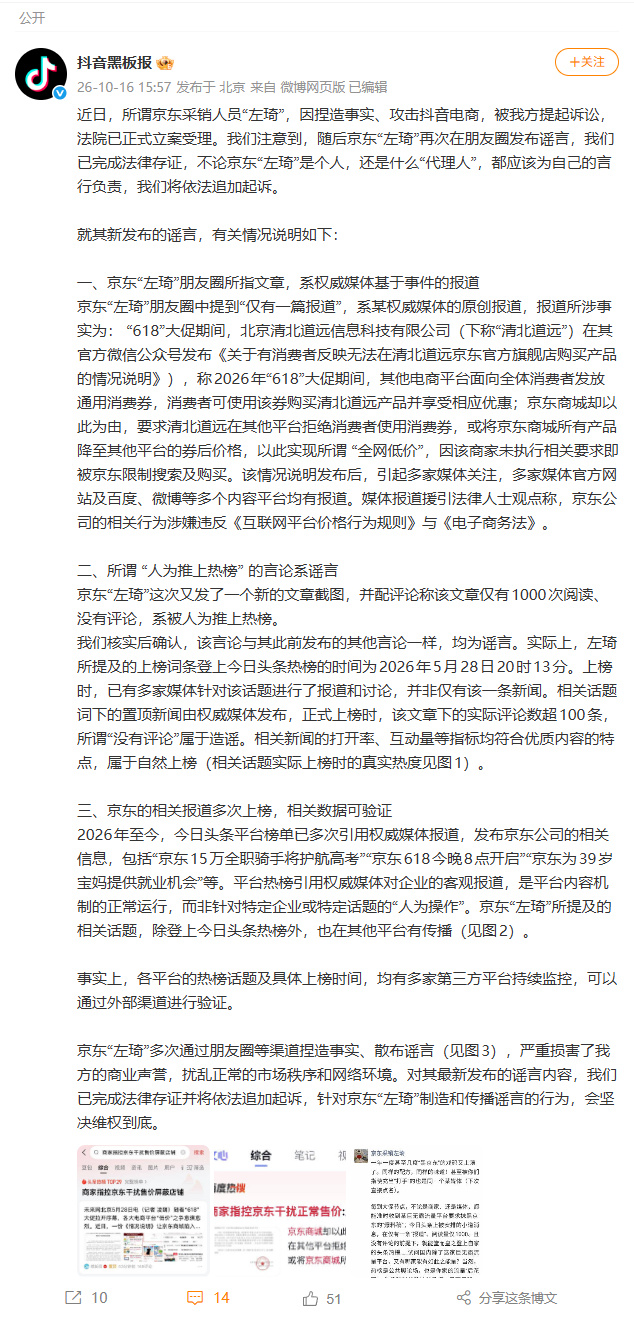
Douyin's governance account, Douyin Heibanbao (@抖音黑板报), had announced hours earlier that a court had formally accepted its case against a JD procurement staffer it names as "Zuo Qi," whom it accuses of "fabricating facts and attacking Douyin e-commerce" in posts on WeChat Moments. When Zuo Qi posted again, the statement said, Douyin notarized the new material as evidence and will "pursue additional lawsuits" — whether he acted for himself, or as someone's "agent."
JD's reply (@京东发言人) recast the employee as the injured party: the company "firmly safeguards employees' lawful rights," would have its legal department back his counterclaim, and "firmly opposes certain platforms manipulating public opinion." The statement closed with an appeal to "facts and law."
The quarrel long predates the lawsuit. Douyin's own statement traces it to the June 618 shopping festival, when a Beijing education-products seller said publicly that JD had asked it to block consumer coupons issued on other platforms — or to match their discounted prices on JD — to protect JD's "lowest price online" positioning. A national outlet reported the seller's account; Zuo Qi's viral posts waded into that fight, and Douyin maintains they distorted it.
Who is right about June will be litigated. What October is about is bigger: the year's largest shopping festival, Double 11, is days away, and each platform runs the trending charts and recommendation feeds through which hundreds of millions of shoppers decide where to spend. Each side's core accusation is the same — that the other manipulates the field before the whistle. The story has broken past Weibo's e-commerce circles onto Baidu's trending board, where JD's pledge to back its employee charted on its own (Baidu).
Onlookers mostly enjoyed the theatre. "JD and Douyin are going at it on Weibo in the middle of the night," one widely shared post observed. "Weibo never did make e-commerce work — but as a battlefield, business is booming" (微博电商搞不起来,但是微博战场依旧生意红火) (@午后狂睡).
Under the spectacle sits a question with consequences beyond the two platforms: how much of an employee's personal social-media speech belongs to his employer — and how far a company will go to underwrite it. JD has committed to the maximal reading. A court will eventually say whether it holds.