China Moves to Add AI, Biotech and Solar Technologies to Its Export-Control Catalogue
The Ministry of Commerce and the Ministry of Science and Technology opened public comment on a revision of China's catalogue of technologies prohibited or restricted from export, with new entries expected in artificial intelligence, biomedicine and photovoltaics. Exports of the technologies proposed for addition face temporary registration from now, and the ministry is already reassuring the world that most AI technology will remain freely exportable.
China took a step on Friday toward extending its export-control regime to three of its most competitive industries. The Ministry of Commerce and the Ministry of Science and Technology announced they are soliciting public comment on a revision of the Catalogue of Technologies Prohibited or Restricted from Export, and that entries are expected to be added covering some artificial-intelligence, biomedicine and photovoltaic technologies. Until the revision is settled, exports of the technologies proposed for addition will be subject to temporary pre-export registration — a signal, analysts noted, that the government does not intend the comment period to become a gap period.
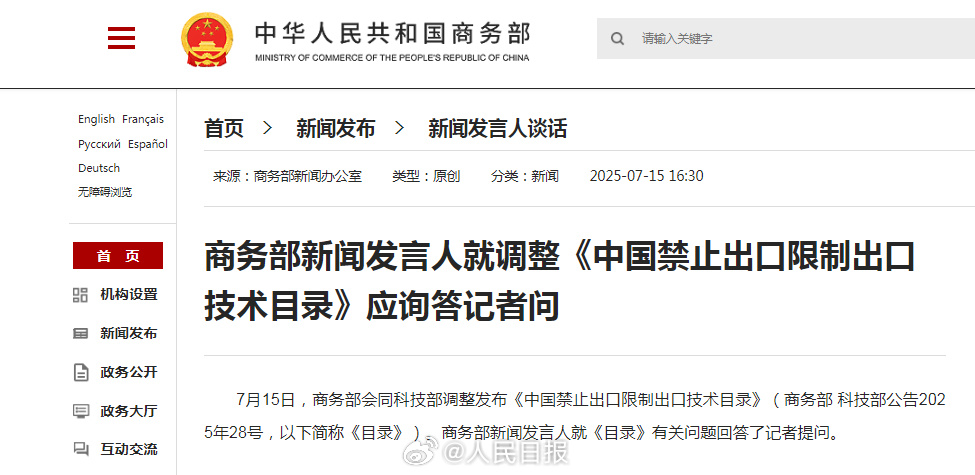
The catalogue is the legal spine of Chinese technology export control. Technologies on the prohibited list may not be exported at all; those on the restricted list require licences; everything else flows freely under contract registration. It dates to 2001 and has been adjusted only a handful of times — 2008, 2020, 2023 — which is why each revision draws attention. A People's Daily post laying out the last adjustment, in July 2025, walked through the mechanics in detail: that round deleted traditional-architecture entries, and added battery cathode-material preparation techniques — lithium iron phosphate among them — plus five lithium-extraction control points, on the reasoning that these materials were "increasingly applied in sensitive fields".
A toolkit with a track record
The catalogue's recent history sketches how Beijing uses it. In December 2023, China revised the catalogue to cover rare-earth extraction and magnet-making technology, prompting the foreign ministry to defend the move as China exercising its rightful management — the rare-earth revision landed amid US chip-export curbs and was widely read as a reply in kind. The 2025 battery-and-lithium additions came as Chinese EV and battery makers held commanding global positions. Adding AI, biomedicine and photovoltaics would extend the same logic to the industries where China now sets the pace — solar manufacturing in particular.
The reassurance, delivered early
Anticipating how the move will be read abroad, the ministry's spokesperson addressed it directly in a question-and-answer session on Friday. Once the measures formally take effect, the spokesperson said, the vast majority of AI technologies will remain freely exportable, and China advocates dialogue and cooperation with all countries on artificial intelligence on the basis of mutual respect and mutual benefit. Asked about the temporary registration requirement, the ministry framed it as ensuring orderly management while the revision proceeds.
The story moved fastest on financial and state media — it was on CCTV, Huanqiu and Yicai within hours, though it had not cracked the Weibo trending board by evening. That may change as the comment period fills in the specifics; the question the revision leaves open, and the one foreign firms will read most carefully, is exactly which AI and biotech entries land on the lists, and how far "the vast majority" extends.