China Writes the Rulebook for Making Brands Visible to AI Chatbots
On Sept 14, China's advertising industry published five group standards for Generative Engine Optimization (GEO) - the business of getting brands accurately represented in AI chatbot answers. The move targets a chaotic market of vague promises and six-figure fees, and signals that AI answers are becoming China's new consumer gatekeeper.
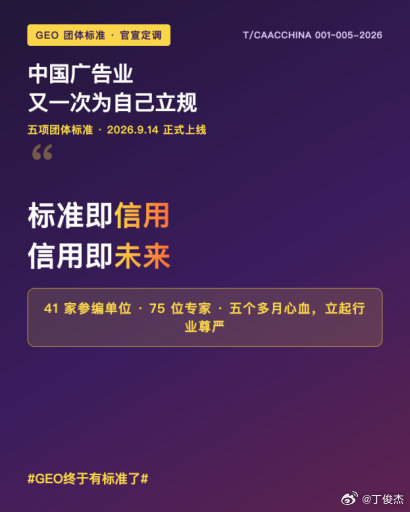
Ask three Chinese agencies what "GEO" is and you will get three different answers — one offered to carpet social platforms with content, another to build walls of official-sounding source material, a third hinting at a secret algorithmic backdoor into AI recommendations. On Sept 14, China's advertising industry moved to end the guessing: five group standards for Generative Engine Optimization — the craft of making a brand visible, and accurately described, inside AI chatbot answers — were published on the national group-standards registry, the product of five months' work by 41 organizations and 75 specialists (丁俊杰).
The reason the category exists at all is a shift many Chinese consumers have already made without noticing. The mental habit of typing "best value phone 2026" into a search box and clicking through links is giving way to asking an AI assistant directly: budget of 3,000 yuan, office worker, long battery life, good camera — and receiving a tidy comparison table, foundation shades included, in seconds (云游互联网). For brands, that convenience is a threat. In the search era you could at least look up your ranking; if an AI answer omits your product entirely, or states your specs wrong, you may never find out — while customers make decisions based on the error.
Enter an industry that, by its own admission, ran wild. One marketing writer's much-shared account of the mess describes a consumer-goods company that paid a six-figure sum for GEO services, with the vendor offering nothing as proof but screenshots of AI chats mentioning the brand. When the client tested different models and phrasings, the AI contradicted itself — praising the product's design one day, its value the next, sometimes naming no reason at all, and forgetting the brand entirely a week later. The vendor's defense: models update constantly, mentions can be guaranteed but not how, and not for long (互联网新分析).
The new standards attack that fog on five fronts: a shared vocabulary, a typology of vendors, pricing norms, measurable outcome criteria, and — the part its advocates stress most — a definition of "trusted corpus," the pool of material an AI may legitimately draw on. The vendor typology alone reframes the market: content production, source-building, technical monitoring, strategy consulting, data measurement, full-service — no longer one vague trade, but six distinct specialisms, on the logic that a provider who can write copy is not thereby qualified to reverse-engineer a large language model.
There is something distinctly Chinese in the remedy, too. Rather than awaiting government regulation, the industry regulated itself through the group-standards system — a mechanism for industry associations to set quasi-official norms — with an advertising association official framing it as the sector "setting rules for itself" and insisting that "standards are credit, and credit is the future" (丁俊杰).
The stakes reach past marketing departments. As conversational AI becomes the entry point for consumer decisions in China, the question of who supplies the "trusted information" AI answers are built from — and whether that supply chain is auditable — becomes a question about the integrity of the answers themselves. Whether a voluntary standard can discipline a market whose core excuse is that the models change daily is the test the industry has now set for itself.