China's Biggest Livestreamer Just Sold Two Trillion AI Tokens in Half an Hour
During the Double 11 shopping festival, Li Jiaqi — the 'Lipstick King' of Chinese livestream commerce — added AI compute to his cart lineup. A hundred thousand monthly memberships of Qwen Office, worth about two trillion tokens, sold out in thirty minutes, with the product's CEO working the livestream himself.
The strangest item sold on Chinese livestreams this shopping season is not a lipstick or a Louis Vuitton bag. It is computing power, priced in trillions.
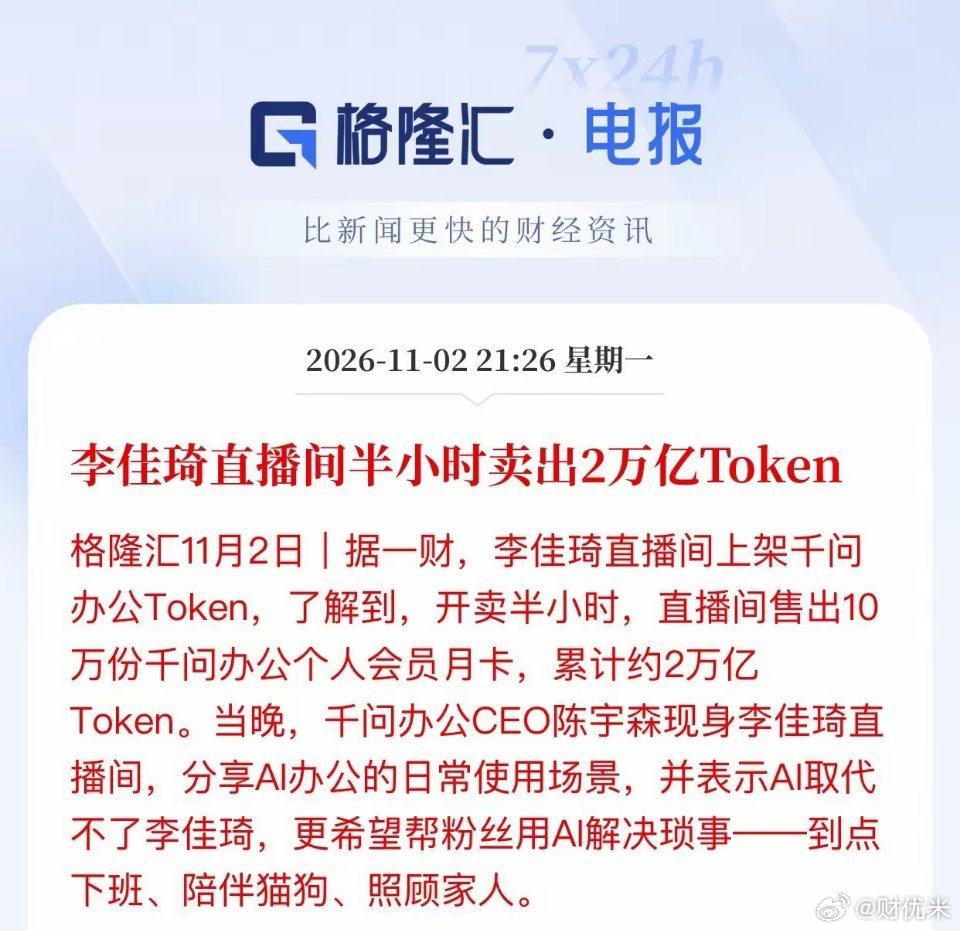
On the evening of November 2, as the Double 11 festival gathered speed, Li Jiaqi — the cosmetics host once known nationally as the "Lipstick King" — put Qwen Office, an AI productivity suite, into his livestream's lineup. As Yicai Daily reported, the session sold 100,000 personal monthly memberships in half an hour, amounting to roughly two trillion tokens of AI usage. Chen Yusen, the product's CEO, appeared in the studio himself to walk viewers through AI office scenarios — an executive doing a live product demo in the same room where merchants once hawked mattresses at midnight discounts.
A token, for readers who have not bought one, is the raw unit of AI consumption: the fragment of text a model reads or writes. Chinese AI companies bill by the token, trade by the token, and now, it turns out, flash-sale by the token. China's compute industry already sells tokens across borders, a trade its participants call "invisible". Li Jiaqi's livestream shows the same commodity being merchandised at home — subscription cards sold in the same session flow as skincare sets, with countdown timers doing the persuading.
The market read it instantly as a signal. Within minutes, Gelonghui's wire-style alert service was flashing the headline "Li Jiaqi's livestream sells 2 trillion Tokens in half an hour," and a screenshot of the alert shot across Weibo's finance accounts, where commentators declared AI applications the sector to watch when markets opened the next morning. The item had trended on Baidu's board by nightfall.
What Chen Yusen was selling, beyond the cards, was a theory of what ordinary Chinese want from AI. "AI cannot replace Li Jiaqi," he told the camera — the machines' job, he said, is to clear away drudgery so that fans can "get off work on time, spend time with the cat and dog, look after family."
That framing says something about the moment. China's AI products have been racing to find a mass-market consumer story, and the country's most efficient sales channel just demonstrated one: not chatbots that write poetry, but a domestic assistant that shortens the workday. Two trillion tokens in thirty minutes is, by any measure, an audience vote.