Hangzhou Police Say the Viral Elevator Attack Was a Neighbor Dispute Over a Dog
Hangzhou police have said a viral elevator video was a dispute over a dog, not a crime: the woman who claimed molestation is now under investigation for publishing false information, while the man she accused faces no penalty.
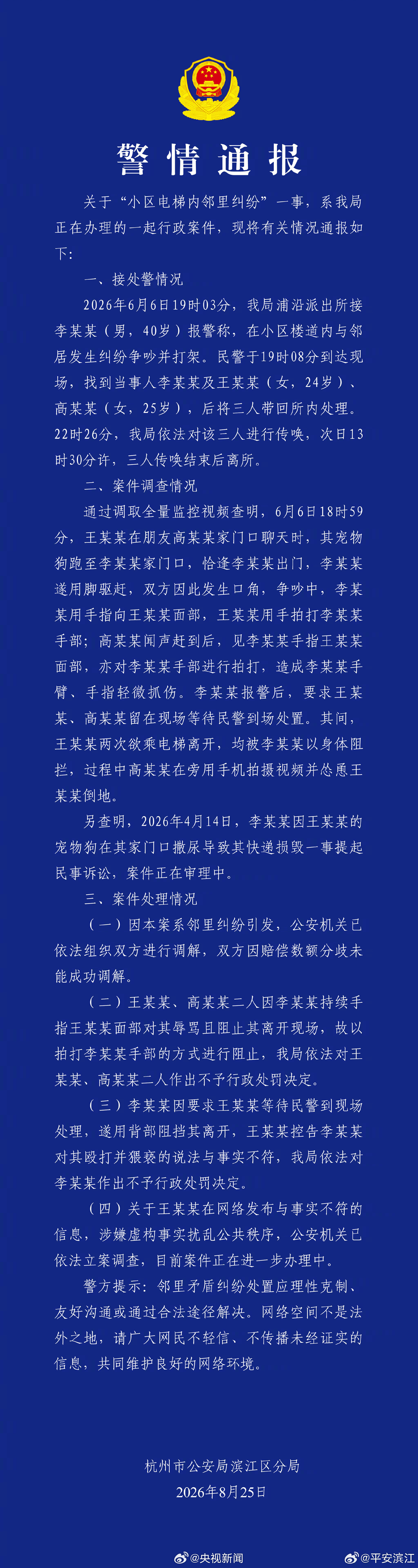
The viral video looked unambiguous: a young woman in a Hangzhou apartment block, cornered in an elevator and filming while a man blocked her way. She said he had molested her, and that when she scratched him in self-defense he demanded 5,000 yuan. By the time Hangzhou's Binjiang district police published their findings, the story had become a national test of who you believe when the evidence is a shaky phone video.
The police version of June 6, reconstructed from full surveillance footage, is almost banal. A 24-year-old woman's pet dog ran toward a neighbor's door as he was leaving. The 40-year-old man kicked at the dog, words followed, and he pointed his finger at her face, according to the notice. She swatted his hand away; a friend arrived and did the same, leaving scratch marks on his arm and fingers. What felt like an assault to her, police concluded, was "a neighborly dispute triggered by a pet." The women were not penalized for the slaps; the man was not penalized for using his back to block the elevator—the action she had described as assault and molestation.
The ruling that matters sits at the end of the notice. The woman "fabricating facts to disrupt public order" by posting her account online is now under formal investigation. The man, meanwhile, had already sued over damage to a parcel caused by the dog in April. Both of them were coming to that hallway with history, and neither, police say, committed the crime the internet assumed.
The episode is a clean specimen of the reversals that now punctuate Chinese social media every month or two: a first-person accusation published with a video, millions of sympathizing shares, the target's address and workplace leaked, then an official finding that drains the story of everything it appeared to be. Commentators have argued that false claims are cheap, while the reputational harm of being named before any investigation is permanent. One poster put the cost plainly—before any correction, the man's personal information had already circulated online.
What Hangzhou leaves open is a question China's platforms have not resolved: when a short video becomes the whole case, who answers for the gap between what a clip appears to show and what the records establish? The Binjiang report is an anchor dropped into fast-moving water. The woman's case now proceeds, and the public that once shared her video has to decide whether its sympathies can be rewound as quickly as a post.