Both Families Thought They'd Struck Gold: A Blind-Date Story Reignites China's Marriage Debate
A love story in which every relative arrives with cash has gone viral for a reason that has little to do with romance: in China's marriage market, a Shanghai flat and a master's degree are the two currencies being weighed against each other.

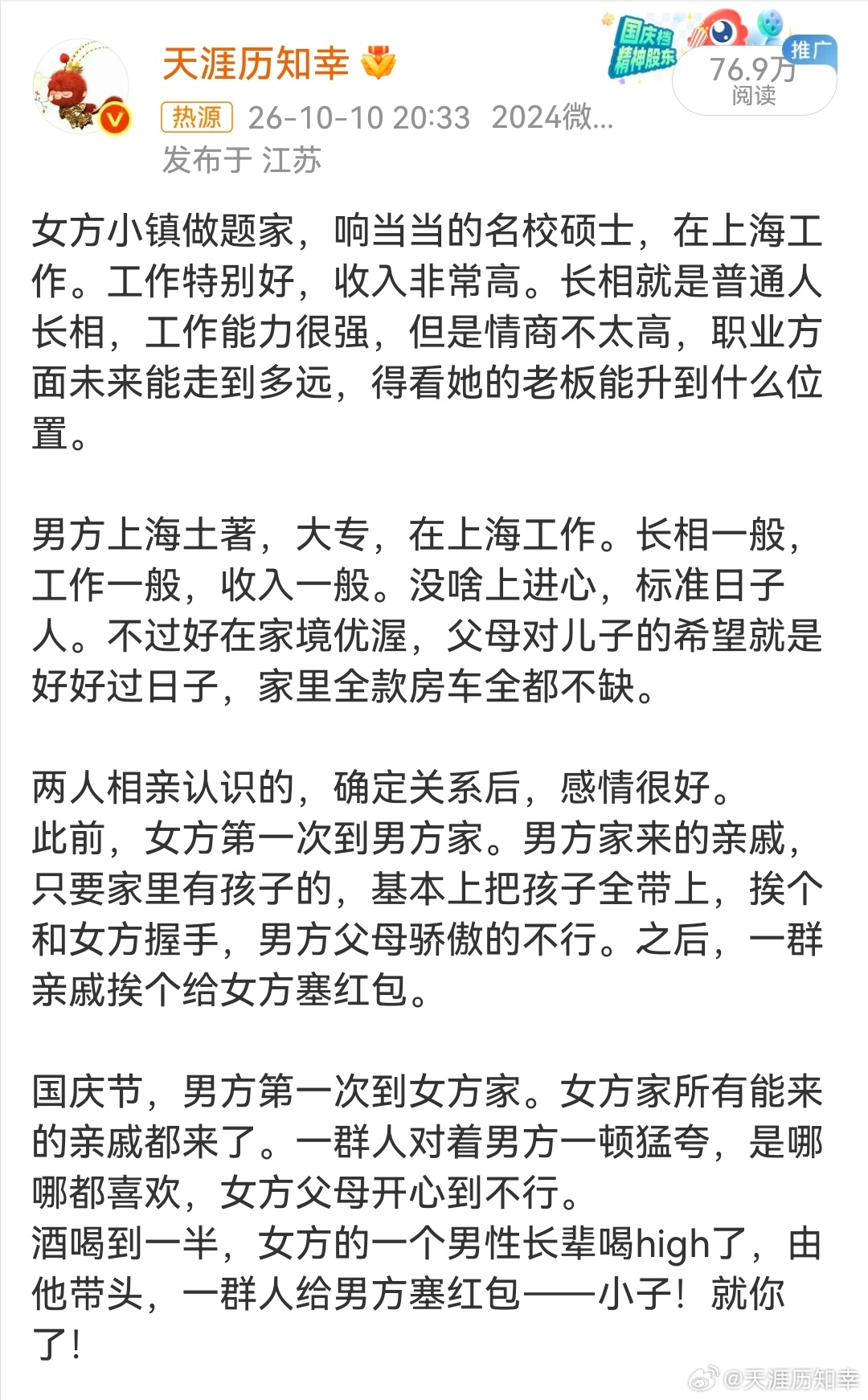
In a post that has been liked more than 5,500 times, the verified Weibo storyteller Tianya Zhixing told the story of a couple who met through matchmaking. The woman is what Chinese internet slang calls a small-town exam grinder (小镇做题家): a master's graduate of a top university from a small town, now on a high salary in Shanghai, "ordinary-looking" and, the post concedes, not much of a diplomat at work. The man is a Shanghai native with an associate degree, an ordinary job and no particular ambition — a "standard-life guy" (标准日子人) — but his family owns its flat and car outright, and his parents' only hope for him is that he lives quietly and well.
The two families meet. When the woman first visits his home, every relative with children brings them along to shake her hand one by one, while the man's parents look on proudly; then a queue of relatives stuffs red envelopes into her hands. When the man visits her family over the National Day holiday, her entire extended clan turns out and showers him with praise — until, mid-banquet, one of her uncles, by then quite drunk, leads the whole table in handing him cash envelopes: "Young man! You're the one!" (小子!就你了!) Both sets of parents, as the post's title has it, felt they had secured an enormous bargain (占了天大的便宜) — his, because their underachieving son had been claimed by a high-earning master's graduate; hers, because their daughter had been claimed by a family with property and no mortgage.
That inversion is why the story caught fire. In much of China's marriage market the transaction runs the other way: an urban groom is expected to arrive with a flat, a car and often a bride price, while a woman's degrees count for less. Here the woman's education and income offset the man's household property so neatly that both sides walked away feeling they had come out ahead — happily. The post reads as gossip, but underneath it is the country's standing argument about what a marriage partner is worth, priced in the two currencies that decide it: a university diploma against a Shanghai flat.
The comment section, though, turned the gossip into a fight. The hot search drew in what Tianya Zhixing called "a miraculous species": commenters with Shanghai IP addresses arriving to mock small-town exam grinders for lacking looks, family money and social polish, their degrees the only thing they had. She answered in a follow-up post that drew a combative thread of its own: anyone who clawed their way out of a gaokao "mountain of blood and corpses" into a top school, a master's and a good job, and changed their family's fate on their own, deserves pride, not sneering. "It's 2026, and someone thinks a Shanghai IP badge alone can defeat me," she wrote. "Does the country send Shanghai residents a monthly stipend, or what?" The argument produced its own artefact: a tabby-cat meme stamped "Shanghai cares about you" in Chinese — and beneath it, in deliberately mangled English, "沪 cares you", 沪 being Shanghai's one-character shorthand.
The red-envelope romance lands in a country already arguing about marriage from every direction. This site has followed why young people in county towns have stopped marrying, the ten-minute Luckin blind date that became a byword for matchmaking fatigue, and the debate over whether a marriage without love can still be a good life. What this story adds is the part rarely visible from outside: how precisely the two sides of a proposed match are priced, down to the envelope.
The storyteller's own closing line was simply that she was happy for them. "Thinking that another couple will soon walk into marriage out of mutual affection, with every relative's blessing, makes me very happy too," she wrote. Whether the comment section lets the couple keep that happiness is, for the moment, the country's argument to have.