Seven Million Yuan From Other People's Livestreams: China's 'Slicing' Economy Has a New Folk Hero
A second-year student at a vocational college in Guangdong says he earned seven million yuan in three years by editing highlights of other people's livestreams and attaching product links. The claim is unverified — and the argument it set off is about the shape of China's creator economy.
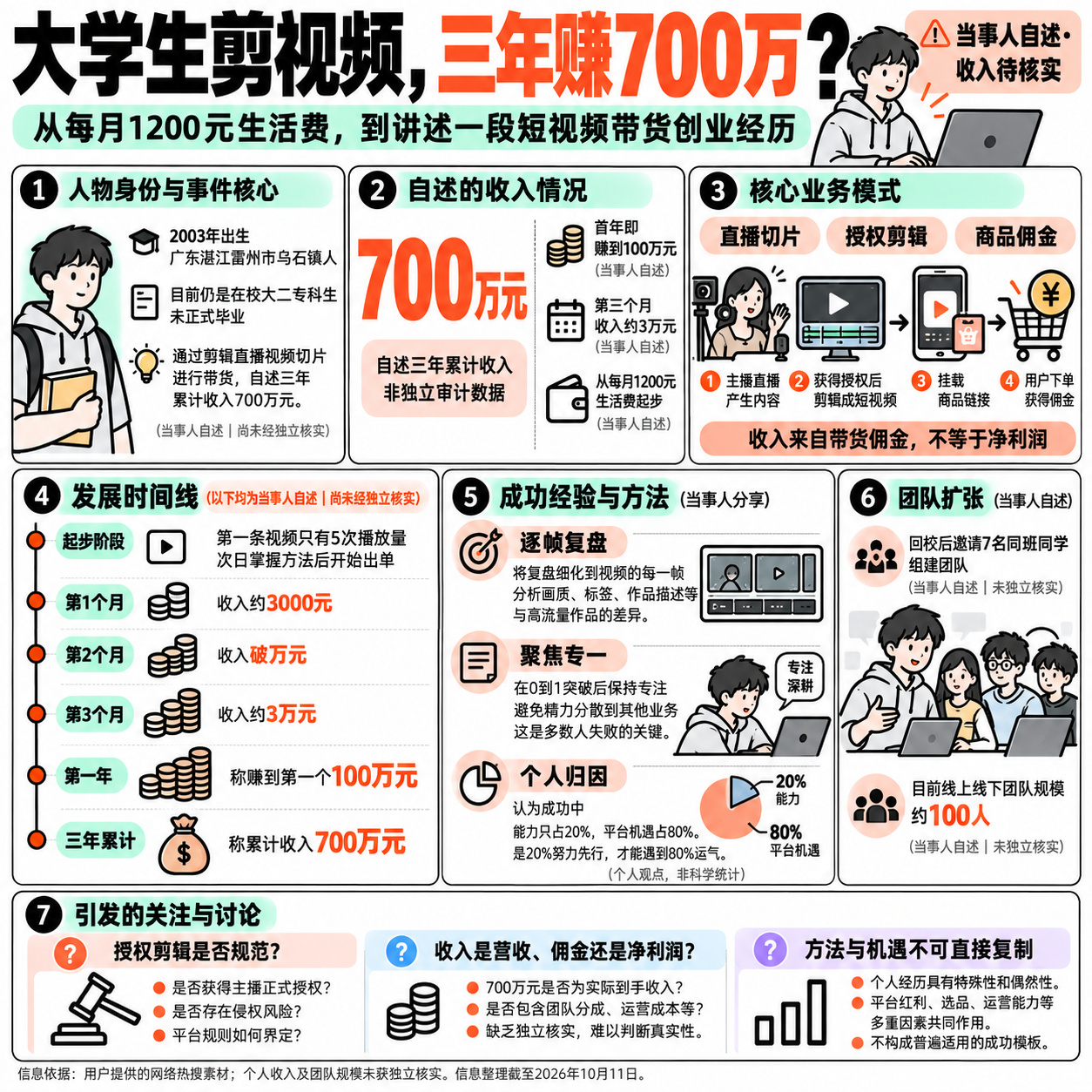
In a video that has been liked almost 10,000 times on Weibo, a second-year student at a vocational college in Leizhou, Guangdong — born in 2003 — tells a story of the kind China's platform economy is built to manufacture. Starting from a monthly allowance of 1,200 yuan, he says, he spent three years editing "slices" of livestreams: short cuts of other people's broadcasts, each carrying a shopping link. His self-tally for the first year alone is more than a million yuan; three years in, he claims a cumulative seven million — roughly a million US dollars — before finishing his associate degree.
The claim is exactly that: a self-account. The infographic summarising his interview carries its own warning box — "the subject's own account; income unverified" — and the comment sections have been doing the arithmetic that such stories invite, on taxes, platform cuts and the gap between one lucky case and a replicable one.
What the debate is really about is the machinery underneath. Livestream commerce, China's dominant channel for everything from detergent to down jackets, runs on a shadow workforce of clippers. Top hosts broadcast for hours; people who license their footage cut the selling moments into short videos, post them to their own accounts, and take a commission on whatever sells through the attached link. The skill is spotting the moment a pitch lands and editing it tight — work that, once uploaded, keeps selling. As one widely read commentary put it, the appeal is a video that "keeps making money while you sleep".
The story trended under a hashtag about the student's credentials as much as his income: a 专科 — a vocational-college associate degree, near the bottom of China's educational prestige ladder — attached to a seven-digit income. On a day when degree inflation is a standing grievance, the pairing did the viral work. The commentator behind the most-shared breakdown, a widely followed AI-research account, drew three lessons from the case — pick work with leverage, survive the brutal first months of cold-start, replicate the system once it works — and then supplied the caveat that cut against the whole genre: the student himself credited "platform opportunity" with eighty per cent of the result. Livestream slicing was a brand-new trade around 2020, when the cohort of clippers was small; the same method attempted today, the account noted, may well return nothing. "The window has changed," as the post put it, "which is why countless people following his method produce no results."
The rails the student rode are the ones the rest of this site has been tracking from the other end — the spending side of the same platforms. The micro-drama industry, after all, billed one Shanghai retiree 226,800 yuan in two years; the commissions that pay a clipper come out of purchases like hers. That is the economy in miniature: the dream is real for the one person on the stage, and the crowd studying his slides is working out its own odds. On his own telling, luck supplied eighty per cent — and the argument on Weibo is about precisely the other twenty.