The Iron Rice Bowl Cracks: Some of China's State-Funded Employers Are Missing Payroll
A mentor's story about a former intern — a staffed post at a community health center that paid no wages last month, only a 2,000-yuan living allowance — has become the emblem of a wider anxiety: in a time of strained local finances, even China's state staffing quota no longer guarantees a paycheck.
The post that anchored this weekend's argument about job security was not about a layoff. It was about the opposite: a job nobody could afford to keep. A Chinese university mentor recounted hearing from a former intern who had won a staffed post at a community health service center in the district of a provincial capital — the kind of appointment supposed to come with lifetime state backing. The center, the intern said, had not paid social insurance or housing-fund contributions last month, had paid no wages or bonuses at all, and had instead given each employee a 2,000-yuan living allowance. Some colleagues were already resigning.
The mentor's surprise was the point of the story. In China's public-sector vocabulary, a post with a staffing quota — bianzhi (编制) — is the "iron rice bowl": a position written into a state institution's authorized headcount, with salary and benefits guaranteed up the funding chain no matter how the institution fares. It is the security that drives more than two million applicants to the national civil-service exam each year. "I was stunned," the mentor wrote — this was, after all, a Type-1 public institution, the category most fully bankrolled by government — in a provincial capital, not a struggling county. The post has been liked more than 4,500 times, and the hashtag it fed, "a staffed post does not equal absolute security," sat high on Weibo's trending list through the weekend.
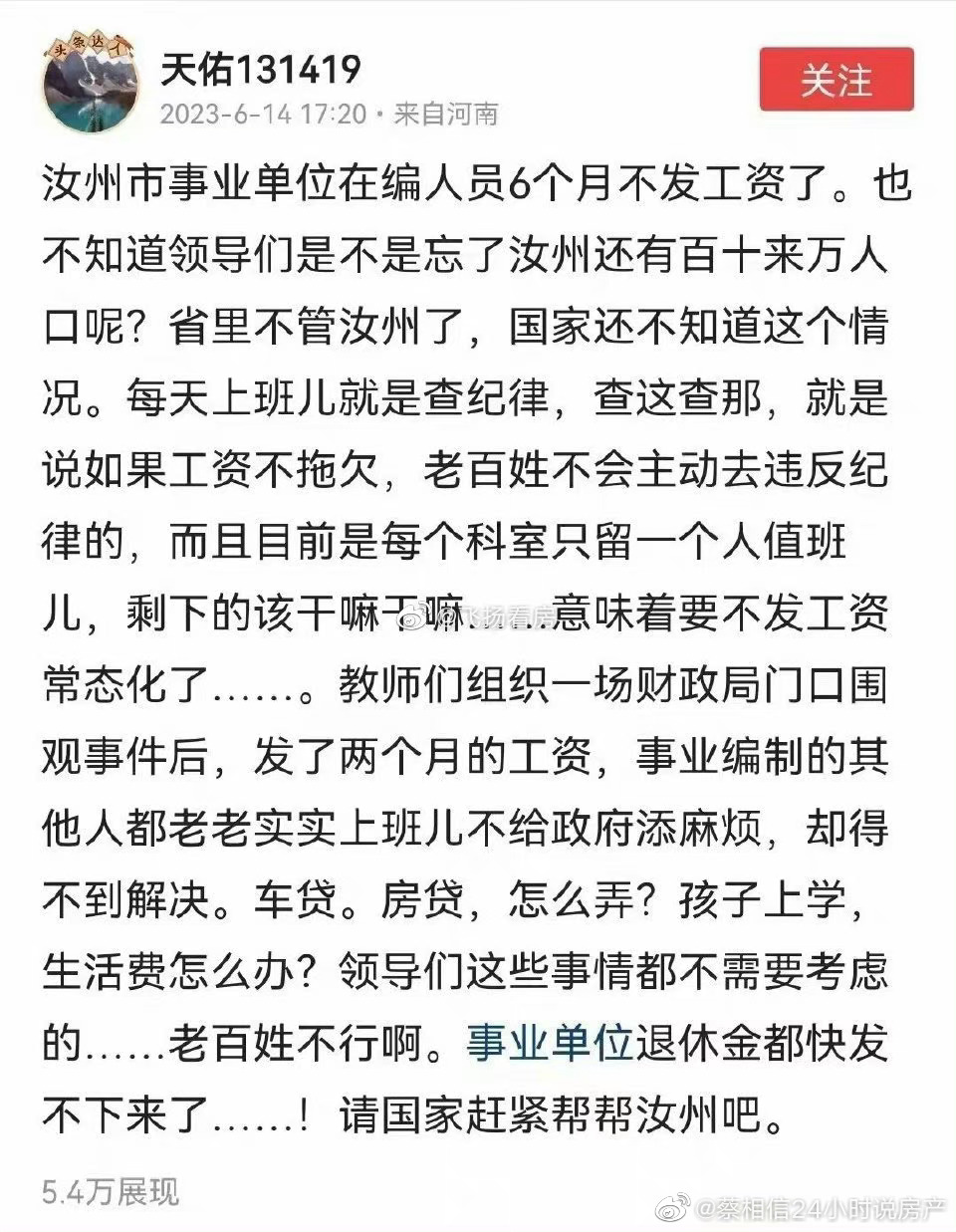
The fiscal backdrop is no secret to the people arguing about it. Local governments across China have watched revenue from land sales collapse along with the property market — we have tracked how far prices have fallen even in the strongest second-tier cities — and public institutions whose budgets assumed that income are adjusting. A widely shared commentary column put it flatly: some grassroots institutions have already seen wage arrears and halted social-security contributions, the practice "breaking the fixed impression of the iron rice bowl," with semi-funded institutions — those expected to generate part of their own revenue — under the sharpest pressure. An older complaint resurfaced alongside it: a 2023 post from Ruzhou, in Henan, describing public-institution staff there as unpaid for six months and skeleton-staffed to one person per department, with teachers winning two months of back pay only after gathering at the finance bureau.
Not everyone in the thread was surprised. "A staffing quota is stable only because the people underneath are holding it up," one commentator with a large following argued. "If everyone below becomes flexible gig labor, how can the top stay unchanged? Sooner or later the cuts and the squeezed wages reach the inside too. Plenty of people inside the system jumped into business in the 1990s — history is simply going around again."
For the intern in the original post, the reckoning was smaller and more concrete. The center's director and party secretary had gone asking the higher authorities for money and been told there was none: the institution should "find ways to generate its own revenue." The mentor's last line was the argument the whole weekend turned on: there is no money, and "money does not appear out of thin air — someone always has to pay.