One County's Fireworks Disposal Shook Its Neighbor's Homes: 570 Households Damaged in Jiangsu
A Jiangsu county's mass disposal of seized fireworks sent a shockwave into a neighboring city, where more than 570 households reported broken glass and cracked walls—and were offered compensation at 150 yuan a pane.
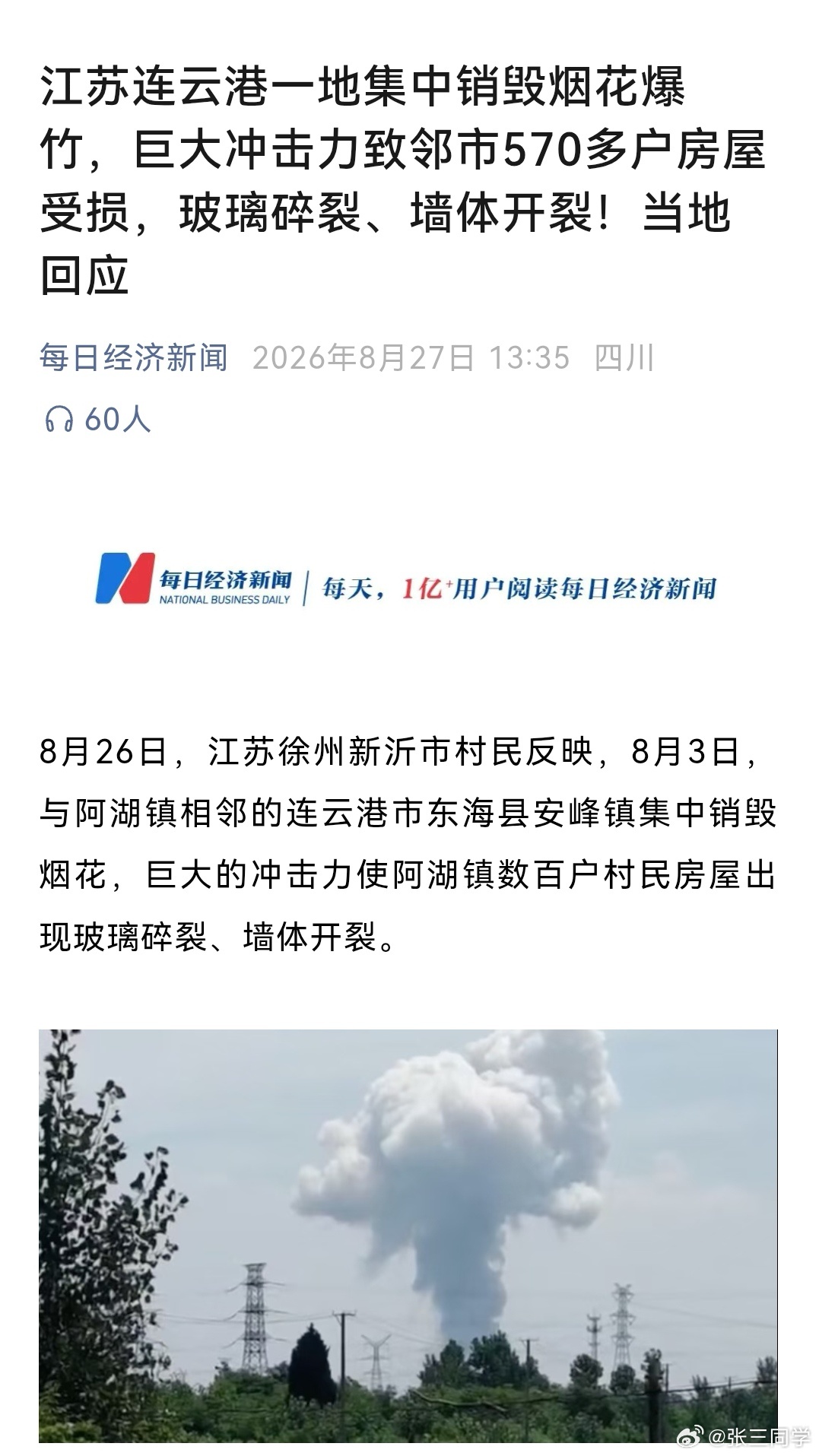
The county of Donghai, in the northern Jiangsu province, was trying to get illegal fireworks off its hands. Police and officials brought the seized stock to a site in Anfeng Township on August 3 and destroyed it in the usual way—by setting it off all at once. The blast crossed a county line. In Ahu Town, roughly next door but administratively inside the neighboring city of Xinyi, more than 570 households later reported shattered windows and cracked walls.
Ahu's residents live in the band of rural villages whose brick and tile houses absorb the weather of the flat East China plain: glass and plaster, not blast-resistant concrete. What their village first registered as a thunderclap in early August became a paperwork problem by late August. Villagers said the shockwave blew out window glass and split walls across hundreds of homes. Local Xinyi officials put the number of damaged households at over 570, and said the county that set off the blast—Donghai—would send people to handle compensation. A village committee reportedly told affected families to register their losses while workers went door to door photographing the damage.
The rates now circulating are what made the story grip. A broken pane of glass: 150 yuan. A tile-roofed house: 200 yuan. A multi-storey building or a cracked wall: 400 yuan. Even on a rural salary these sums are modest against a shattered upstairs window, and they carry an awkward moral shape: the same officials seized and destroyed the fireworks in the name of public safety, then damaged the public whose safety was being protected—across a jurisdictional boundary no one had checked when choosing the site.
The Paper, the Shanghai outlet that first surfaced the villagers' account, produced a photograph of the blast itself: a tall white mushroom cloud rising over scrubland and transmission towers, the kind of eruption that used to signal a factory accident rather than a scheduled disposal. One Weibo user's summary of the episode caught the public mood: "a giant improv act." In China, concentrated fireworks destruction is common before major holidays, precisely because storing seized stock is dangerous. The criticism is not that the fireworks were destroyed; it is that a disposal meant to remove risk was conducted where the risk could land on people's roofs.
The open question is how many such disposals happen near homes and how a county across the line answers for its fallout. For Ahu's villagers, the repair bill is being documented house by house, and the county that shook their windows has promised to send someone. What remains unspecified is whether the compensation rates will survive contact with actual broken glass, and whether the next scheduled boom will be checked against a map first.