From November, These Chinese Universities Will Pay Salaries in Digital Yuan
Several Jiangsu universities have told staff their November salaries will be paid into digital yuan wallets, following a provincial finance directive. It is the first time China's central bank digital currency has entered the monthly payroll — the most consequential test yet for a decade-old pilot that just launched a 2.0 version paying interest.
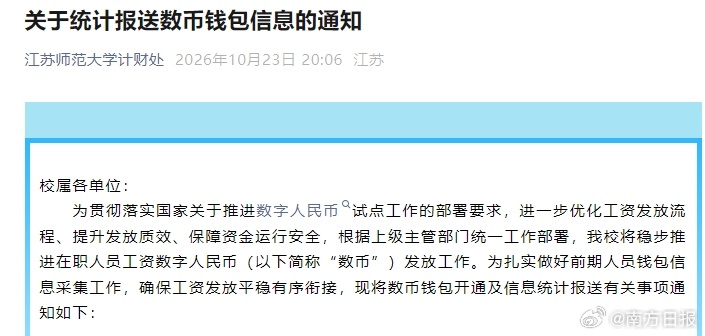
The notices arrived through university finance offices, in the dry language of administrative deadlines. Yangzhou University announced on October 20 that from November, all in-post staff — including agency-contract employees — would have salaries paid into digital yuan wallets, and gave them three days to open one. Nantong University required every employee to open two wallets, one for salary and one for performance pay, by October 30. Jiangsu Normal University is collecting staff wallet details. All three say they are executing a directive from Jiangsu's provincial finance department, under the national digital yuan pilot program.

For a currency that has existed in pilots since 2019, the payroll is a striking escalation — as one post under the news put it, the first time the digital yuan has moved out of consumption scenarios into a monthly, high-frequency payment. The currency is not a balance inside WeChat Pay or Alipay but central-bank money itself, and one popular explainer post tried to pin down the distinction: "Don't confuse it: WeChat and Alipay are wallets; the digital yuan is the money itself, issued by the central bank. It works without an internet connection, transferring it costs nothing, and merchants are not allowed to refuse it." That last clause is the legally meaningful one: the digital yuan is legal tender, the electronic equivalent of a banknote, and no shop can turn it away.
What has changed in 2026 is the reason to hold it. Early this year the People's Bank of China launched digital yuan 2.0, which for the first time pays interest on wallet balances — until now the currency was electronic cash, worth exactly what you deposited and less appealing than a money-market fund. The Nanfang Daily, the provincial paper that reported the payroll story, quoted a Beijing office worker on the difference: "Using digital yuan used to feel like spending cash — once it ran out, you had to top up. Now it earns interest, so I'm happy to leave small change in it: I can pay at convenience stores or on JD with money that's quietly growing." Shanghai has gone further, piloting a "carbon inclusive" program that converts users' low-carbon behavior into credits redeemable for the currency.
Not everyone is persuaded. "I still don't understand what the digital yuan is actually for," one finance blogger confessed under the payroll news — a fair summary of a decade in which the currency stayed mostly inside pilot cities, transit gates and government disbursements, unable to displace the payment apps that already do everything. The strategy now visible is to skip persuasion entirely and go where the money already flows: a monthly salary is a captive, high-frequency scenario no marketing campaign can replicate.
Whether staff spend their pay inside the wallet or sweep it into a bank account the day it lands, the transaction data will show soon enough. The pilot has run for seven years; the payroll is the first scenario where ordinary earners cannot simply opt out.