Why South Korea Is Talking About Putting Chinese Characters Back in Primary Textbooks
South Korea's Presidential National Education Commission is discussing marking hanja — Chinese characters — in elementary textbooks from 2028, the first such reconsideration in a decade, after examples went viral of students reading the word for 'genealogy' as a pork-trotter dish. Weibo watched with pride, amusement and a pinch of unease about China's own script education.

South Korea's Presidential National Education Commission has begun discussing whether to mark Chinese characters — hanja — in elementary school textbooks from 2028, and the news has promptly trended on Weibo, where it arrives with an unmistakable tang of historical irony. It is the first time the body has revisited the question in ten years; the last attempt at parallel hanja notation was scrapped in 2016.
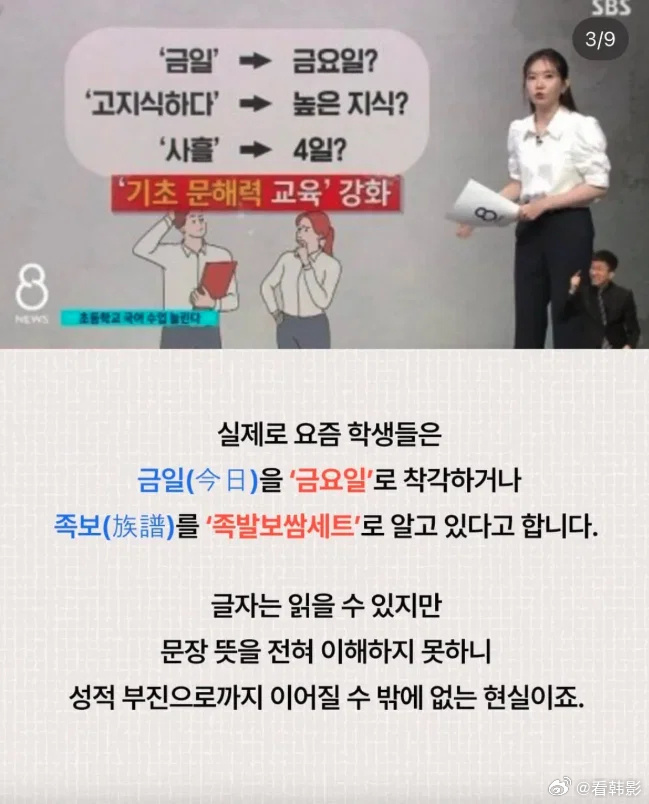
The immediate driver is not cultural diplomacy but reading comprehension. Korean is written in hangul, an alphabet that encodes sounds but, in most texts, not meaning — and since the 1970s textbooks have largely dropped the hanja that once glossed Sino-Korean vocabulary. The result, commission members argue, is a generation that can pronounce every word and parse less and less of what it reads. A screenshot of the commission's meeting material circulating on Weibo gave the viral examples: students mistaking geumil (今日, "today") for Friday, because geumyoil is the day word they actually know; or reading jokbo (族谱, "genealogy") as jokbal-bossam — a pork-trotter set meal. Homophone soup, produced by an alphabet that no longer shows the roots.
On Chinese social media the story is being read through a particular lens: pride, with a side of schadenfreude, and a thread of anxiety about China's own script habits. The account @看韩影, which tracks Korean media, packaged the story as "hot discussion on the Korean internet" and let the examples do the comedy. Others took the longer view. "Five thousand years of our history and culture — coveted and borrowed abroad," one poster wrote, contrasting Korea's plan with Chinese debates over whether history should count toward the zhongkao, the high-school entrance exam. The comparison flatters China, but it also stings: the poster's real point was that both countries are fighting the same comprehension problem, and only one of them is responding with characters.
There is substance behind the nostalgia-bait. A large share of Korean vocabulary is Sino-Korean — words built from Chinese morphemes, much as English draws on Latin and Greek. For centuries, educated Koreans read and wrote in hanja, and older textbooks marked them as pronunciation aids; giving that up simplified schooling but severed readers from the etymology inside their own language. The 2028 plan would only mark characters alongside hangul in primary texts — a partial and contested restoration. Critics in South Korea have long argued that hanja notation adds a second writing system to a child's burden; supporters counter that it inoculates against exactly the homophone failures now showing up in test scores.
For Chinese readers, the debate doubles as a status update on the character's regional standing. The script that Korea spent half a century dislodging from its textbooks is now being courted back into them — not as deference to China, but because the words themselves are half Chinese and the meanings have started to slip away. Whatever the commission decides in 2028, the discussion has already given Chinese readers a small lesson in their own writing system: that hanja is not only a national script but a regional infrastructure, still load-bearing in Seoul even where the politics of it run cold.