Hubei Names a Central State-Owned Builder in a Wage-Arrears Disclosure
Hubei province's quarterly list of major labor-law violations cites China Construction Seventh Engineering Division — a subsidiary of one of China's biggest central state-owned enterprises — for owing 118 migrant workers 3.2 million yuan, and for missing the deadline to fix it.
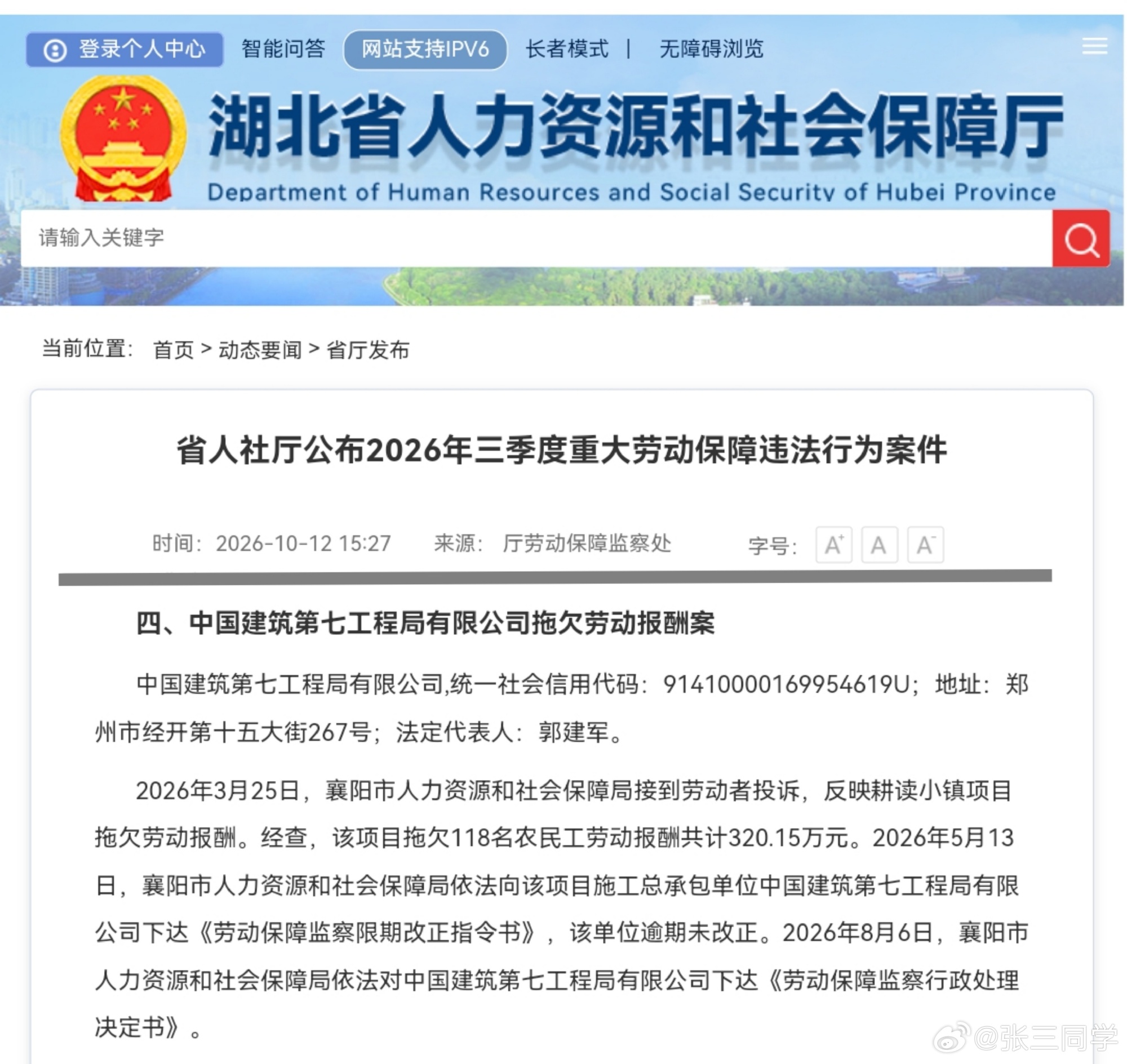
The government disclosure that trended hardest on Friday was a single paragraph on Hubei's provincial human-resources department: in its third-quarter list of major labor-security violations, the province named China Construction Seventh Engineering Division Corp. — the central state-owned builder known as Zhongjian Qiju — for unpaid wages owed to 118 migrant workers totaling 3.2 million yuan. The local bureau in Xiangyang, where the work was done, had ordered the company to make good within a time limit. The company, the notice records, let that deadline pass.
These quarterly disclosures are the enforcement mechanism itself. Once a county-level order fails, the province does not simply note it — it publishes the company's name, the number of workers, and the sum, putting a central SOE on the same public ledger as any small contractor. That is the point of the exercise, and the reason the post of the list by a Weibo user surfacing the case collected more than 6,600 likes: the interesting word is 央企, central state-owned enterprise. Wage arrears are an old grievance of China's construction sites, and it is usually told as a story about fly-by-night subcontractors. This is a subsidiary of China State Construction, the state's flagship builder, whose branding — from #央企中建七局拖欠农民工工资#, the trend phrase itself — stands for exactly the institutional reliability migrant workers are told to trust.
The timing sharpens it. From November 1, new national rules take effect fining employers who withhold social-insurance contributions up to three times the arrears — a tightening we covered when it was announced. Hubei's disclosure lands two weeks before that enforcement climate begins, with a case in which the administrative order was already ignored.
What the disclosure does not say is whether the 118 workers have been paid since. It records the violation and the expired deadline, and leaves the next step — penalties, bidding restrictions, or resolution — unspoken. The province's fourth-quarter list will carry the answer, and on Friday's evidence, people will be reading it for one name in particular.