Five Sacred Peaks in Five Days: Inside Golden Week's Special-Forces Pilgrimage
A climber ticked off China's five great mountains — five provinces, five days — and posted her spoils: five enamel badges, a medal and a numbered silver-tier certificate. The internet answered with awe and amputation jokes.
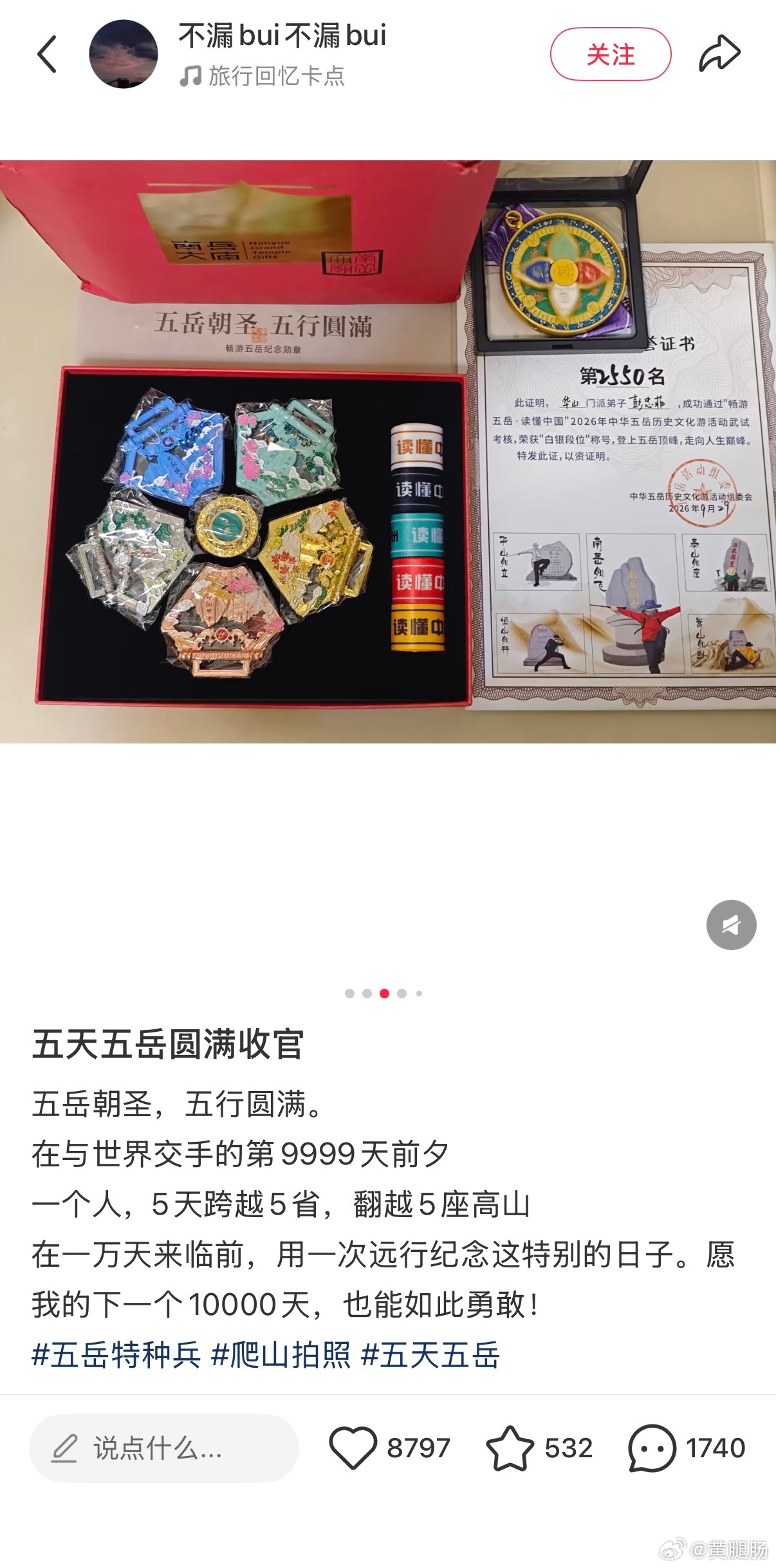
The summary post reads like a mission report: five carved summit markers in a row, five summit photos beneath them, and a caption that counts the feat in provinces. "One person, five days, crossing five provinces, climbing five high mountains," it runs, posted, the caption notes, on the eve of the climber's 9,999th day of grappling with the world. "May my next 10,000 days be as brave."
The five mountains are China's canonical five: Tai in the east, Hua in the west, Song in the centre, and two mountains that sound identical in Mandarin — the Heng of Hunan in the south, the Heng of Shanxi in the north, different characters, same sound. These are the peaks where emperors once made sacrifices to heaven and earth, and climbing all five is an old pilgrimage idea dressed in new grammar; the trending captions frame it as completion of the five elements, five peaks, five directions, five provinces, one circuit. It is also, now, officially gamified. The "Tour the Five Peaks, Read China" challenge issues completers a numbered certificate by tier, and the flat-lay photo in the post shows her takings: a set of five enamel mountain badges, a commemorative medal, and a silver-tier certificate, No. 2,250.
The internet's response was awe, seasoned with amputation. The repost that set the trend put it in surgical terms: "If it were me doing five peaks in five days, my legs could go straight to amputation," liked more than 6,000 times. Beneath it, the commentary wrote itself: "Don't copy this out of province, she's from Guizhou, born with a mountaineering body"; "Five peaks in five days? I'm aiming for five peaks in five years"; and the wuxia crowning, borrowed from a costume-drama meme: Alliance Leader of the Five Mountains, mistress of the martial world. Another account put the feat's economics plainly: "Are college students really this fearless? Two thousand yuan bought the whole thing."
The speed run belongs to a style of travel young Chinese call special-forces tourism, boot-camp itineraries that treat a holiday like a military exercise, and Golden Week is its proving ground. It is the same holiday that sent record crowds fanning out to county towns in search of room to breathe, and the same generation whose souvenir habits have turned against the fridge-magnet tat that used to mark a trip. The badge set is the telling detail: travelers who refuse impulse keepsakes will grind a five-province challenge for a numbered certificate and a set of enamel pins they plan to keep.
The pilgrimage now keeps score. The badges come in a set of five; the certificate is numbered No. 2,250, which is to say she has four digits' worth of company, and the challenge, like the mountains, is not going anywhere.