China's Tech Media Take the Measure of GPT-6, the Model OpenAI Calls First AGI
OpenAI's launch of GPT-6 Astra dominated Baidu and Zhihu within hours, with near-perfect benchmark scores, a fifteen-minute 3D iPod demo and a disputed number-theory result driving the discussion. The trending conversation doubles as a status report from a tech scene measuring a frontier it does not hold.

OpenAI released GPT-6 Astra in the small hours of Friday Beijing time, and by mid-morning the launch had displaced everything else on China's technology internet. Baidu's trending board carried it as "OpenAI's president announces AGI has arrived"; Zhihu, the Q&A platform, pinned a discussion that drew thousands of answers within a day. For China's tech media, the exercise of the week is taking the measure of a model their own industry did not build.
The claims are large even by the standards of launch days. OpenAI called Astra "the most intelligent and most aligned model in the world," and the benchmarks Chinese outlets circulated give the claim some footing: 97.6 percent on FrontierMath's hardest research-grade tier, and a jump from 7.8 to 99.9 percent on ARC-AGI-3, a test of reasoning in unfamiliar settings that its predecessors barely dented. Business outlet Boss Broadcast also highlighted the security result — a perfect score on an exploit-writing benchmark — which OpenAI framed with a new label, "critical-level cyber capability," that reads as achievement and warning at once.
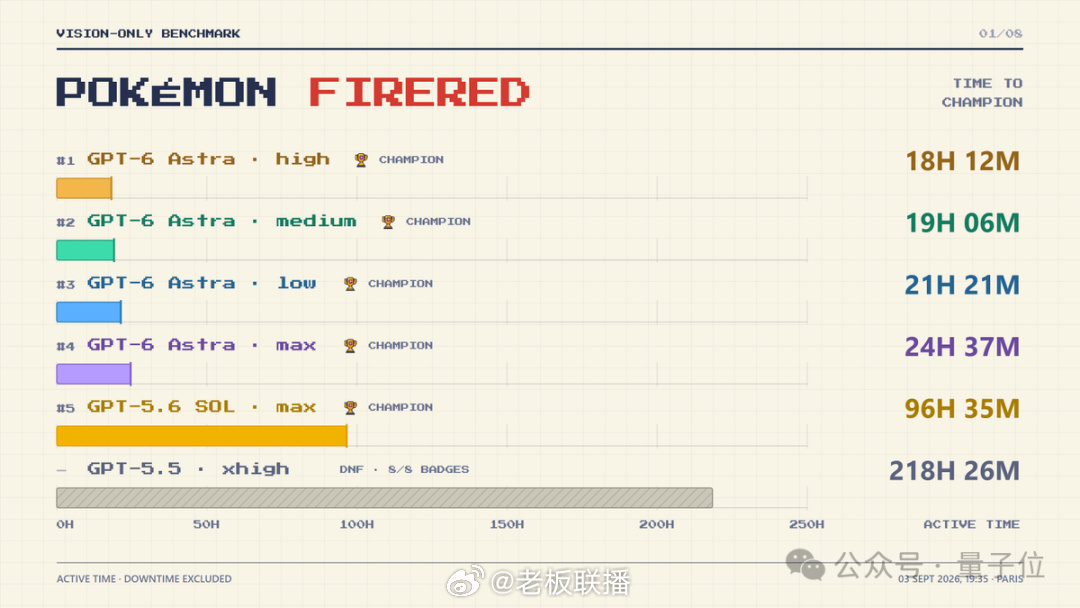
The demos carried the argument further than the numbers. A developer's fifteen-minute build — a working 3D iPod recreated in Blender, classic click-wheel and all — circulated everywhere, as did a side-by-side villa scene rendered from a single photograph with editable geometry rather than a baked mesh. Under a hashtag reading "GPT-6 hands-on," one 3D-industry commenter wrote that workflows that took a modeler two weeks now produce a usable first draft in a couple of conversations, a sentence that was being forwarded less as hype than as a staffing notice.
Zhihu's most upvoted discussion seized on a different headline: OpenAI's claim that Astra pushed the best known upper bound on the twin prime conjecture from 246 down to 186 — an assertion in number theory, credit assigned to the model in the abstract itself, that mathematicians in the thread were still picking apart. The debate captures the mood: astonishment at the result, and argument over whether an AI-assisted bound, unverified by human referees, counts as mathematics.
What the coverage mostly skips is the domestic scoreboard, and that silence is its own datum. The posts dwell on token prices — "GPT-6 is expensive" trends on Baidu — and on staggered access, while the comparison models are American rivals. For readers outside China, the week's trending debate is less a review than a status report: Chinese tech commentary processing, in public and in real time, what a frontier it does not currently hold looks like.