Courts Overrule Police Who Closed the Case of the Slap That Deafened a Pupil
A slap from a PE teacher in 2023 left a Guangdong sixth-grader deaf in one ear. Police called it an internal school matter and closed the file — until two courts ordered the investigation reopened, re-igniting the debate over where classroom discipline ends and criminal assault begins.

In the fall of 2023, a sixth-grader identified only by the pseudonym Xiao Yang was lining up for PE class at a primary school in Guangdong province. He fidgeted in the queue, and the PE teacher slapped him across the face. That single blow left the boy with profound hearing loss in his left ear — the account Haibao News retold this week, in a post liked nearly 2,000 times, that turned a three-year-old case into the country's most argued-about news.
What made the story explode was not the slap itself but the institutional response that followed. When the family reported the injury, the police concluded that a teacher striking a pupil was an "internal educational matter" for the education authorities, and formally terminated the investigation. The parents' answer was to sue the public security bureau. Two levels of courts sided with them: both ruled the termination decision unlawful and ordered the police to take the case back up.
The case lands in the middle of an argument China has never fully settled: where does a teacher's right to keep order end, and where does assault begin? In 2021 the Ministry of Education issued national rules on "educational discipline" that let teachers impose penalties such as extra duties or temporary removal from class, while banning beatings and punishment that causes pain or injury. The gray area between the two is policed unevenly, and mostly by institutions inclined to treat classroom incidents as school business.
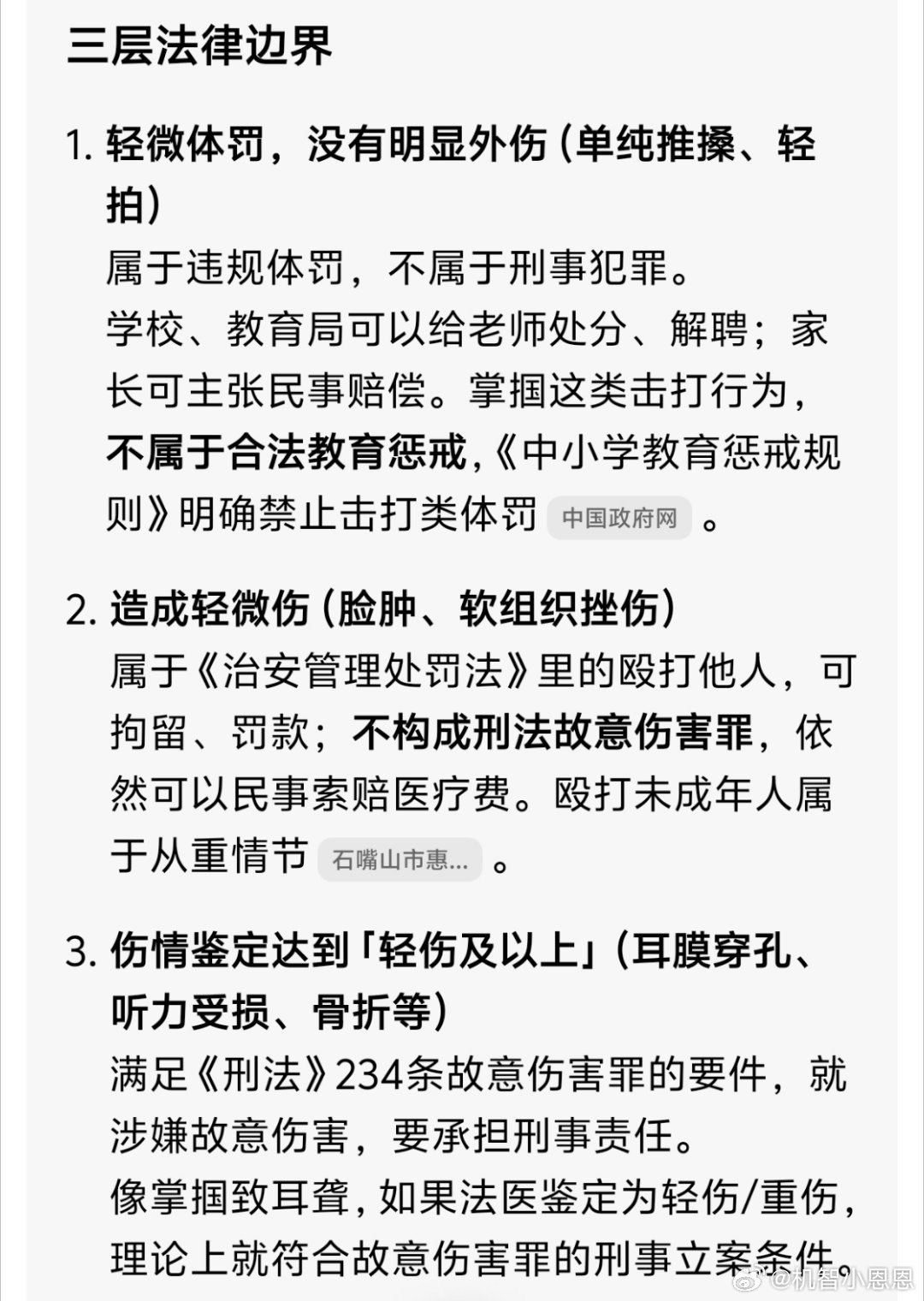
One widely shared post laid out the legal tiers many readers reached for: a slap that leaves no injury is a school-discipline matter; injuries such as swelling fall under the public security law, which allows detention and fines; and eardrum perforations, hearing damage or fractures — a "minor injury" or worse in forensic terms — meet the elements of intentional injury under Article 234 of the Criminal Law. The post's implicit question was the obvious one: by that standard, why was Xiao Yang's case ever treated as internal school business?
One commenter put the stakes plainly: the teacher hit far too hard, and a child deaf in one ear carries that for his whole life.
Haibao's report notes the pattern is not unique to one school: in several similar cases around the country, police downgraded or quietly closed investigations into classroom injuries, treating them as matters for schools rather than for the criminal law. The Guangdong rulings — a terminated investigation revoked at both levels of court — stand out as a judicial check on that reflex.
A reopened investigation does not guarantee a prosecution; forensic grading of the ear injury and the teacher's conduct will now decide how far the case goes. What it does establish is the principle the family spent three years fighting for: a slap that costs a child his hearing is not something the state may simply file away as "education."