U.S. Immigration Raid on Hyundai‑LG Battery Plant Triggers Diplomatic Fallout with South Korea
The raid that unfolded on a September morning in Georgia has sent shockwaves through Washington, Seoul and even Beijing, prompting a fresh debate over how the United States treats its closest allies when the two sides’ economic interests collide. On September 5, Immigration and Customs Enforcement agents swooped on a joint battery‑manufacturing complex operated by Hyundai Motor Group and LG Energy Solution, arresting 475 people in a single sweep. Among those taken into custody were roughly 300 South Korean citizens—engineers, technicians and skilled workers who had been brought to the United States under a patchwork of visa arrangements that, critics say, left them vulnerable to exactly this kind of enforcement action.
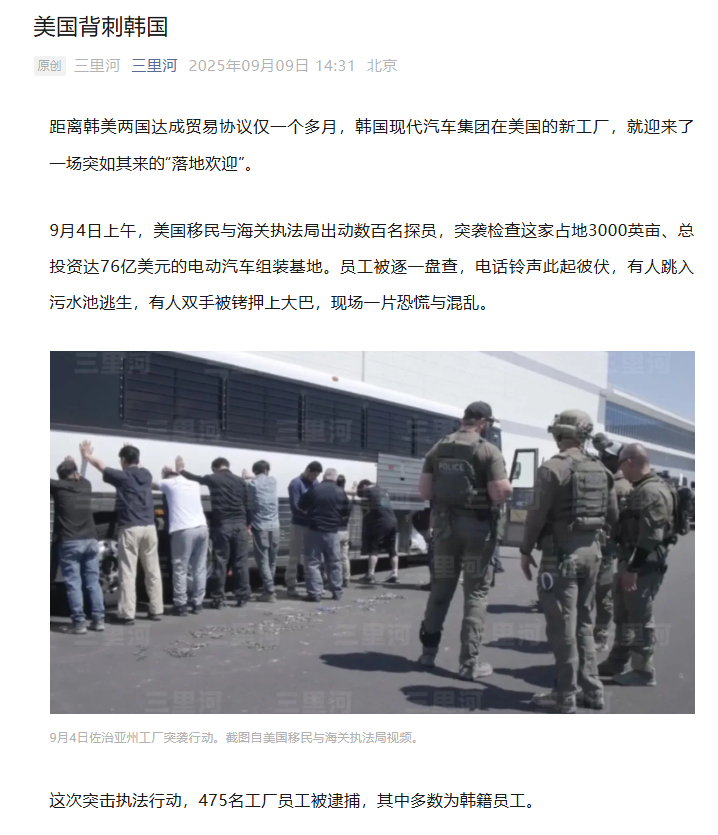
The workers were accused of entering the country without the proper work permits, overstaying their visas or otherwise violating immigration rules. Video footage that quickly spread on social media showed Korean engineers in handcuffs and shackles being led away from the plant, a sight that many in South Korea described as “a humiliating experience” and “like being hit on the back of the head with a club.” The incident has been labeled in Chinese social media as 美国背刺韩国, literally “America stabs South Korea in the back,” a phrase that has trended across platforms netizens vent their outrage at what they see as a betrayal by a supposed ally.
The timing of the raid could not have been more contentious. In the months leading up to the enforcement action, Seoul had pledged a historic wave of investment to the United States—$350 billion in capital projects, $100 billion in energy purchases and a flood of new factories ranging from electric‑vehicle assembly lines to high‑tech battery plants. The Hyundai‑LG battery facility in Georgia was a flagship component of that plan, symbolising South Korea’s commitment to help the United States rebuild its domestic supply chain for next‑generation electric vehicles. Yet, as the’s construction was about to shift from groundbreaking to production, ICE agents shut it down, effectively freezing a critical segment of the supply chain and raising immediate concerns about project timelines, costs and the reliability of foreign‑sourced labor.
Industry observers warn that the raid could have lasting reverberations far beyond the walls of the Georgia plant. Trust, once eroded, is difficult to restore; the incident has fed a chorus of voices on platforms like Weibo asking, “who would dare to invest in the US?” For foreign firms weighing the prospect of building factories on American soil, the spectre of a sudden, large‑scale immigration crackdown adds a new layer of risk to the already complex calculus of regulatory compliance, labor costs and geopolitical stability. Companies may now reconsider whether to concentrate their manufacturing footprints in the United States or to diversify across other regions where immigration frameworks are as more predictable.
The diplomatic fallout is already evident. South Korean President Yoon Suk‑yeol’s office has dispatched senior officials to Washington in an effort to secure the release of the detained workers, while opposition parties in the National Assembly have seized on the incident to demand a tougher stance on protecting Korean citizens abroad. Lee Jae‑myung, a prominent politician and former presidential contender, publicly expressed hope that such “backstabbing” would not recur, underscoring the political pressure on Seoul to defend its nationals without jeopardising the broader alliance. Inside the United States, former President Donald Trump weighed in on social media, reiterating an “America First” line: “We welcome your investment… As a reward, we ask you to hire and train American workers.” The comment was read by many as a tacit endorsement of the ICE action and an indication that the United States may be willing to accept foreign capital while rejecting foreign labor.
Beyond the immediate political theater, the episode has reignited longstanding questions about the adequacy of U.S. visa categories for skilled foreign workers from treaty partners. Although the United States and South Korea signed a Free Trade Agreement in 2012, the agreement never provided a dedicated work‑visa stream for the kind of high‑tech, temporary labor that companies like Hyundai and LG need to staff new plants. As a result, many Korean employees have been forced to rely on tourist visas, student visas or other classifications that do not permit employment, leaving them exposed to the sort of enforcement action that unfolded in Georgia. Advocates argue that this regulatory gap not only harms individual workers but also undermines the very spirit of the bilateral trade deal, which was meant to facilitate smoother economic cooperation.
Public sentiment in South Korea reflects a mixture of anger, humiliation and a dawning sense of insecurity about the alliance. Polls conducted in the weeks after the raid indicate a noticeable dip in Korean public’s confidence in the United States, even as government officials continue to stress the strategic importance of the U.S.–South Korea partnership. The image of Korean engineers in handcuffs has become a potent symbol, one that transcends the specifics of immigration law and speaks to a broader perception that the U.S. is willing to prioritize domestic political messaging over the interests of its long‑standing allies.
The incident also highlights a shifting global narrative about “America First.” While former President Trump’s rhetoric framed the United States as a benefactor eager to receive foreign investment, the operational reality on the ground—cracking down on the very workers who would make those investments viable—suggests a more complex calculus. For allies such as South Korea, Japan and even European partners, the raid serves as a reminder that the United States can, at times, treat its allies as transactional partners rather than steadfast comrades. Analysts predict that this perception could accelerate the diversification of strategic partnerships, prompting nations to hedge against potential U.S. policy swings by deepening ties with other powers, such as the European Union, Japan or even China.
In the short term, the fate of the detained workers remains the most pressing concern. South Korean officials have arranged for a chartered flight to repatriate many of those held, and diplomatic channels appear to be working toward a resolution. Yet, the broader implications of the raid are already reshaping dialogues in boardrooms, diplomatic corridors and public squares alike. The episode underscores how tightly intertwined immigration policy, trade commitments and geopolitical alliances have become in an era where supply chains are global, technology is strategic and the rules of engagement can shift with a single law‑enforcement operation.
As the United States continues to balance its domestic political imperatives with the expectations of its allies, the Georgia raid stands as a stark illustration of the costs when that balance tips. For South Korea, the lesson may be to demand more robust legal mechanisms to protect its workforce abroad and to reassess the wisdom of placing entire strategic investments in a market where political winds can so quickly turn. For the United States, the episode offers a cautionary tale: a perceived betrayal can erode decades‑long goodwill and undermine the very economic benefits that “America” policies strive to achieve. In the end, the image of handcuffed engineers may fade, but the questions it raised about trust, reciprocity and the future of trans‑Pacific partnerships will linger much longer.