Chinese Badminton Association's Third Official in Four Months Is Under Graft Investigation
The vice president of China's badminton governing body was placed under investigation on August 31 — the third senior association official targeted in four months, as the national anti-corruption campaign reaches one of the country's most successful Olympic sports.
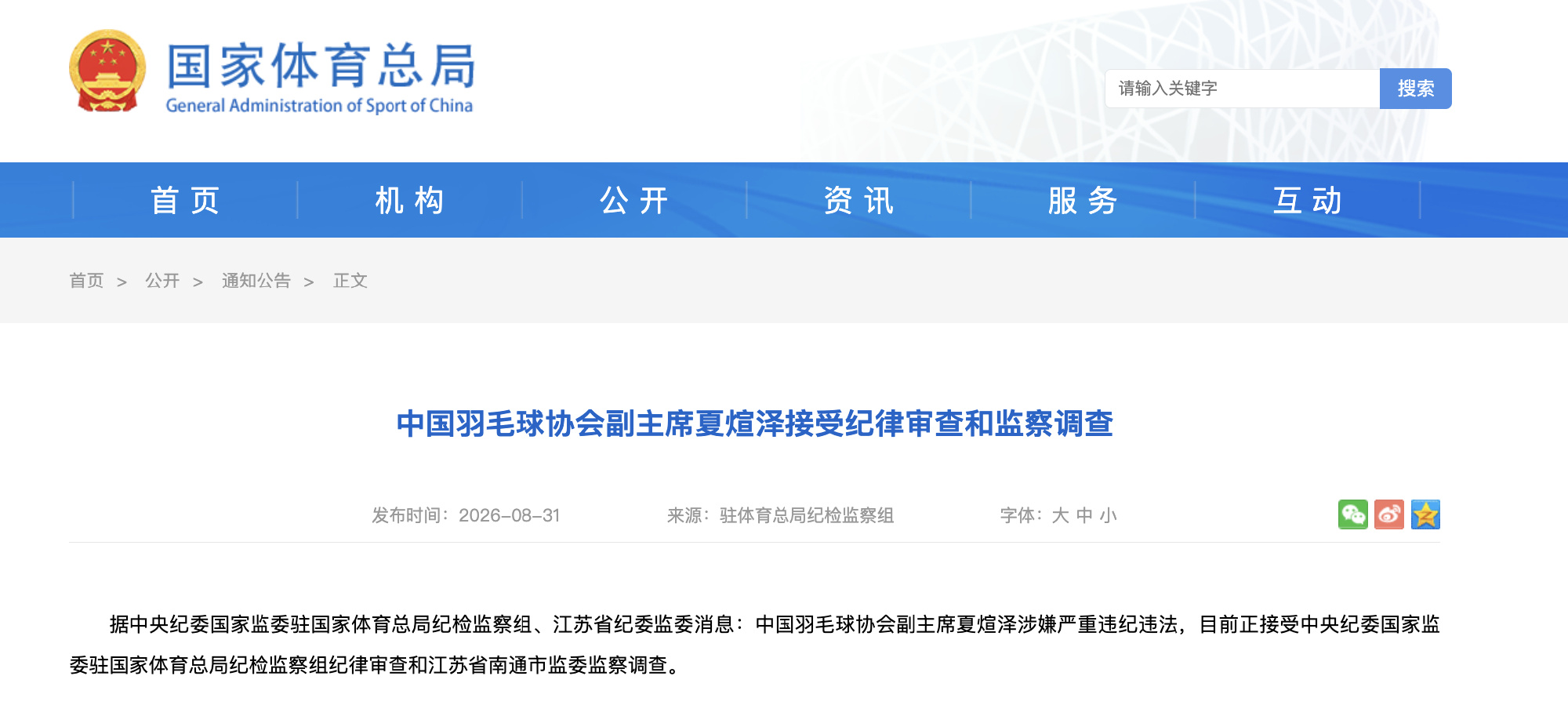
The notice ran two sentences and omitted the details that matter most. Xia Xuanze, vice president of the Chinese Badminton Association, is suspected of "serious violations of discipline and law" and is under investigation by the discipline-inspection group stationed at China's General Administration of Sport and by the supervisory commission of Nantong, a city in Jiangsu province, according to the announcement carried by the Beijing Youth Daily. It drew several hundred comments within hours. No allegations were spelled out: in China's disciplinary system, that fixed formula is the opening move, and formal charges tend to follow.
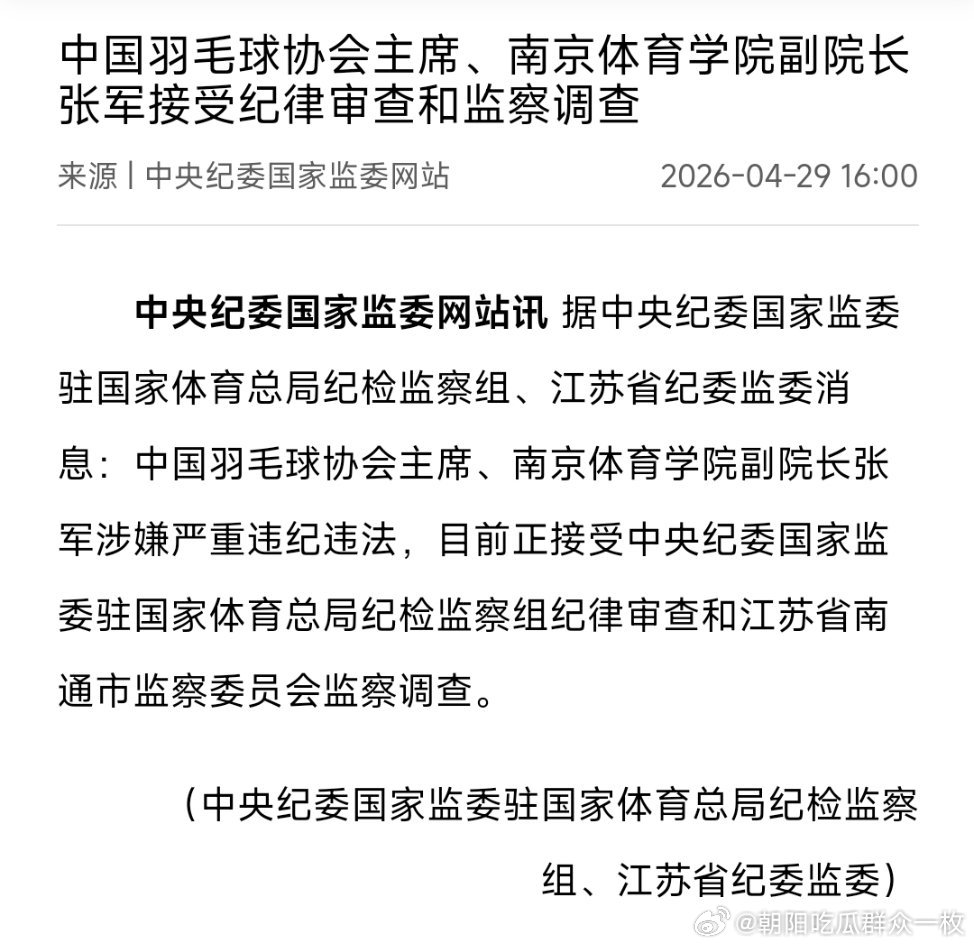
The same announcement carried a second name. Wang Wei, the association's former vice president and secretary-general, is facing a supervisory investigation of his own, issued by the identical pair of authorities. And it was not the first such notice this year — on April 29 the association's president, Zhang Jun, was placed under review. A trending hashtag folded the three announcements into a single tally — three badminton officials investigated in four months (羽协四个月3人被查) — and by evening Xia's entry on Baidu Baike, the country's dominant online encyclopedia, had acquired a new closing line, recording the investigation directly beneath his playing and coaching career.
The machinery behind the formula
For an outside reader, the mechanics are the story. The Central Commission for Discipline Inspection, the Communist Party's top anti-graft body, stations inspectors inside ministries and the organisations beneath them; the General Administration of Sport oversees the national associations that run each Olympic sport. An investigation announced this way can end in expulsion and prosecution, and the involvement of a municipal commission in Nantong, rather than Beijing authorities alone, suggests investigators are following specific conduct on the ground rather than auditing an institution from the capital.
Sport, in particular, has been here before. The account that rounded up the two notices framed the day as a step in "anti-corruption in the sports field" (体育领域反腐) — a campaign Chinese readers associate most strongly with football, which underwent a sweeping purge of its own in recent years. The badminton story climbed Baidu's hot list within hours, and by evening it was among the most-followed questions on Zhihu, where users pressed on the obvious next question: how far into the association does the inquiry reach? A basketball blogger put the mood more drily: "On the last day of August, badminton has big news again."
China's most reliable medal machine
Badminton is not a marginal sport in China. Since it became an Olympic medal event in 1996, it has been one of the country's steadiest sources of gold, and the association sits atop that pipeline — the national team, coaching appointments, the domestic circuit, the talent pathways that feed them. Xia himself spent years inside that system as a coach before moving into the association's leadership.
That is what gives the four-month tally its weight. The investigations now touch the association's presidency, its sitting vice presidency and its secretariat. What none of the three announcements says is what the men are alleged to have done.