Why Chinese Men Are Abandoning Leather Shoes
Aokang, China's 'king of leather shoes,' has lost more than 900 million yuan in four years as business casual displaces the formal dress shoe — a shift Chinese commentators read as men dressing 'for themselves, not to be seen.'
For decades, a polished pair of leather shoes was what a Chinese man put on to signal he had arrived — the business deal, the wedding banquet, the first day at a desk job. Now the shoes are going, and the companies that made them are going with them. Aokang International, long known in China as the "king of leather shoes," has lost more than 900 million yuan (about $125 million) across the past four years, and its core business is still in the red. On Monday the question of why sat at No. 19 on Baidu's search board: Chinese men are abandoning leather shoes.
Aokang's half-year report, laid out by China News Weekly, traces the slide. Revenue fell 29 percent from a year earlier, to 769 million yuan. The company booked a net profit of 17.6 million yuan — its first black ink after those four loss-making years — but strip out one-off gains and the shoe business itself lost another 6.6 million yuan. Men's shoes still account for more than 60 percent of Aokang's sales, a concentration that once looked like dominance and now looks like exposure. The trouble reaches across the industry: Red Dragonfly has lost money in 2024 and 2025, and Fuguiniao, a onetime household name, went bankrupt and delisted back in 2019.
In Chinese film and television, the crisp suit and the gleaming shoe are still the visual shorthand for a man who matters — the image Aokang built its brand on. But the office has changed around the image. Business casual, barely a concept in China's state-dominated workplaces a generation ago, is now the default in much of the private economy, and the sneaker has followed the T-shirt into settings that once demanded leather. As one widely read commentary argued on Weibo, the shift is bigger than footwear: Chinese men have moved from 悦人 to 悦己 — from dressing to be seen to dressing for themselves — and comfort has become the new essential. The companies that tried to save themselves by licensing sports labels or, in one case, venturing into semiconductors, the commentary concluded, "forgot to re-examine the road under their own feet."
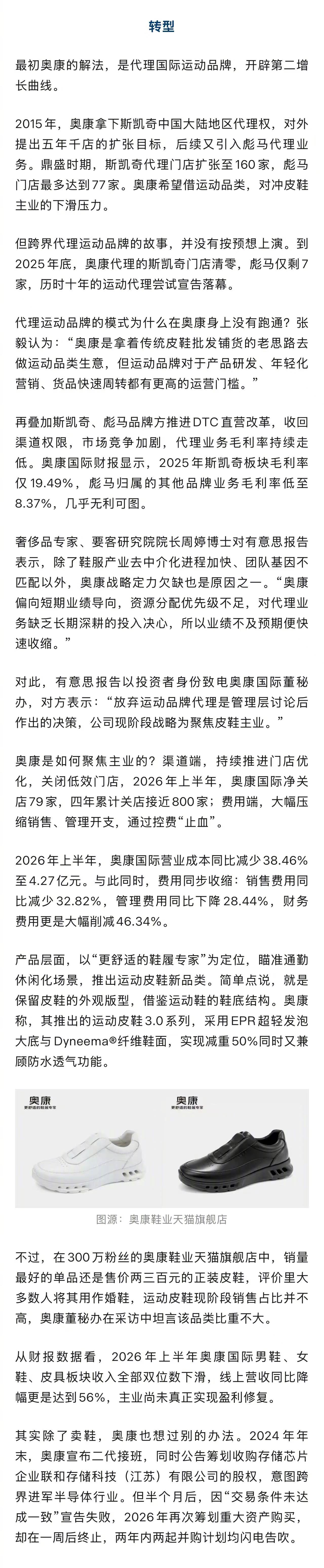
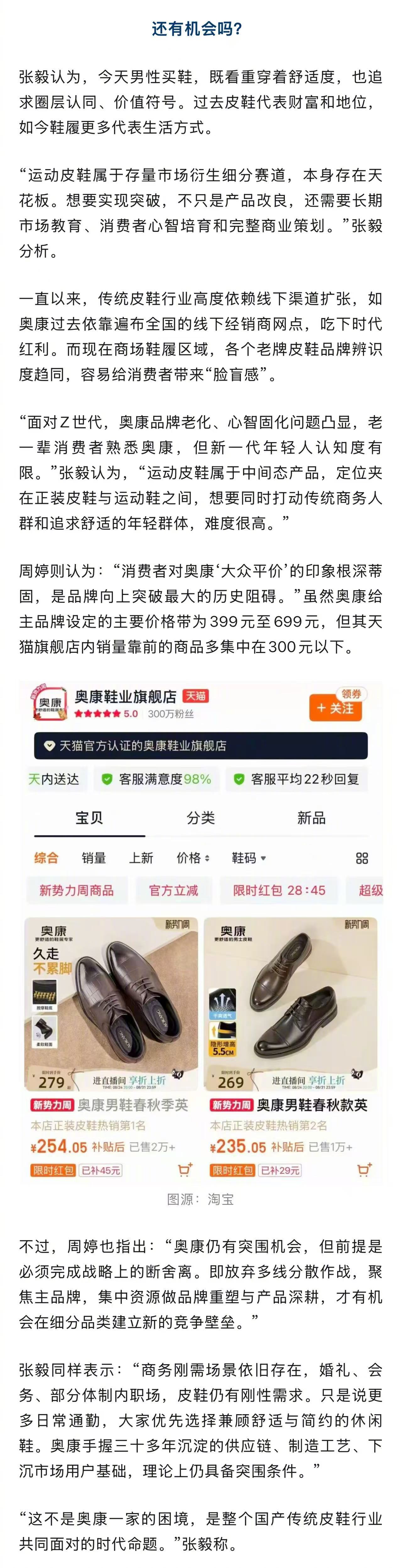
The accounting is blunter than the nostalgia. Aokang's own storefront shows the pivot: under a banner reading "transformation" (转型), its Tmall flagship store now pairs a chunky white sneaker with the classic black dress shoe, while its brown oxfords sit listed at 235 to 279 yuan — the mass price band where the brand once ruled.
The leather shoe is not disappearing from Chinese life; it is being reassigned to the occasions that still demand it — weddings, ceremonies, the rare formal event. For companies built on the assumption that every man needed a pair for every day, that is a far smaller market to sell to, and, Aokang's red ink suggests, they have not yet found what their customers actually want to wear instead.