Volkswagen's Answer to China's Price War: An X3-Sized EV From 135,900 Yuan
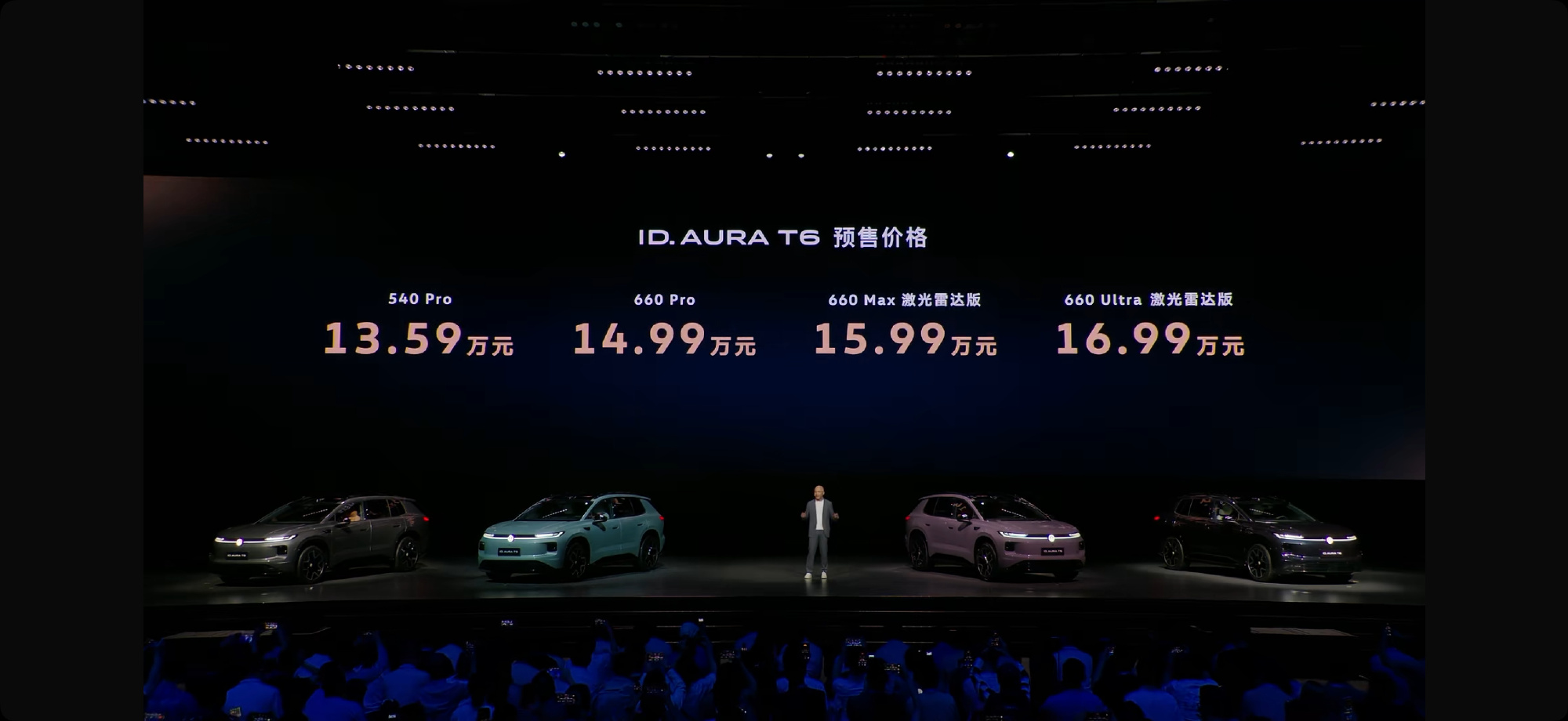
FAW-Volkswagen opened pre-sales on August 28 for the ID. AURA T6, a 4.81-metre electric SUV priced from 135,900 yuan — the size of a BMW X3 at a fifth of the cost — built on a China-led tech stack and aimed straight into the market's bruising price war.

The sticker that stopped Chinese car watchers on August 28 was not the price of a new flagship but the price of an ordinary family SUV. FAW-Volkswagen opened pre-sales for the ID. AURA T6, a 4.81-metre electric SUV, from 135,900 yuan — roughly 19,000 US dollars — for a vehicle the length of a BMW X3 or Mercedes GLC, segments where German badges normally begin near 400,000 yuan.
The launch, staged on the banks of Hangzhou's Grand Canal, was as much a statement about where Volkswagen now builds its brains. The T6 is the first model of the company's "China Electric 2.0" push: its cockpit runs on the China-led CEA electrical architecture with a 4-nanometre chip, and its driver assistance is built on Horizon Robotics' Journey 6H chip, with an optional 192-line lidar supporting city-level navigation assist. Sina Auto's preview called Volkswagen's intelligence genuinely caught up to "the industry's first tier" — a launch post that drew more than 4,000 likes.
The spec sheet reads like a checklist of Chinese-market expectations: a 15.6-inch 2.5K centre screen and AR head-up display; four-zone voice control that understands nine dialects; a cabin camera that nudges a drowsy driver and alerts if a child or pet is left inside; 660 kilometres of claimed range on the long-range version, 30-to-80-percent charging in 22 to 24 minutes, and front seats that fold flat into a 1.8-metre bed. Four trims run from 135,900 to 169,900 yuan.
For an outside reader the interesting number is not the range but the sticker. The price war that has consumed China's car market since 2023 has pushed domestic brands into territory the joint ventures long left untouched; the German-incumbent camp is now answering with cars engineered, sourced and priced in China. Whether the T6's lidar-and-dialect bundle ever ships to another market is, for now, beside the point — it exists to defend Volkswagen's share in the world's largest EV market.
Not everyone cheering the price is cheering the direction. On Zhihu, one of the week's most-followed questions asks why China's new-energy vehicles keep getting "longer, wider and heavier" (太长、太宽、太重), and whether the trend is reasonable — parking bays, city lanes and crash physics all feature in the thread. The T6, at 4.81 metres, sits squarely inside the trend it is pricing into.
The question the T6 quietly tests is whether buyers still pay a premium for the roundel. Volkswagen has priced the car as if they no longer do.