Meta Agrees to Pay Donald Trump $25 Million to Settle Lawsuit Over Banned Accounts
The recent news that Mark Zuckerberg's company, Meta, has agreed to pay Donald Trump $25 million to settle a lawsuit is a significant development. The lawsuit was filed by Trump in 2021 after his Facebook and Instagram accounts were banned by Meta following the January 6th US Capitol riot. The payout is seen as a victory for Trump, and it raises questions about the relationship between tech giants and political leaders.
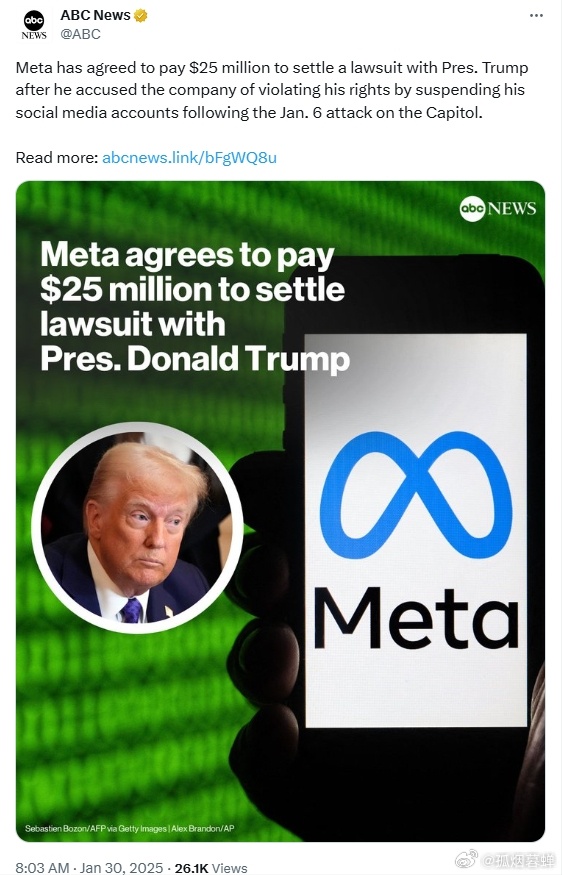
According to reports, the $25 million payment will be used to fund Trump's future presidential library, with $22 million allocated for this purpose and the remaining amount covering legal fees and compensation for other plaintiffs in the case. Notably, the settlement does not require Meta to admit any wrongdoing in banning Trump's accounts.
This development is part of a broader shift in the relationship between Trump and tech industry leaders, including Zuckerberg. After a period of tension, Trump has been seeking to build bridges with tech executives, including Zuckerberg and Elon Musk, who attended Trump's presidential inauguration ceremony last week. Zuckerberg has expressed support for Trump and has adjusted Meta's policies, including lifting some content restrictions on the company's apps, such as Facebook, Instagram, and Threads. Additionally, Zuckerberg announced the cancellation of fact-checking operations earlier this month.
The settlement between Meta and Trump has been reported by several news outlets, including The Wall Street Journal, which first broke the story. The agreement marks a significant turning point in the relationship between Trump and the tech industry, and it will be closely watched by observers interested in the intersection of politics and technology.
On January 6, 2021, the storming of the US Capitol led to a wave of suspensions and bans on various social media platforms, including Facebook and Twitter, targeting then-President Donald Trump and users associated with the event. Trump subsequently sued Meta, alleging that the company had illegally censored him. This legal battle stemmed from the decision by major social media platforms, including Facebook, Twitter, and YouTube, to suspend or ban Trump and several related users following the January 2021 Capitol riot. Trump's accounts on Facebook and Instagram were suspended indefinitely, prompting him to file a lawsuit against Meta, accusing the company of wrongful censorship. The suspensions were part of a broader effort by social media companies to curb the spread of misinformation and violent content in the wake of the riot.
The lawsuit, which named Meta and its CEO Mark Zuckerberg as defendants, claimed that the company's decision to suspend Trump's accounts was a form of censorship that violated his rights. The lawsuit was seen as a significant challenge to the power of social media companies to regulate content on their platforms.
In recent months, Trump has attempted to rebuild relationships with tech moguls, including Zuckerberg and Elon Musk, who owns X. Both Zuckerberg and Musk attended Trump's presidential inauguration ceremony earlier this month. Zuckerberg has expressed support for Trump and has adjusted Meta's policies, including lifting some content restrictions on the company's apps, such as Facebook, Instagram, Threads, and WhatsApp. Additionally, Zuckerberg announced earlier this month that the company would be canceling its fact-checking operations.
The settlement between Meta and Trump marks a significant turning point in the legal battle between the two parties. Under the terms of the agreement, Meta will pay Trump approximately $25 million, with $22 million going towards funding Trump's future presidential library and the remainder covering legal fees and compensation for other plaintiffs in the lawsuit. Notably, the settlement does not require Meta to admit any wrongdoing in its decision to suspend Trump's accounts.
In a significant development, Meta, the parent company of Facebook and Instagram, has agreed to pay Donald Trump approximately $25 million to settle a lawsuit filed by the former President in 2021. This lawsuit was initiated after Trump's Facebook and Instagram accounts were suspended following the January 6th Capitol riot, with Trump alleging that the suspension constituted wrongful censorship.
As part of the settlement, $22 million will be allocated towards funding Trump's future presidential library, while the remaining amount will cover legal fees and compensation for other plaintiffs involved in the case. It's noteworthy that Meta does not admit to any wrongdoing as part of this agreement. Trump had previously criticized social media platforms for banning his accounts, accusing them of stifling free speech and conservative voices. This settlement is seen as a victory for Trump and marks a turning point in his relationship with tech giants, including Meta's CEO Mark Zuckerberg.
Recently, there has been a marked shift in Trump's approach towards tech moguls, including attempts to mend fences with figures like Zuckerberg and Elon Musk, the owner of X. Both were in attendance at an event at the White House, indicating a potential thaw in relations. Zuckerberg has expressed support for Trump and has made changes to Meta's policies, including overturning certain content restrictions on Meta's apps, which include Facebook, Instagram, Threads, and WhatsApp. Additionally, Zuckerberg announced this month that the company would be ending its fact-checking operations, a move that could significantly impact the moderation of political content on its platforms.
This development and the settlement underscore the evolving landscape of tech and politics, particularly as social media companies navigate the complexities of free speech, political censorship, and legal challenges from high-profile figures. The move by Meta is part of a broader trend of tech companies seeking to make amends or find common ground with political leaders, following a period of heightened tension and scrutiny over their moderation practices and influence on public discourse.
The event in question involves Meta, the company owned by Mark Zuckerberg, agreeing to pay $25 million to Donald Trump as part of a settlement. This settlement resolves a lawsuit Trump filed against Meta in 2021, after the company banned his Facebook and Instagram accounts following the January 6th US Capitol riot. Trump had accused Meta of wrongful censorship.
This settlement has significant implications. Firstly, it marks a shift in the relationship between Zuckerberg and Trump, with the latter having previously been critical of social media platforms for censorship. The move by Meta to pay $25 million, with $22 million going towards Trump's future presidential library and the rest covering legal fees and compensating other plaintiffs, suggests an effort by the company to improve its relations with Trump.
The reaction to this settlement is likely to be mixed. Some may view it as a victory for Trump, reinforcing his stance against what he perceives as censorship by social media platforms. Others might see it as a strategic move by Meta to avoid further conflict and potential regulatory repercussions under a Trump administration. The fact that Meta does not acknowledge any wrongdoing as part of the settlement may mitigate some of the criticism it faces.
This event could have broader implications for tech policy, especially concerning censorship, free speech, and the regulation of social media platforms. Trump's efforts to reconcile with tech moguls like Zuckerberg and Elon Musk indicate a recognition of the importance of the tech industry in political discourse and the potential for these platforms to influence political outcomes.
The financial aspect of the settlement, with the majority of the funds going towards Trump's presidential library, raises questions about the use of such settlements for political or personal gain. This could spark discussions about the ethical considerations of corporate settlements with political figures and how these funds are allocated.
The settlement between Meta and Donald Trump, where Meta agrees to pay $25 million to resolve a lawsuit over the banning of Trump's social media accounts, has sparked widespread discussion and controversy. Many are questioning the fairness of Meta's decision and its potential impact on other banned users. The change in the relationship between Zuckerberg and Trump, as well as the implications of this settlement on future tech policy, are under scrutiny. As the details of the settlement become clearer, including the allocation of funds towards Trump's presidential library and legal fees, the debate is likely to continue, reflecting broader concerns about censorship, free speech, and the political influence of social media platforms.