How a Chinese Defense-Trade Insider Became a Spy for Two Countries
China's Ministry of State Security has told the story of 'Zhang,' a promising employee at a military-trade company who took money from two foreign intelligence services in succession — a diplomat met at a wine reception, then an embassy 'fixer' — and leaked sensitive arms-trade materials before his arrest. The serialized case is the agency's public lesson in how recruitment actually starts.
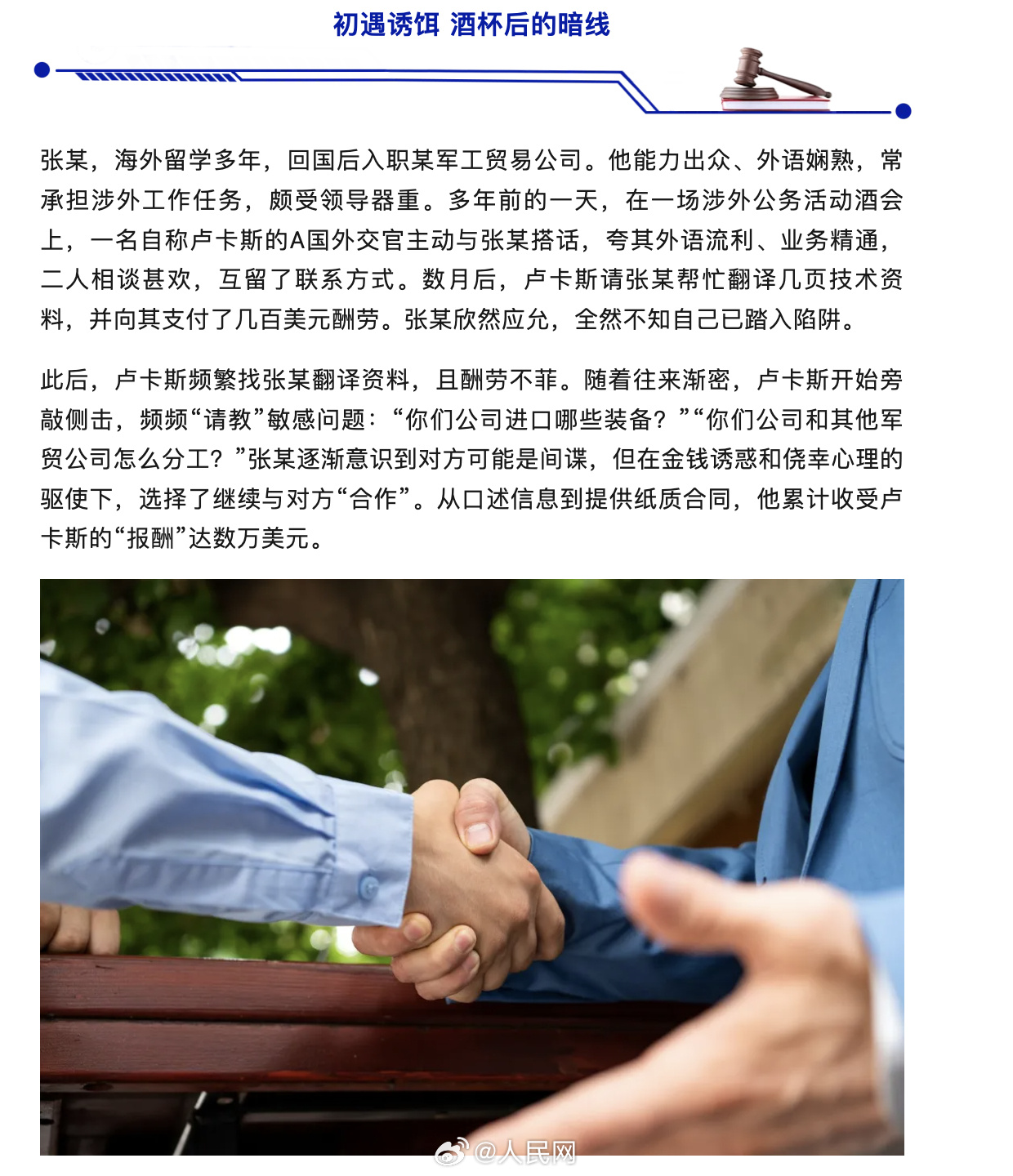
China's Ministry of State Security published its latest counter-espionage case file on Monday, and it reads like a spy novel outline compressed into a few hundred words: a promising young insider at a military-trade company, recruited at a wine reception by one foreign intelligence service, then picked up by a second through an embassy "problem-solver" — before Chinese counterintelligence arrested him for serving both at once.
The case, announced under the title "How Did He Become a 'Double Agent'?", concerns a man identified only as Zhang. After years studying overseas, Zhang returned to China and joined a military-trade company, where his ability and fluent foreign languages won him plum foreign-facing assignments, the ministry's account, relayed by Red Star News, recounts. Years ago, at a reception attached to an official event, a diplomat calling himself Lucas, from "Country A," struck up a conversation and exchanged contact details. Months later Lucas began paying Zhang to translate technical documents, then started probing equipment imports and the division of labor in arms trading. Zhang came to suspect what Lucas was — and kept the arrangement going, eventually collecting tens of thousands of dollars in "fees."
The second service reached him on a business trip to "Country B," where sudden visa trouble was smoothed over by a helpful embassy staffer named Mike. Mike later introduced his assistant Sara, whose friendly talk about family and career curdled into requests to "help gather materials," then a demand for paper documents. By that point, the ministry's account says, Zhang knew he had stepped into "another quagmire" — but promises that Mike could make his troubles disappear, plus the money, kept him supplying sensitive materials on Chinese weapons and military trade to Country B's service as well.
State security officers, who had been monitoring both liaisons, arrested him. The ministry says he confessed on the spot and let out a long breath during questioning: "I finally waited for this day — it's just that regret comes too late."
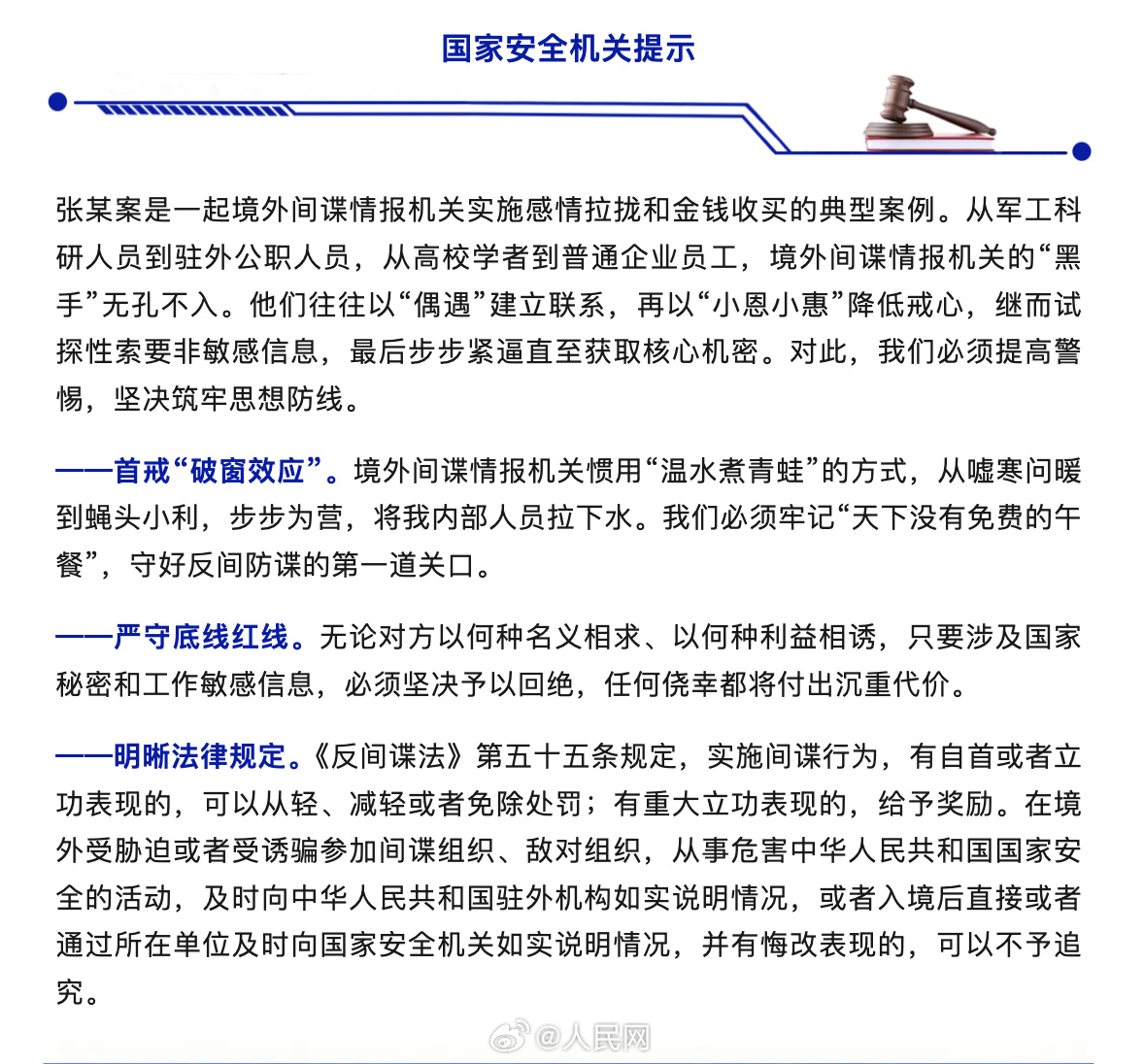
The "kindred spirit" at the reception and the fixer at the visa counter, People's Daily Online's summary of the case puts it, were "wolves in sheep's clothing" (披着羊皮的狼). That is the pedagogical point of the exercise: the ministry has turned cases like Zhang's into serialized public education, narrating the tradecraft step by step so readers can recognize the sequence — warm greetings first, small favors next, secrets last, a method it describes as "boiling the frog" (温水煮青蛙). Its closing reminder to readers: when talk turns to state secrets or sensitive work, refuse absolutely, and remember there is no free lunch. The case sat at No. 14 on Baidu's search board Monday morning, one of two spy-case items in the day's top fifty.
The ministry did not say which countries "A" and "B" were, nor what sentence Zhang faces — the case, it said, is still being processed. What it published instead is the routine it wants Chinese professionals who work across borders to recognize: the reception, the translation fee, the visa favor. Each step small, each, in the ministry's telling, staged.